Lesson plan

A Day in a Medieval Castle: Diary of a Page
Writing40 minutesGrades: 4th, 5th
A Day in a Medieval Castle: Diary of a Page

Overview

Write a castle diary entry packed with real medieval details.

Description

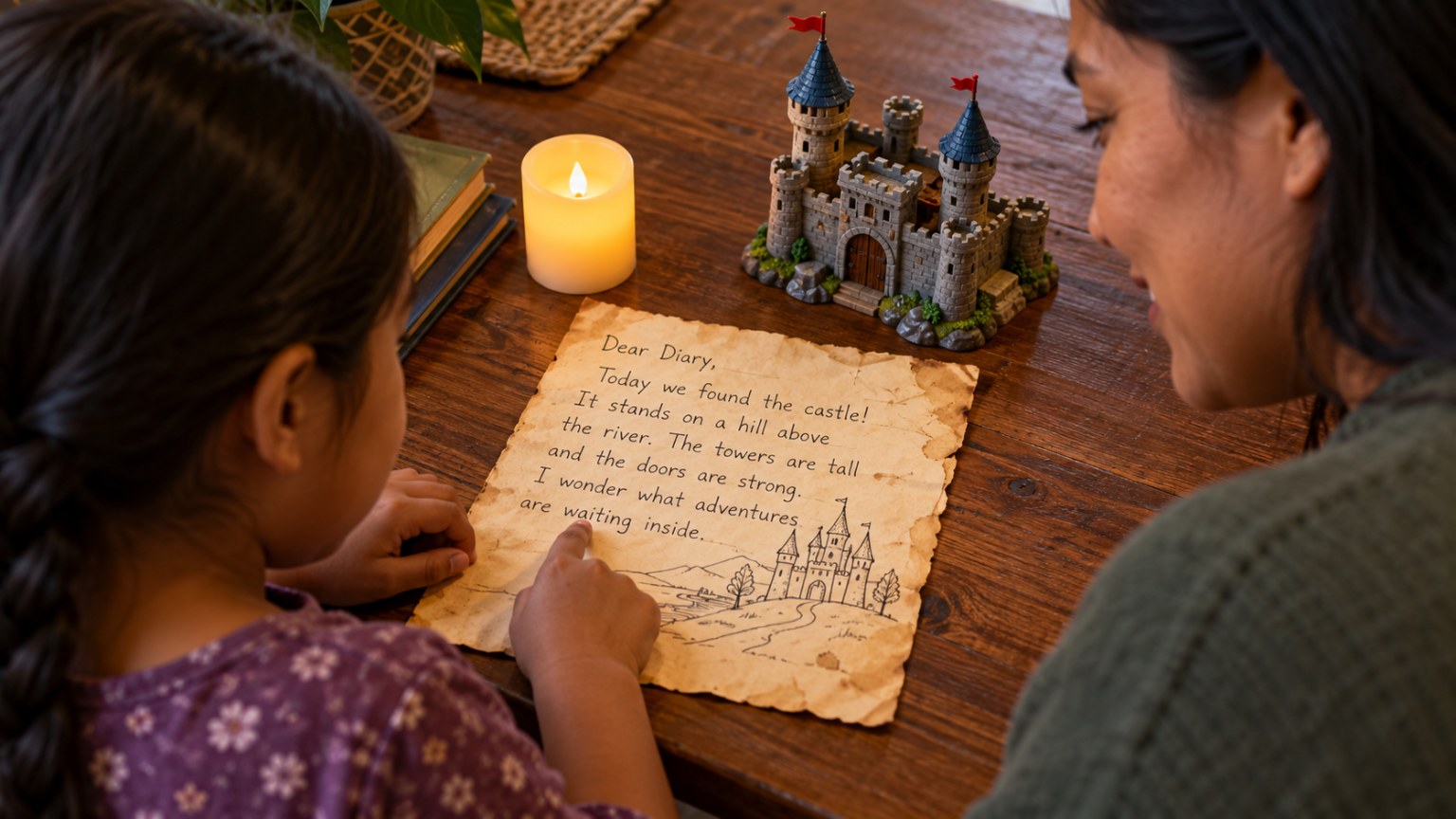
Your child reads a fact sheet about life in a castle around the year 1250, then writes a diary entry as a 9-year-old page or a kitchen helper, using real details, sensory words and a bit of dialogue to show one day from dawn to night.

Objective

Your child will write a first-person diary entry set in a medieval castle that includes at least 4 accurate details, sensory language and dialogue that shows how characters respond.

Standards

W.4.3bELA · Grade 4 · Writing
Use dialogue and description to develop experiences and events or show the responses of characters to situations.
W.4.3dELA · Grade 4 · Writing
Use concrete words and phrases and sensory details to convey experiences and events precisely.

Materials

ItemQuantity
Castle fact sheet (in the About section below)1 copy or on screen
Lined paper2 sheets
Pencil1
A tea bag and a cup of cool water (optional, to "age" the paper)1 each
Highlighter or colored pencil1

Vocabulary

Page
A boy, often about 7 to 14 years old, who served in a castle while training to become a squire and then perhaps a knight.
Great hall
The large main room of a castle, used for meals, meetings and celebrations.
Rushes
Dried plants spread on castle floors, sometimes mixed with sweet-smelling herbs.
Garderobe
A small toilet room built into a castle wall, often over a drop to the outside.
Sensory details
Words that tell what you see, hear, smell, taste or feel.

Preparation

Introduction

Ask your child to close their eyes. Say: it is 5 o'clock in the morning in the year 1250. A bell is ringing in a stone tower, the floor under you crunches with dried rushes, and you smell bread baking and horses in the stable. Where are you? Today your child will live a day in a castle through writing.
What would be the hardest part of living in a castle?
What would you miss most from today's world?

Steps

1Step 1
Read the fact sheet
(7 min) Read the castle fact sheet together and your child highlights 6 details they might use, such as the great hall, rushes, serving at table or learning to ride. Talk about which details are about sight, sound, smell, taste or touch.
2Step 2
Plan the day
(7 min) Your child picks a character (a page or a kitchen helper) and plans 3 moments: morning, midday and evening. For each moment they jot one event, one sensory detail and one person they talk to.
3Step 3
Draft the entry
(15 min) Your child writes the diary entry in first person, starting with a date like "The feast of St. Michael, 1250." They include at least 2 lines of dialogue that show how someone reacts, such as the cook scolding or the knight praising, and at least 4 sensory details.
4Step 4
Check the facts
(6 min) Your child underlines every historical detail and checks it against the fact sheet. They cross out anything that could not happen in 1250, like potatoes, clocks on every wall or glass in every window, and replace it with something accurate.
5Step 5
Share by candlelight
(5 min) Turn down the lights and switch on a battery tea light or flashlight. Your child reads the diary aloud in character, and you name your favorite sensory detail.

Conclusion

Ask: would you rather be a page or a kitchen helper, and why? Write a second entry another day from a different character, such as a stable hand or the knight.

Make your own lesson plan in minutes

Describe a topic and Resource Portal AI writes the objectives, materials and steps for your group.

Try Resource Portal AI