Lesson plan

Tower Crane Counterweight: Balance a Ruler Lever and Write the Equation
Science45 minutesGrades: 6th, 7th
Tower Crane Counterweight: Balance a Ruler Lever and Write the Equation

Overview

Balance a coin crane and find the lever equation.

Description

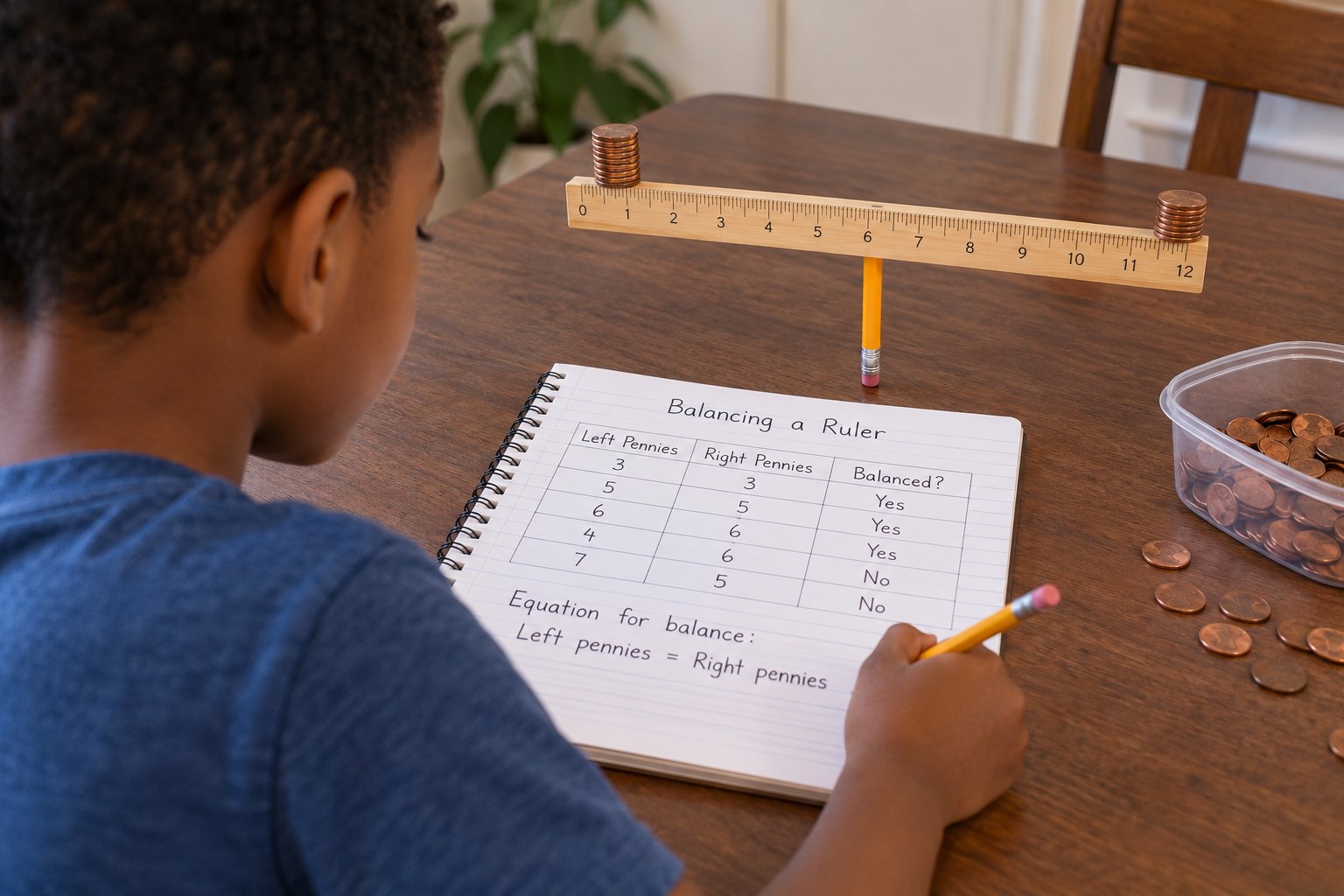
Your teen models a construction tower crane with a ruler balanced on a pencil, finds where different stacks of coins balance a load, and discovers and writes the equation that tells a crane operator how far out a load can go.

Objective

Your teen will collect balance data with a ruler lever, identify the relationship between weight and distance from the pivot, write it as an equation, and solve one-step equations to predict balance points.

Standards

6.EE.7Math · Grade 6 · Expressions & Equations
Solve real-world and mathematical problems by writing and solving equations of the form x + p = q and px = q for cases in which p, q and x are all nonnegative rational numbers.
6.EE.9Math · Grade 6 · Expressions & Equations
Use variables to represent two quantities in a real-world problem that change in relationship to one another; write an equation to express one quantity, thought of as the dependent variable, in terms of the other quantity, thought of as the independent variable. Analyze the relationship between the dependent and independent variables using graphs and tables, and relate these to the equation.

Materials

ItemQuantity
30-centimeter (12-inch) ruler, flat and stiff1
Round pencil or marker for the pivot1
Identical coins, such as pennies20
Small piece of tape1
Graph paper, pencil and calculator1 each

Vocabulary

Lever
A simple machine: a stiff bar that turns on a pivot point.
Fulcrum
The pivot point a lever turns on.
Counterweight
A weight placed on one side to balance a load on the other.
Moment (torque)
The turning effect of a force: weight times distance from the pivot.
Variable
A letter that stands for a quantity that can change.

Preparation

Introduction

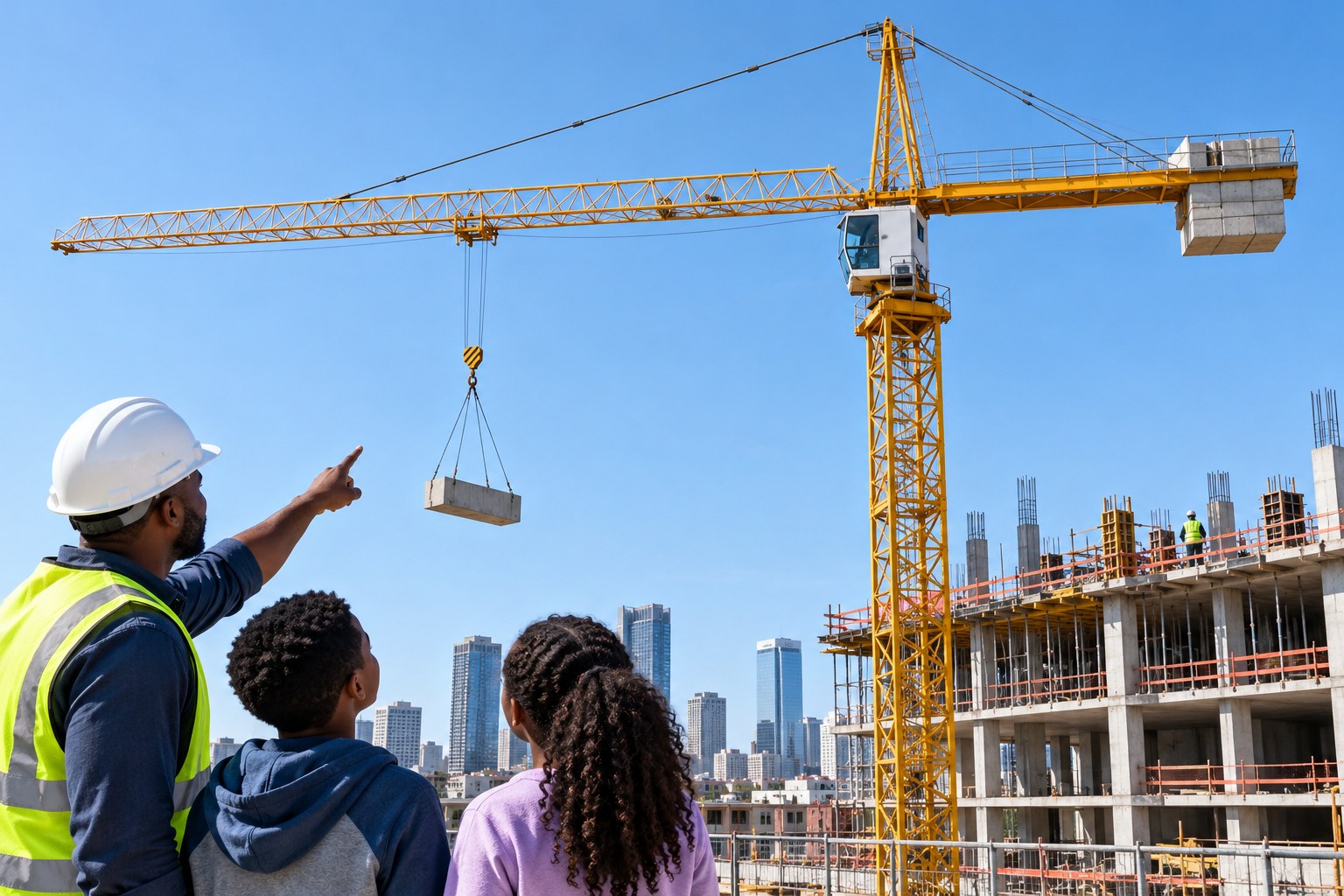
Show your teen a picture of a tower crane. Ask: why don't these cranes tip over when they lift steel beams? And why do the giant concrete blocks sit on the short arm at the back? Today you'll build a coin crane and find the math the crane is built on.
What do you think happens if the load moves farther out on the arm?
Have you ever balanced a seesaw with someone heavier or lighter than you?

Steps

1Step 1
Set the load
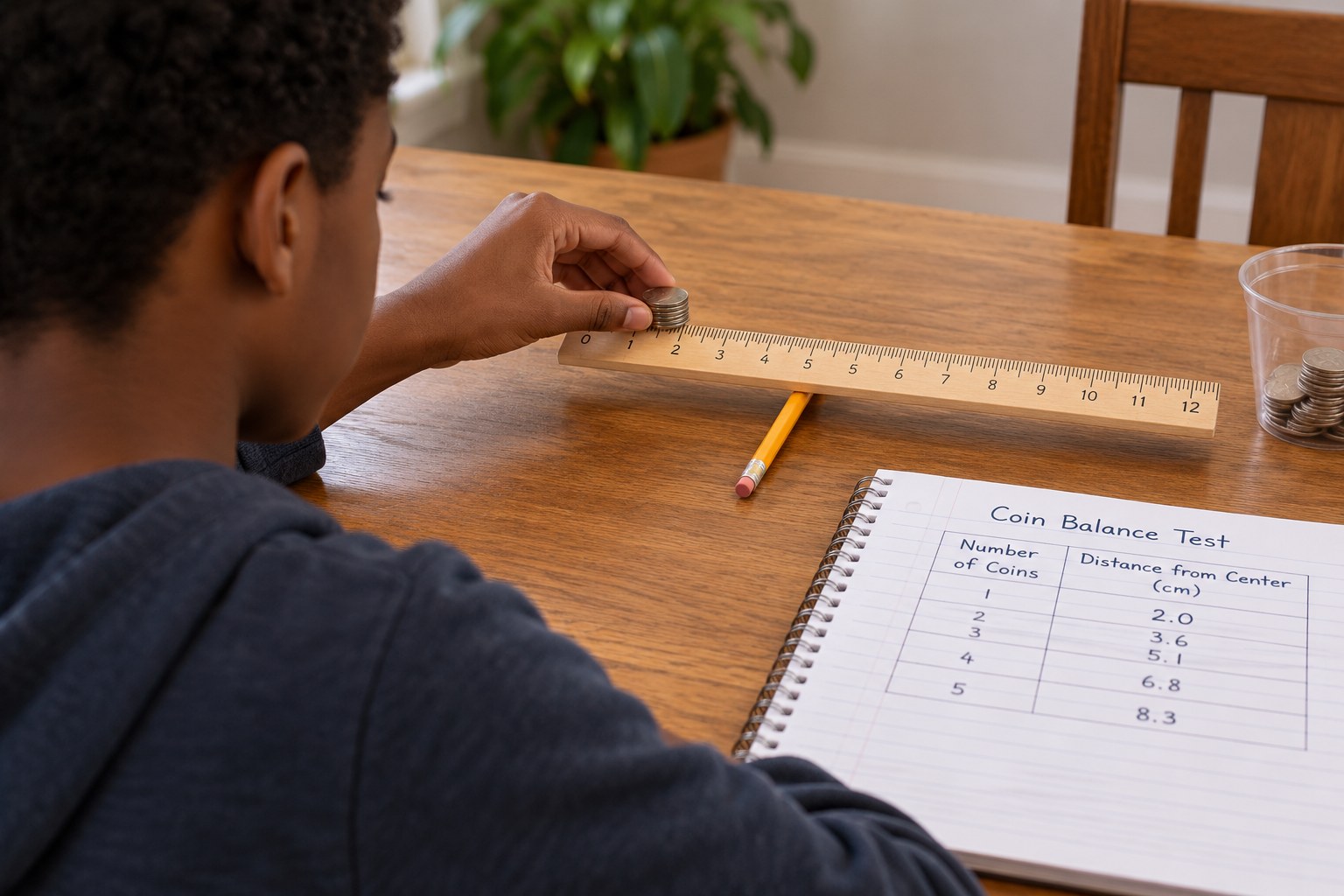
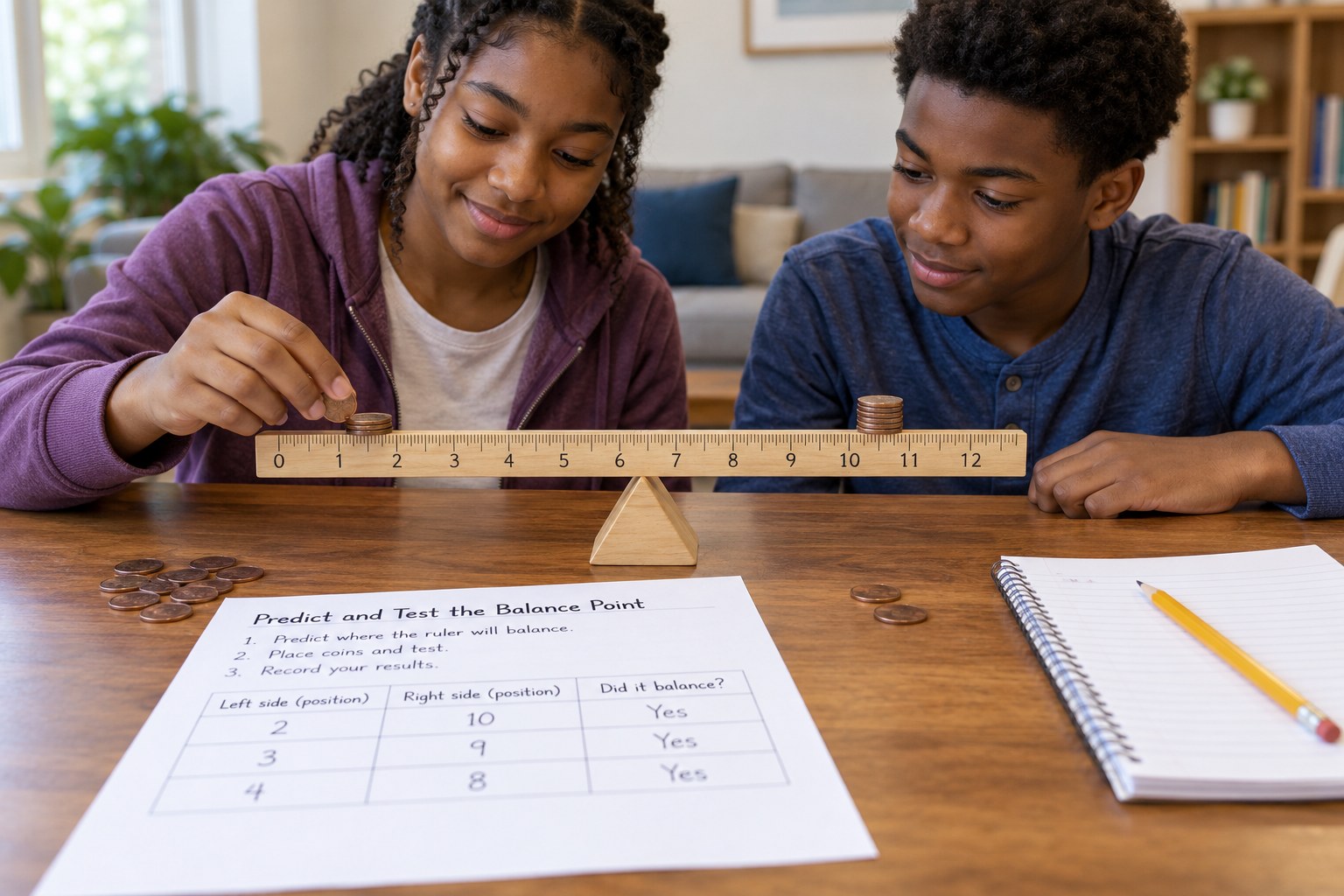
(6 min) Your teen places a stack of 2 coins 12 cm from the pivot on the left side; this is the crane's load. They predict where a stack of 4 coins must go on the right side to balance it.
Step 1
2Step 2
Collect balance data
(12 min) Your teen tries stacks of 1, 2, 3, 4, 6 and 8 coins on the right side, sliding each stack until the ruler balances level, and records the number of coins n and distance d from the pivot in a table. If a stack would need to sit beyond the end of the ruler, they record 'off the arm'.
Step 2
3Step 3
Find the pattern
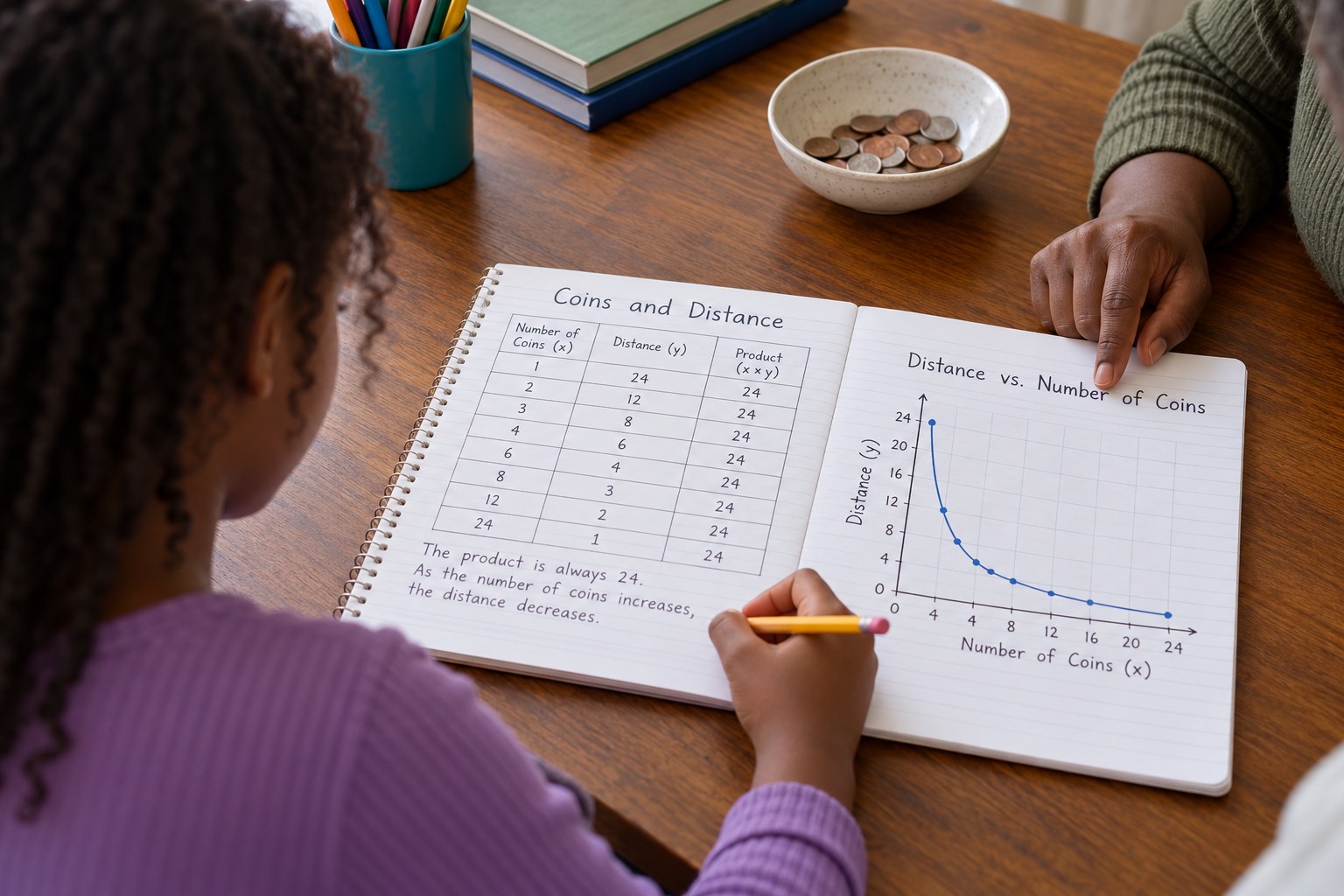
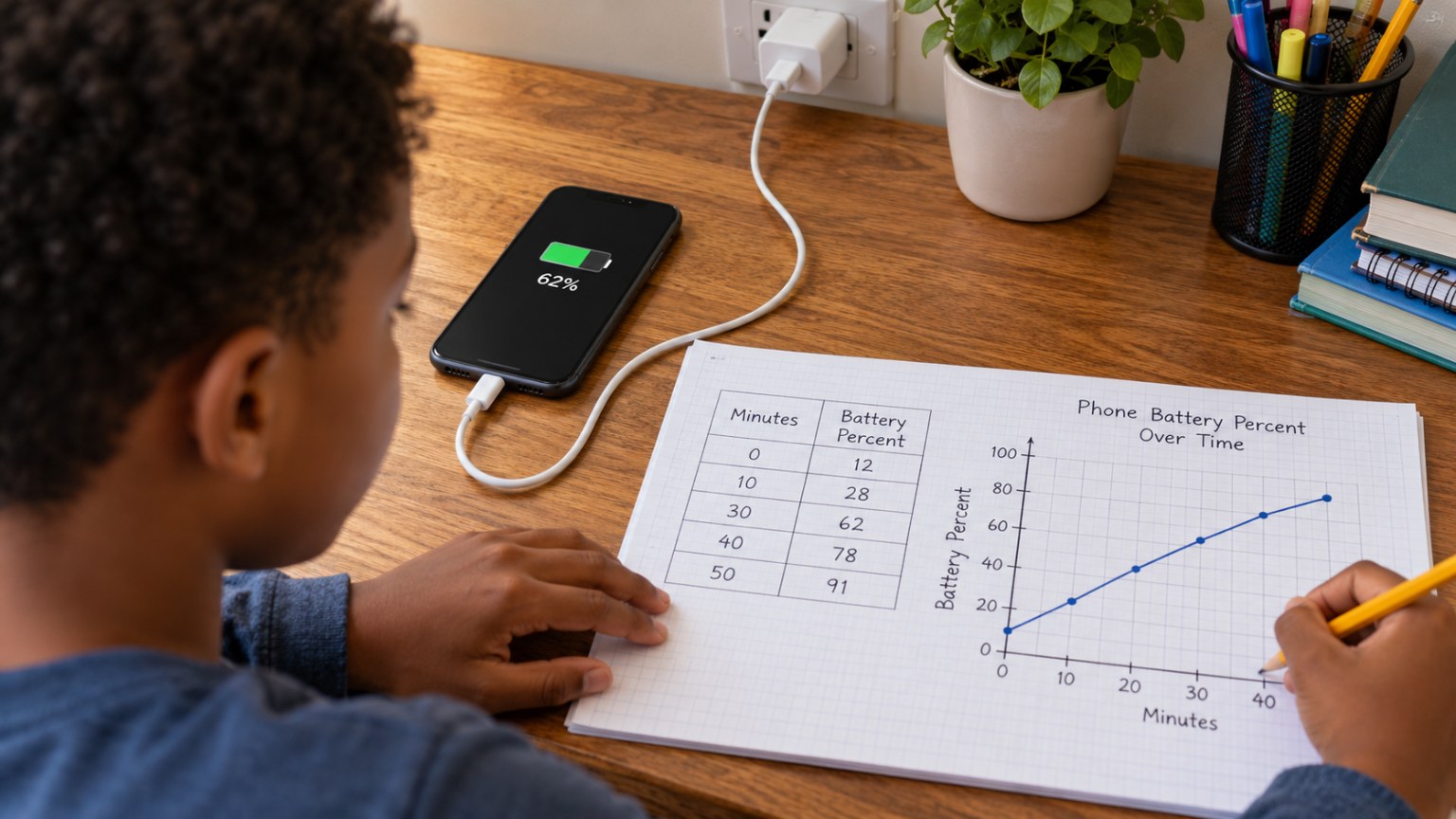
(10 min) Your teen multiplies n times d for each row and notices the products are all about the same as the load's 2 x 12 = 24. They write the equation n x d = 24 and also d = 24 / n, then plot the points to see that the graph is a curve, not a straight line.
Step 3
4Step 4
Solve crane problems
(10 min) Your teen solves the problems in 'Crane operator problems' by writing and solving one-step equations, then tests at least two answers on the ruler. Ask: what happens when the load moves out but the counterweight stays the same?
Step 4
5Step 5
Connect to real cranes
(6 min) Read 'About construction cranes' together. Your teen explains in two or three sentences why cranes have load charts that allow lighter loads farther out on the jib.
Step 5

Conclusion

Ask: where else do you see levers? Seesaws, scissors, wheelbarrows and bottle openers all use the same rule. Find one at home and explain which side has the longer arm.

Make your own lesson plan in minutes

Describe a topic and Resource Portal AI writes the objectives, materials and steps for your group.

Try Resource Portal AI