Lesson planDesign a Shamrock Garden: Area and Perimeter
Math40 minutesGrades: 3rd, 4th
Overview
Plan a shamrock-shaped garden using area and perimeter.
Description
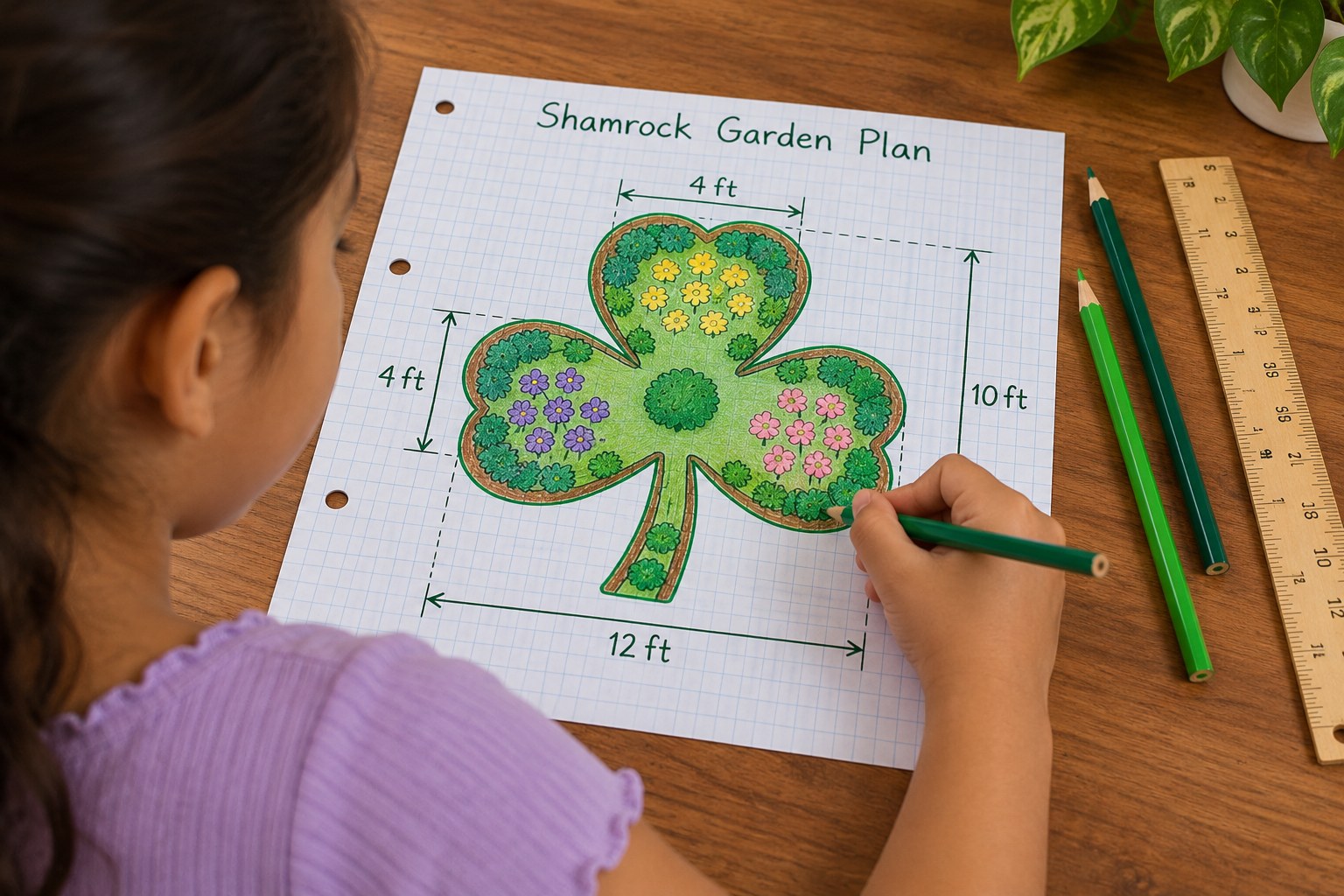
Your child designs a St. Patrick's Day shamrock garden on graph paper, building three square-ish 'leaf beds' and a stem path, then finds the area to know how many clover plants fit and the perimeter to know how much fence to buy.
Objective
Your child will find the area of rectangles by multiplying side lengths, find perimeters by adding side lengths, and design two gardens with the same area but different perimeters.
Standards
3.MD.7bMath · Grade 3 · Measurement & Data Multiply side lengths to find areas of rectangles with whole-number side lengths in the context of solving real world and mathematical problems, and represent whole-number products as rectangular areas in mathematical reasoning.
3.MD.8Math · Grade 3 · Measurement & Data Solve real world and mathematical problems involving perimeters of polygons, including finding the perimeter given the side lengths, finding an unknown side length, and exhibiting rectangles with the same perimeter and different areas or with the same area and different perimeters.
Materials
| Item | Quantity |
|---|
| Graph paper (or a grid drawn with a ruler at 1 cm) | 3 sheets |
| Pencil, ruler and green and brown colored pencils | 1 each |
| Square sticky notes or paper squares as 'garden tiles' (optional) | about 30 |
| Calculator for checking (optional) | 1 |
Vocabulary
Area
The number of square units that cover a flat shape.
Perimeter
The distance all the way around the outside of a shape.
Square unit
A square 1 unit long on each side, used to measure area.
Dimensions
The length and width of a rectangle.
Preparation
- Print or draw graph paper and write the garden rules from the Garden Challenge section at the top of one sheet.
- Optional: set out sticky-note squares so your child can build gardens before drawing them.
Introduction
Tell your child that a community garden wants a shamrock-shaped flower bed for St. Patrick's Day, with three rectangular 'leaves' of clover around a center square and a stem path. Each square on the grid is 1 square foot, and each clover plant needs 1 square foot.
How could we figure out how many plants fit without counting every square?
What is the difference between how much space is inside and how much fence goes around?
Steps
1Step 1
Area by counting and multiplying
(7 min) Your child draws a 4-by-3 rectangle on the grid and counts the squares. Then they multiply 4 times 3 and check that both ways give 12 square feet.
2Step 2
Build the shamrock
(12 min) Your child draws a 2-by-2 center square, then attaches three rectangular leaves (top, left and right) and a 1-square-wide stem path going down. They label the dimensions of every rectangle and shade the leaves green and the path brown.
3Step 3
Count the plants
(6 min) Your child finds the area of each leaf by multiplying, then adds the three leaves and center to get the total number of clover plants. They record each step in a short table.
4Step 4
Fence one leaf
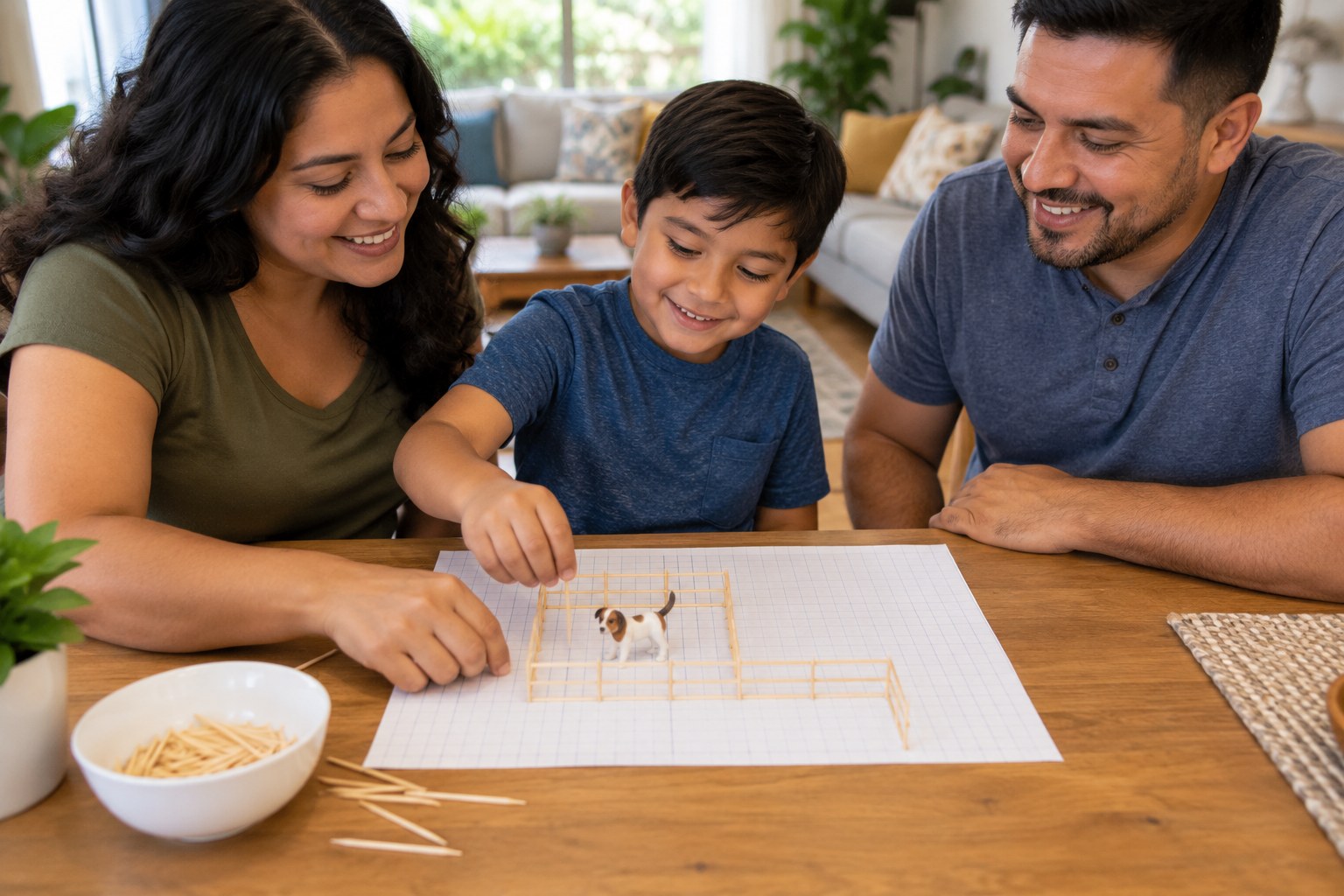
(7 min) The leaves need a small fence. Your child finds the perimeter of one leaf by adding all four sides, then the perimeter of each other leaf. Ask: which leaf needs the most fence?
5Step 5
Same area, different fence
(7 min) Challenge: draw every rectangle with an area of 12 square feet (1 by 12, 2 by 6, 3 by 4). Your child finds the perimeter of each and decides which shape uses the least fence.
Conclusion
Ask: why does a long, skinny garden need more fence than a square one with the same area? If you have a yard or planter, use the plan to plant real clover this spring.
Make your own lesson plan in minutes
Describe a topic and Resource Portal AI writes the objectives, materials and steps for your group.
Try Resource Portal AI