Soil Evidence Lab: Match Mystery Dirt with Settling Jars and Percents
Overview
Use soil layers and percents to trace a muddy shoe.
Description
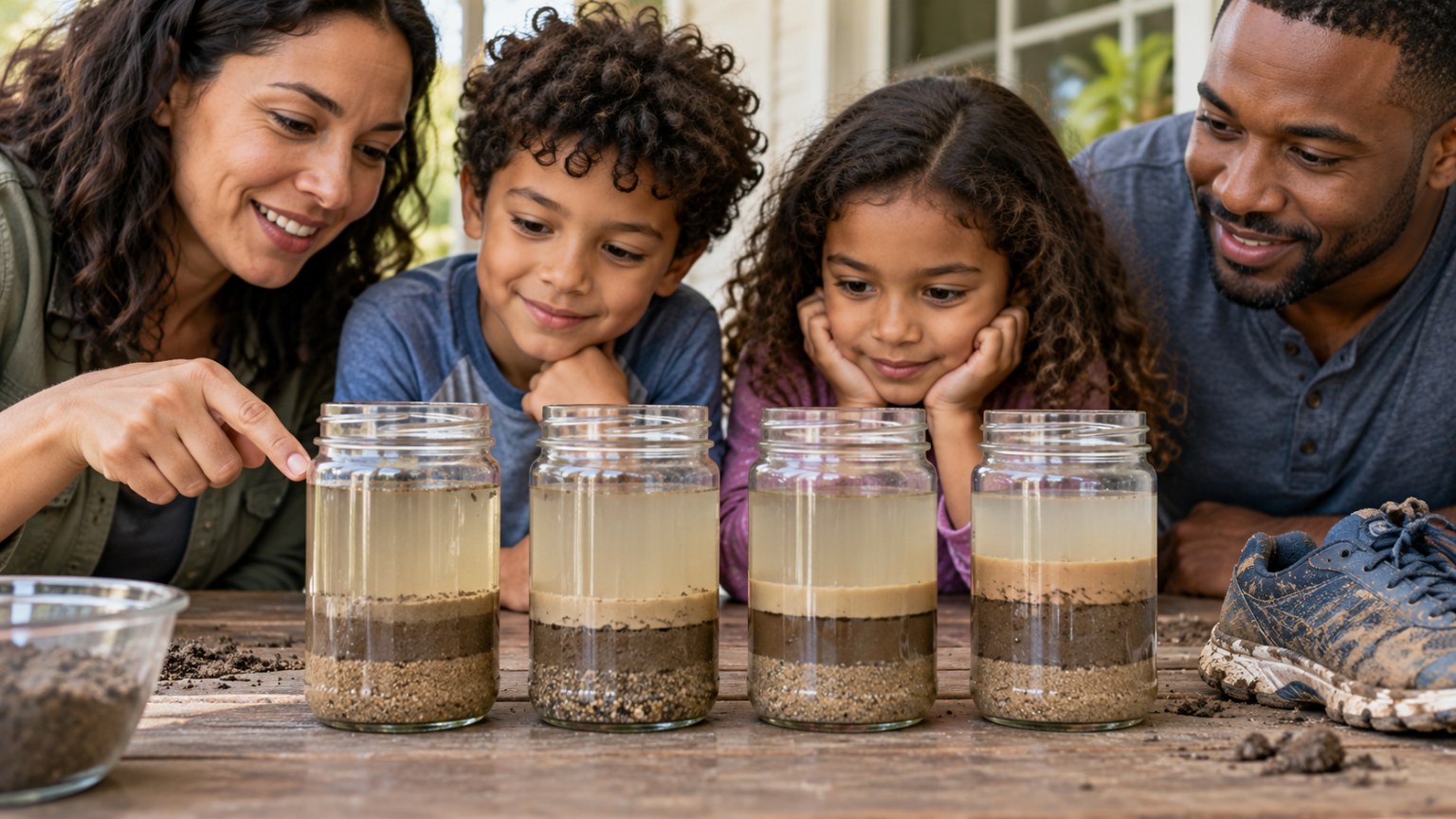
Your teen collects soil from three spots around home plus a mystery sample scraped from a muddy shoe, compares color and texture, separates each sample into sand, silt and clay layers in shaken settling jars, calculates percent composition, and decides where the shoe has been.
Objective
Your teen will measure the layers in soil settling jars, calculate the percent of sand, silt and clay in each sample, and use ratio and percent comparisons as evidence to match a mystery sample.
Standards
Materials
| Item | Quantity |
|---|---|
| Clear jars or bottles with lids, all the same size | 4 |
| Soil samples from 3 different places (garden bed, lawn edge, under a tree, a planter) plus a mystery sample | about 1 cup each |
| Water | enough to fill each jar about 3/4 |
| Dish soap or salt | 1/2 teaspoon per jar |
| Ruler with millimeters | 1 |
| Masking tape and marker for labels | 1 each |
| White paper plates | 4 |
| Calculator | 1 |
Vocabulary
Preparation
- The day before: collect 3 known soil samples, labeling where each came from. Secretly scoop a mystery sample from one of the same spots (or scrape mud off a shoe that walked there) and label it MYSTERY.
- Also the day before: fill each jar about one-third with its soil, add water to about three-quarters full and a little dish soap, shake hard for 2 minutes and let the jars sit undisturbed overnight so the layers settle. Keep a spoonful of each dry sample on a labeled plate.
Introduction
Hold up a muddy shoe and say: this shoe came home caked in mud, and someone says they never left the porch. Soil is surprisingly different from place to place. Can the dirt tell us where this shoe has been?
Why might soil from the garden look different from soil under a tree?
How can we compare samples fairly if the jars have different amounts of soil?
Steps
Conclusion
Ask: which piece of evidence was strongest, the percents or the color and texture? Investigators combine several kinds of evidence because one alone is rarely enough.
Make your own lesson plan in minutes
Describe a topic and Resource Portal AI writes the objectives, materials and steps for your group.
Try Resource Portal AI