Full lesson previewWhy Is Mars Red? Rusting Steel Wool to Model a Planet's Surface
Science40 minutesGrades: 12th
Overview
Rust steel wool three ways to model why Mars is red.
Description
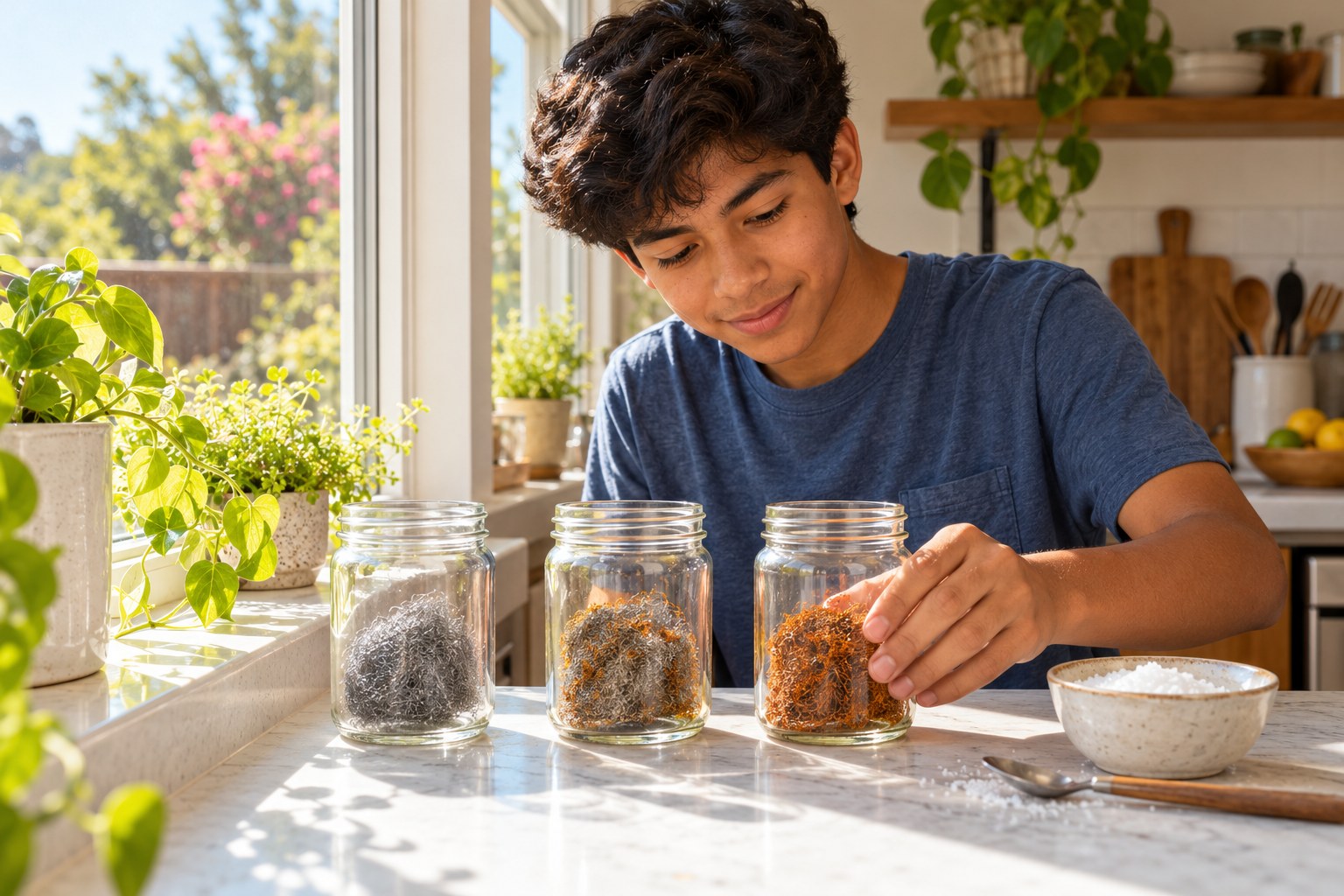
Your teen sets up three jars of plain steel wool, one dry, one with tap water and one with salt water plus a splash of vinegar, and photographs them every day for a week. They write the oxidation reaction that forms iron oxide, compare the reaction rates, and connect the results to the iron-rich dust that colors Mars and to what rovers have found about the planet's watery past.
Objective
Your teen will set up a controlled oxidation experiment, describe the chemical reaction that forms iron oxide, compare reaction rates under different conditions, and explain how iron oxides and past water shaped the surface of Mars.
Materials
| Item | Quantity |
|---|
| Plain steel wool pads with no soap (fine or medium grade) | 3 |
| Clear glass jars with lids | 3 |
| Table salt | 1 teaspoon |
| White vinegar | 1 tablespoon |
| Tap water | 1 cup |
| Masking tape and marker for labels | 1 of each |
| Kitchen gloves | 1 pair |
| Phone camera | 1 |
| Sheet of lined paper | 1 |
Vocabulary
Oxidation
A chemical reaction in which a substance loses electrons, often by combining with oxygen; rusting is the oxidation of iron.
Iron oxide
A compound of iron and oxygen, such as rust or hematite, that is usually red, orange or brown.
Electrolyte
A substance, like dissolved salt, that lets ions move in water and speeds up corrosion.
Regolith
The loose layer of dust, soil and broken rock covering a planet or moon, like the reddish surface of Mars.
Preparation
- Buy plain steel wool without soap; the soap-filled kind will not give clear results.
- Pick a spot where the jars can sit undisturbed for a week, away from food prep areas.
Introduction
Show your teen a photo of the Martian surface and ask: why is an entire planet the color of a rusty nail? The answer is chemistry they can grow on the windowsill this week.
What do you think rust needs to form?
If Mars is rusty, what might that hint about its past?
Steps
1Step 1
Set up the three jars
(10 min) Wearing the kitchen gloves to avoid splinters, your teen pulls each of the 3 steel wool pads into a loose ball and places one in each jar. Jar 1 stays dry; Jar 2 gets enough tap water to dampen the pad and leave about 1 cm in the bottom; Jar 3 gets the same amount of water with the 1 teaspoon of salt and the 1 tablespoon of vinegar stirred in. They label each jar with masking tape and loosely rest the lids on top so air can still get in.
2Step 2
Write the hypothesis and reaction
(10 min) On the sheet of lined paper your teen predicts which jar will rust fastest and why, and writes the simplified overall reaction: 4Fe + 3O₂ → 2Fe₂O₃, noting that water is needed for rust to form and is part of the hydrated rust that results. They explain which jar is the control and which variables they are changing.
3Step 3
Take day-one photos and plan the log
(8 min) Your teen photographs all 3 jars side by side in the same spot and lighting, and draws a 7-day log table with columns for date, color, amount of rust (0 to 5) and notes. They set a daily phone reminder to take a photo at the same time each day.
4Step 4
Connect to Mars
(12 min) Your teen reads a short NASA article on why Mars is red and on rover discoveries, then writes three points on the lined paper: that Mars's dust is rich in iron oxides; that Opportunity found hematite spheres in 2004 and Curiosity found ancient streambed rocks in 2012, both signs of past water; and that a 2025 study suggested the dust's main iron oxide may be a water-bearing form called ferrihydrite. They write one sentence comparing which jar is most like early, wet Mars.
Conclusion
After the week, ask your teen: 'Which jar rusted fastest, and what does that say about water and salt on early Mars?' One kitchen experiment can explain the color of an entire planet.
Make your own lesson plan in minutes
Describe a topic and Resource Portal AI writes the objectives, materials and steps for your group.
Try Resource Portal AI