Lesson plan

Write a Calavera Literaria: A Funny Día de los Muertos Poem
Writing40 minutesGrades: 3rd, 4th, 5th
Write a Calavera Literaria: A Funny Día de los Muertos Poem

Overview

Write a playful rhyming calavera poem.

Description

Your child learns about calaveras literarias, the playful rhyming poems written for Día de los Muertos, reads a model poem, and writes two rhyming verses in which La Muerte comes for a family member (with permission) or a pet, who outsmarts her through a funny habit.

Objective

Your child will identify verse, rhyme and rhythm in a poem, write two four-line stanzas with an AABB rhyme scheme, and revise word choices to be more precise and funny.

Standards

L.4.3aELA · Grade 4 · Language
Choose words and phrases to convey ideas precisely.
RL.4.5ELA · Grade 4 · Reading: Literature
Explain major differences between poems, drama, and prose, and refer to the structural elements of poems (e.g., verse, rhythm, meter) and drama (e.g., casts of characters, settings, descriptions, dialogue, stage directions) when writing or speaking about a text.
W.4.4ELA · Grade 4 · Writing
Produce clear and coherent writing in which the development and organization are appropriate to task, purpose, and audience.

Materials

ItemQuantity
Paper and pencil2 sheets and 1 pencil per child
Colored pencils or markers for a border1 set to share
Optional: a rhyming dictionary or rhyme website1

Vocabulary

Calavera literaria
A short, funny rhyming poem written for Día de los Muertos that playfully imagines Death visiting a living person.
La Muerte
Death shown as a character, often a skeleton lady such as La Catrina, in Mexican folk art and poems.
Stanza
A group of lines in a poem, like a paragraph in a story.
Rhyme scheme
The pattern of rhyming line endings, such as AABB, where lines 1 and 2 rhyme and lines 3 and 4 rhyme.

Preparation

Introduction

Read the model poem aloud with a dramatic voice. Ask: 'Is this poem sad or funny? Every fall in Mexico, people write funny poems like this about friends, teachers and even presidents for Día de los Muertos.'
How did Grandpa escape La Muerte in the poem?
Which words rhyme, and where do you hear the beat?

Steps

1Step 1
Learn and read
(5 min) Read the 'About calaveras literarias' section together, then read the model poem twice. Your child circles the rhyming words and taps the beat on the table.
2Step 2
Brainstorm
(8 min) Your child picks the person or pet and lists three harmless funny habits (always snacking, talking too long on the phone, losing their keys). Then they list rhyming pairs that fit, such as late and wait, snack and back, phone and alone.
3Step 3
Draft two stanzas
(15 min) Your child writes stanza 1, in which La Muerte arrives to take the person away, and stanza 2, in which the person's habit makes her give up and leave. Each stanza has four lines in an AABB rhyme scheme, with roughly the same number of beats in each line.
4Step 4
Revise word choice
(7 min) Reread the poem aloud and swap at least three plain words for more precise or funnier ones (went becomes tiptoed, ate becomes gobbled). Check that every joke is kind and teases a habit, never someone's looks or feelings.
5Step 5
Perform it
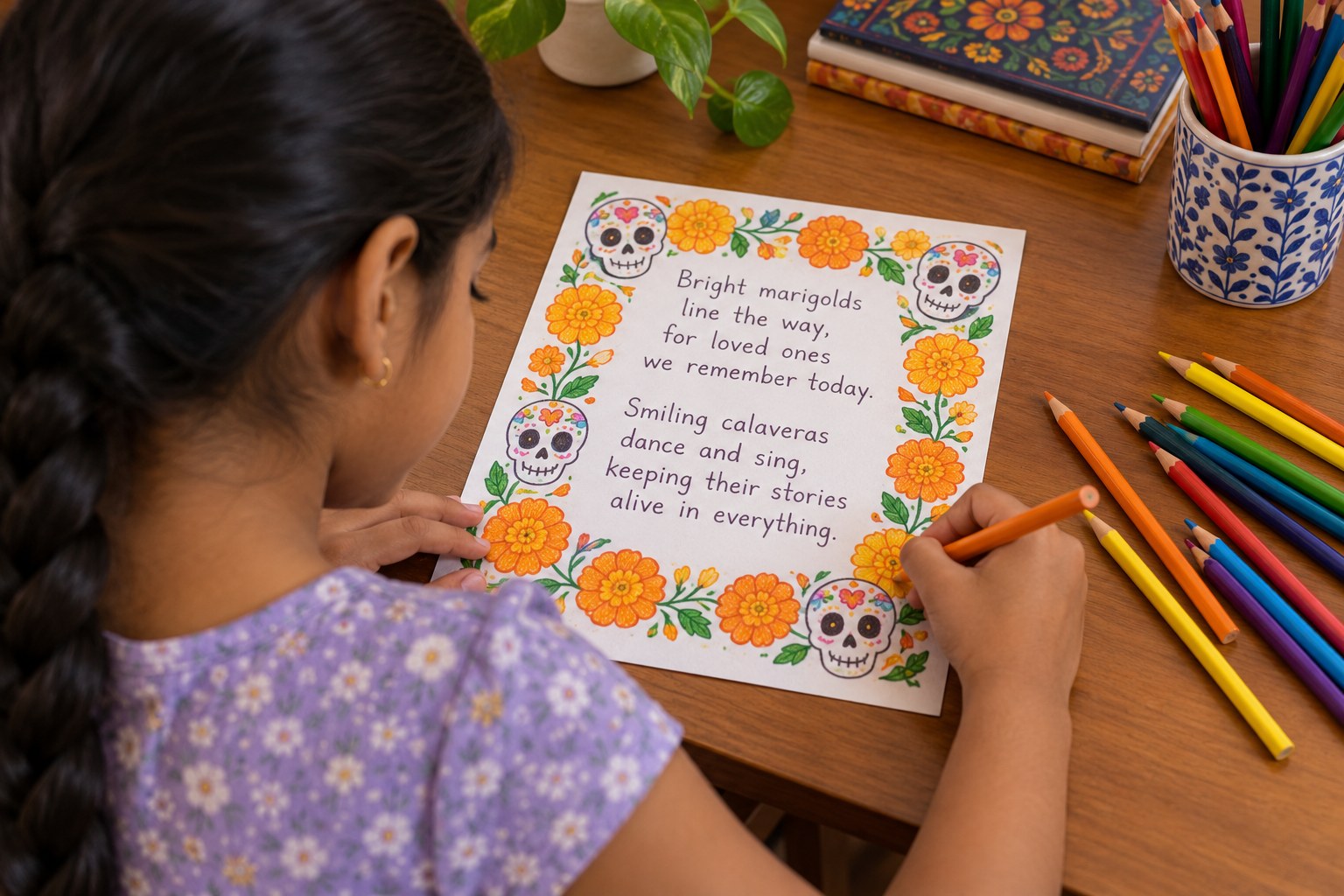
(5 min) Your child copies the poem neatly, adds a border of marigolds and calaveras, and performs it for the family. The person in the poem gets to laugh first.

Conclusion

Ask: what made your poem funny? How did the rhyme scheme help? Calaveras literarias show that Día de los Muertos can face death with humor and affection.

Make your own lesson plan in minutes

Describe a topic and Resource Portal AI writes the objectives, materials and steps for your group.

Try Resource Portal AI