Full lesson previewDensity Clues: Identifying Mystery Fragments Like a Trace Lab
Science50 minutesGrades: 12th
Overview
Use density to identify a mystery fragment and write it up like a lab.
Description
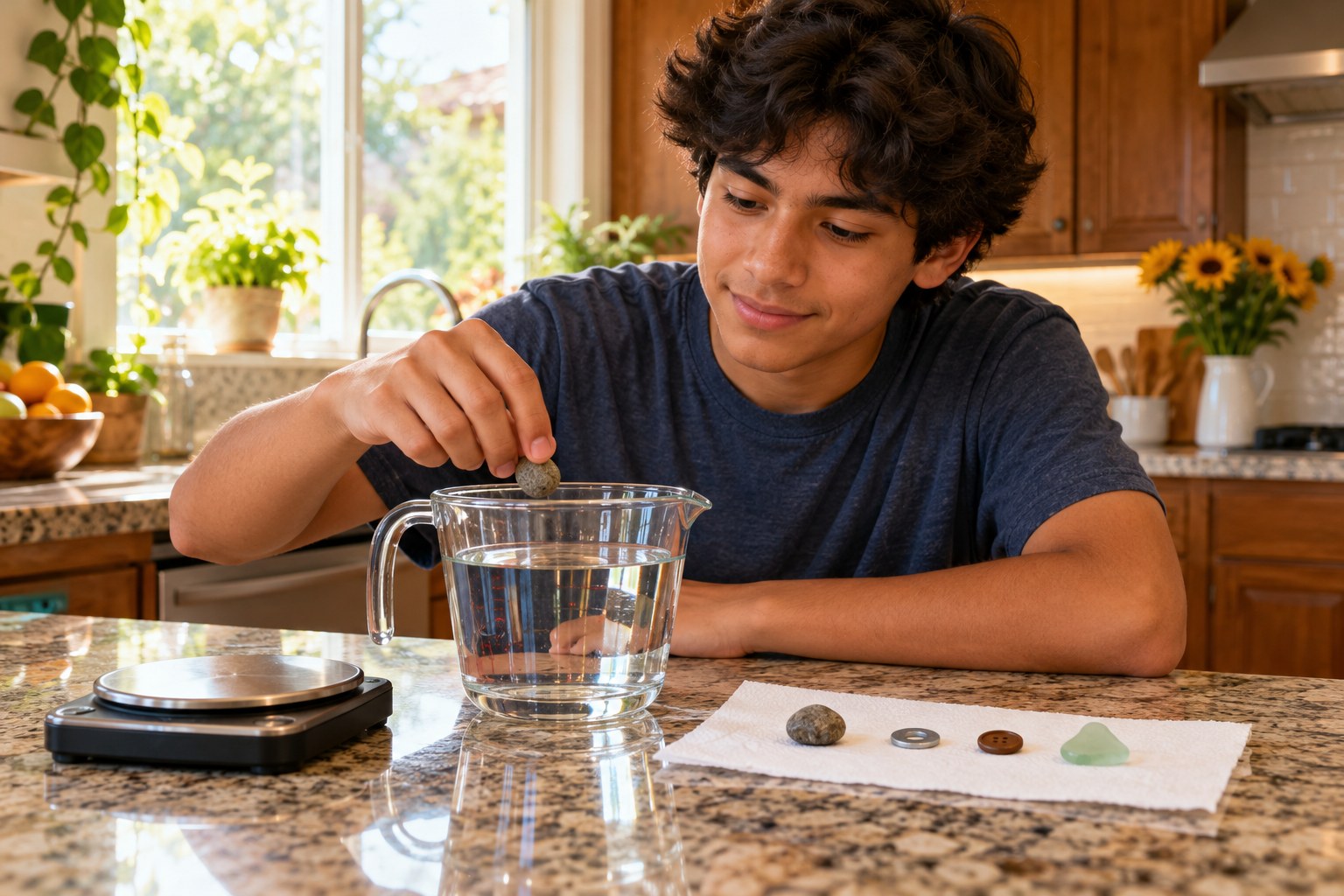
Your teen measures the mass and volume of four household samples (a small rock, a plastic button, a piece of sea glass and a metal washer) with a kitchen scale and water displacement, calculates each density, and identifies a mystery fragment from a reference table. They finish by writing a lab-style conclusion that uses precise forensic vocabulary, the way a trace-evidence analyst would.
Objective
Your teen will measure mass and volume accurately, calculate density with correct units, identify an unknown sample by comparing it with reference values, and write a precise, discipline-appropriate lab conclusion.
Standards
WHST.11-12.2dELA · Grade 11-12 · Writing in History/Social Studies, Science & Technical Subjects Use precise language, domain-specific vocabulary and techniques such as metaphor, simile, and analogy to manage the complexity of the topic; convey a knowledgeable stance in a style that responds to the discipline and context as well as to the expertise of likely readers.
Materials
| Item | Quantity |
|---|
| Digital kitchen scale that reads to 1 gram (0.1 g is better) | 1 |
| Glass measuring cup with milliliter marks | 1 |
| Small samples: a pebble or small rock, a plastic button, a piece of sea glass (or a smoothed glass bead), a metal washer | 1 of each |
| Mystery fragment chosen by a parent (a second piece of glass, rock or metal) | 1 |
| Sewing thread | 30 cm |
| Small cup or glass of water | 1 |
| Paper towels | 4 sheets |
| Sheets of lined paper | 2 |
Vocabulary
Density
Mass per unit volume, usually in grams per cubic centimeter (g/cm³); it depends on what a material is made of, not how big the piece is.
Water displacement
Finding an object's volume by measuring how much water it pushes aside when fully submerged; 1 mL of water equals 1 cm³.
Trace evidence
Tiny physical materials, such as glass, soil, paint or fibers, transferred between people, objects and places.
Class characteristic
A property shared by a whole group of materials, like density, that can narrow down a source but cannot single out one exact source.
Preparation
- Hide the mystery fragment in an envelope and secretly note what it is.
- Tie the 30 cm of sewing thread into a small loop you can hang samples from.
- Copy the reference table from the extra section onto the top of one sheet of lined paper, or keep the lesson open nearby.
Introduction
Tell your teen: a window was broken and a suspect has a glitter of glass in a shoe tread. Is it window glass, a bottle, or a bit of quartz from the driveway? Analysts often start with one simple property: how heavy the material is for its size.
If a big rock and a small rock are both granite, should they have the same density? Why?
Why is "it matches" a weaker statement than "it came from this exact window"?
Steps
1Step 1
Measure mass
(7 min) Your teen dries each of the 4 samples on a paper towel and weighs them one at a time on the kitchen scale, recording each mass in grams in a data table on the first sheet of lined paper. They weigh each sample twice and record the average, noting the scale's smallest division as their uncertainty.
2Step 2
Measure volume two ways
(15 min) For the rock, your teen fills the measuring cup to a clear line, gently lowers the rock in, and records the rise in milliliters. For smaller samples, they use the more precise scale method: set the small cup of water on the scale, press tare, hang the sample from the thread loop so it is fully under water without touching the sides or bottom, and read the scale; the grams shown equal the volume in cm³ because each cm³ of water weighs 1 gram.
3Step 3
Calculate and compare
(8 min) Your teen divides mass by volume for each sample, rounds to two significant figures, and compares the result with the reference table. They note how far each value is from the reference and suggest one source of error, like an air bubble clinging to the button.
4Step 4
Identify the mystery fragment
(8 min) You hand over the mystery fragment from its envelope, and your teen measures its mass and volume with the method they trust most and calculates its density. They decide which reference material it best matches and whether any other materials on the table are too close to rule out.
5Step 5
Write the lab conclusion
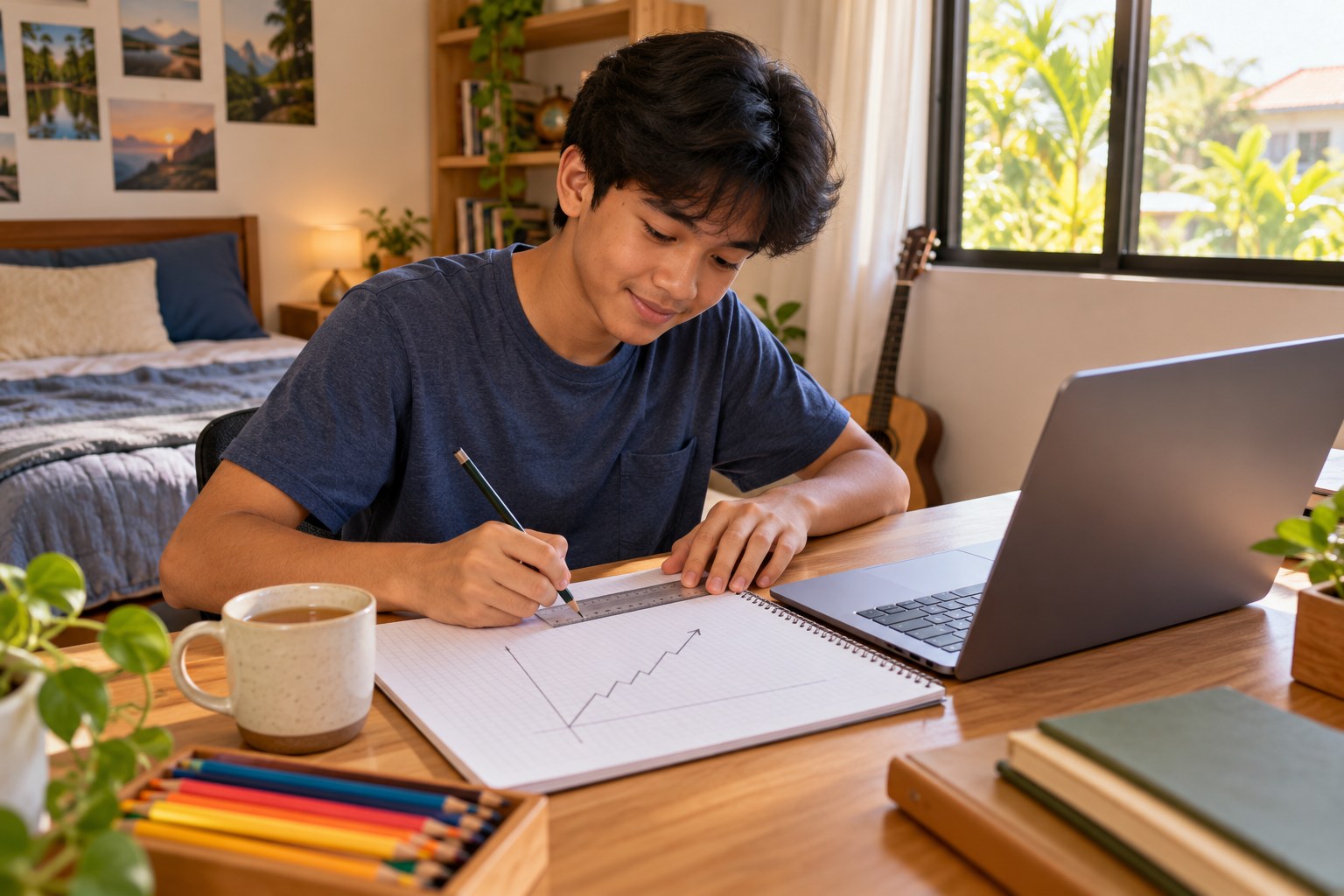
(12 min) On the second sheet of lined paper your teen writes a 150-word conclusion using at least four terms such as density, class characteristic, trace evidence and uncertainty, plus one analogy that would help a juror understand density. They check it against the checklist in the extra section and read it aloud to you.
Conclusion
Ask your teen: 'If the mystery fragment matched glass, what can you say and what can you not say?' Good forensic writing says exactly as much as the evidence supports.
Make your own lesson plan in minutes
Describe a topic and Resource Portal AI writes the objectives, materials and steps for your group.
Try Resource Portal AI