Ocean Oil Spill Cleanup Challenge
Overview
Engineer a cleanup for a mini ocean oil spill.
Description
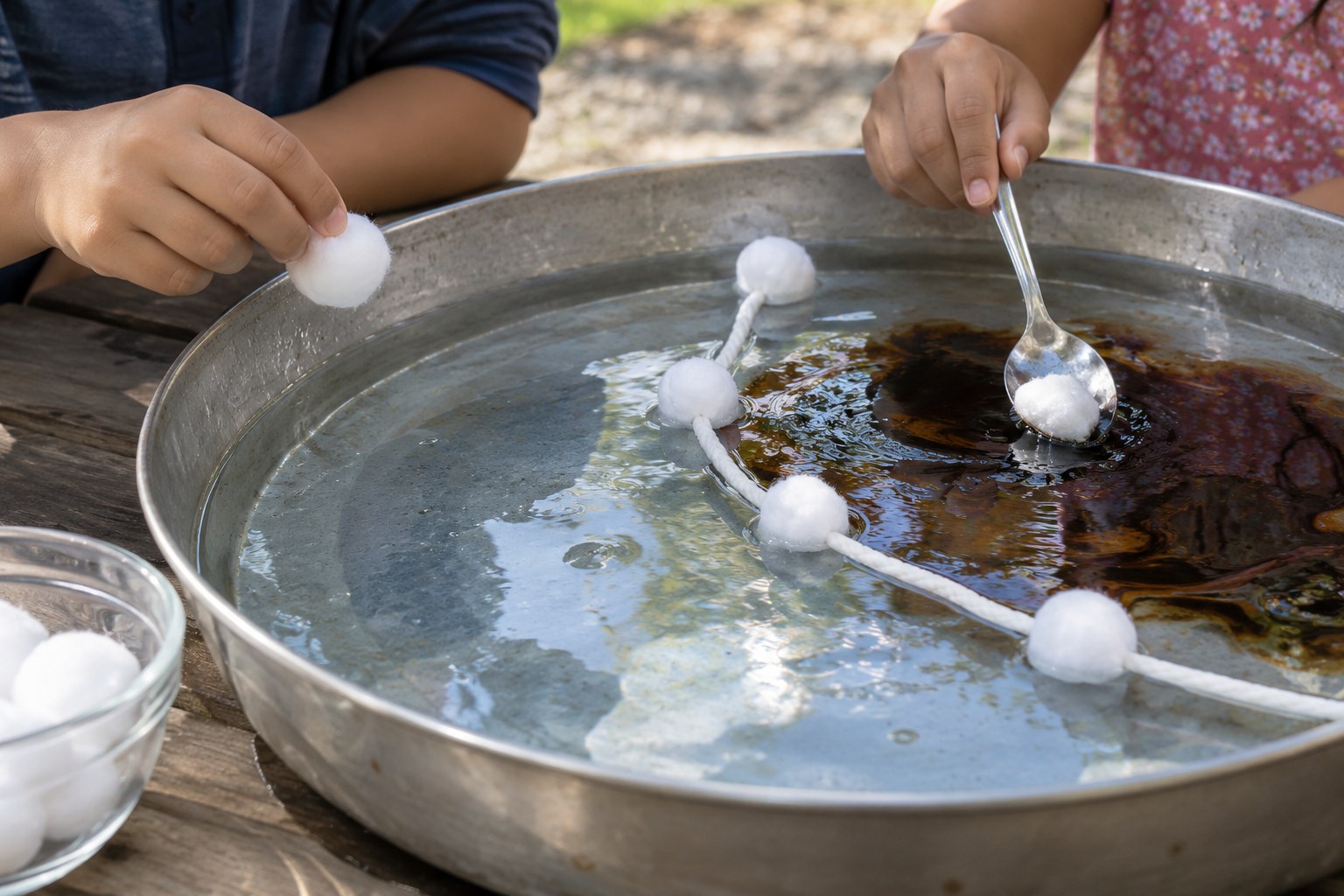
Your child makes a mini 'oil spill' in a pan of water, tests cleanup tools like cotton balls, a string boom, spoons and dish soap on a budget, then designs and runs the best cleanup plan and sees how a feather is affected.
Objective
Your child will test and compare cleanup tools, design a plan within a budget, measure how much oil they recover, and explain why oil spills are so hard to clean up and harmful to ocean life.
Materials
| Item | Quantity |
|---|---|
| Baking pan or large shallow container | 1 per team |
| Water | enough to fill the pan about 1 inch deep |
| Vegetable oil mixed with 1 teaspoon cocoa powder to darken it | about 1/4 cup per spill |
| Cotton balls | 5-10 |
| String or yarn (for a boom) | about 2 feet |
| Spoons, a turkey baster or eyedropper | 1-2 |
| Paper towels, small sponge squares | a few |
| Dish soap | a few drops |
| Feather (craft feather) or a strip of paper towel to test | 1-2 |
| Clear cup and measuring spoons for measuring recovered oil | 1 set |
Vocabulary
Preparation
- Mix the oil and cocoa in a cup. Fill the pan with an inch of water and set out tools on a tray with price tags: cotton ball $2, string boom $5, spoon $3, baster $5, paper towel square $2, sponge $4, dish soap $8 per drop.
- Make a budget card: each team has $25 to spend on the final cleanup.
Introduction
Pour the oil into the pan and blow gently across it to make 'wind.' Ask: the oil is spreading out on the ocean, and there are birds and otters nearby. What would you do first?
Why might it matter whether the oil sinks or floats?
What makes a cleanup tool good? Fast? Cheap? Gets the most oil?
Steps
Conclusion
Ask: how much oil could you get back, and what did that teach you? Even with the best tools, real cleanups recover only part of the oil, which is why preventing spills is the most important step.
Make your own lesson plan in minutes
Describe a topic and Resource Portal AI writes the objectives, materials and steps for your group.
Try Resource Portal AI