Dinosaur Time Machine: A Mesozoic Timeline to Scale
Overview
Build a to-scale timeline of dinosaur time and subtract big numbers.
Description
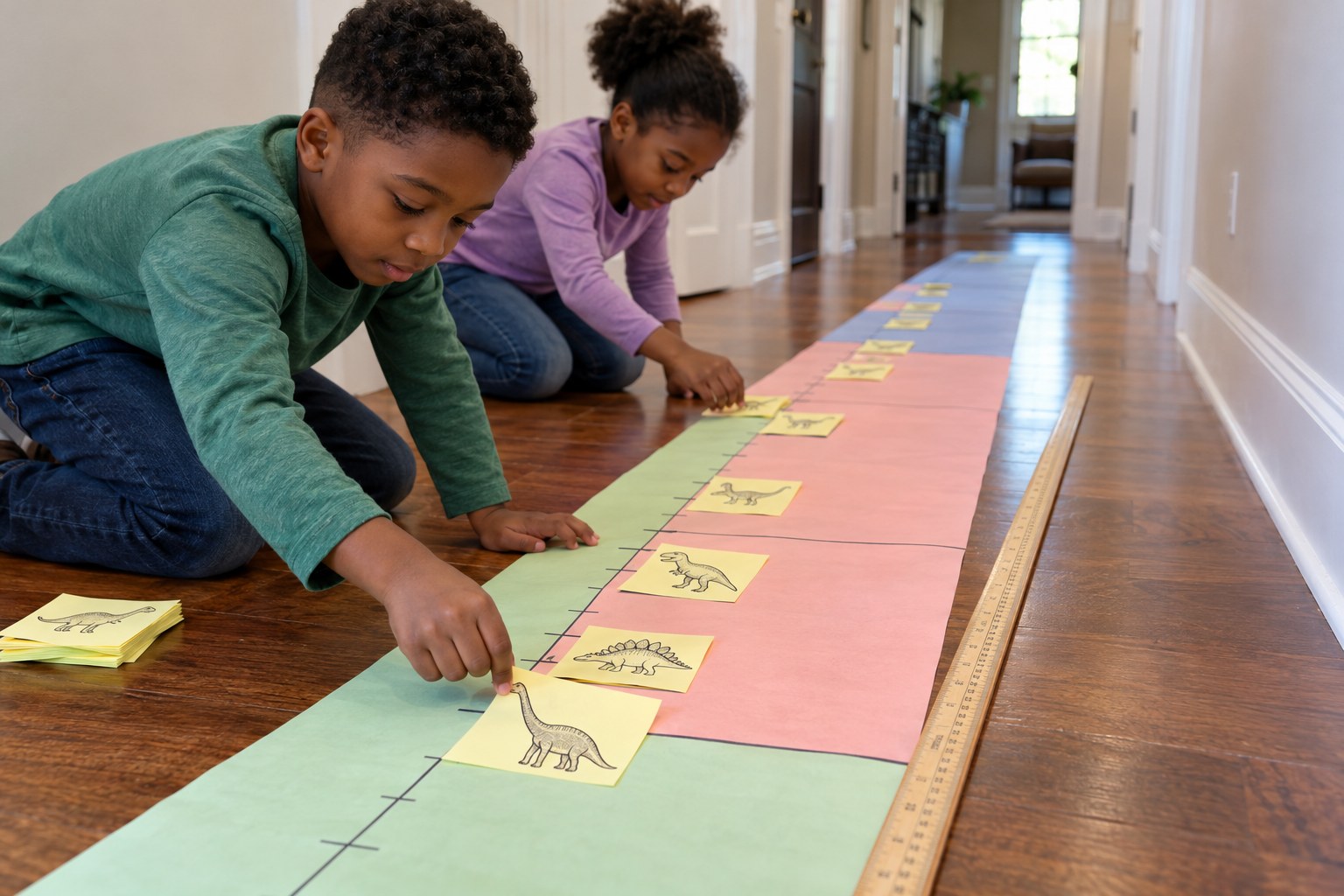
Your child builds a scale timeline on a long strip of paper where 1 centimeter equals 1 million years, marks the Triassic, Jurassic and Cretaceous periods and famous dinosaurs, and uses subtraction to discover surprises, like the fact that T. rex lived closer in time to us than to Stegosaurus.
Objective
Your child will use a scale (1 cm = 1 million years) to place events on a timeline, subtract multi-digit numbers to find lengths of time, and convert between centimeters and meters.
Standards
Materials
| Item | Quantity |
|---|---|
| Long strip of paper about 3 meters long (taped-together printer paper, adding-machine tape, or wrapping paper turned over) | 1 per child or group |
| Meter stick or tape measure with centimeters | 1 |
| Markers in 3 colors | 1 set |
| Sticky notes or small paper squares | 10 |
| Pencil and scratch paper | 1 each |
| Tape | 1 roll |
Vocabulary
Preparation
- Tape paper together to make a strip at least 260 cm long and lay it along a hallway or table.
- Write each event from the event list on its own sticky note.
Introduction
Ask your child to guess: did T. rex and Stegosaurus ever meet? Write down their guess and tell them the timeline will answer it.
How long is a million years? How could we make that something we can see?
Do you think all dinosaurs lived at the same time?
Steps
Conclusion
Revisit the starting guess: T. rex lived about 85 million years after Stegosaurus but only about 66-68 million years before us. "Dinosaur time" was enormous, and dinosaurs lived on Earth for over 160 million years.
Make your own lesson plan in minutes
Describe a topic and Resource Portal AI writes the objectives, materials and steps for your group.
Try Resource Portal AI