Lesson planCloudburst Lab: Measure a Kitchen Downpour in Inches per Hour
Science45 minutesGrades: 6th
Overview
Measure a pretend downpour and convert it to inches per hour.
Description
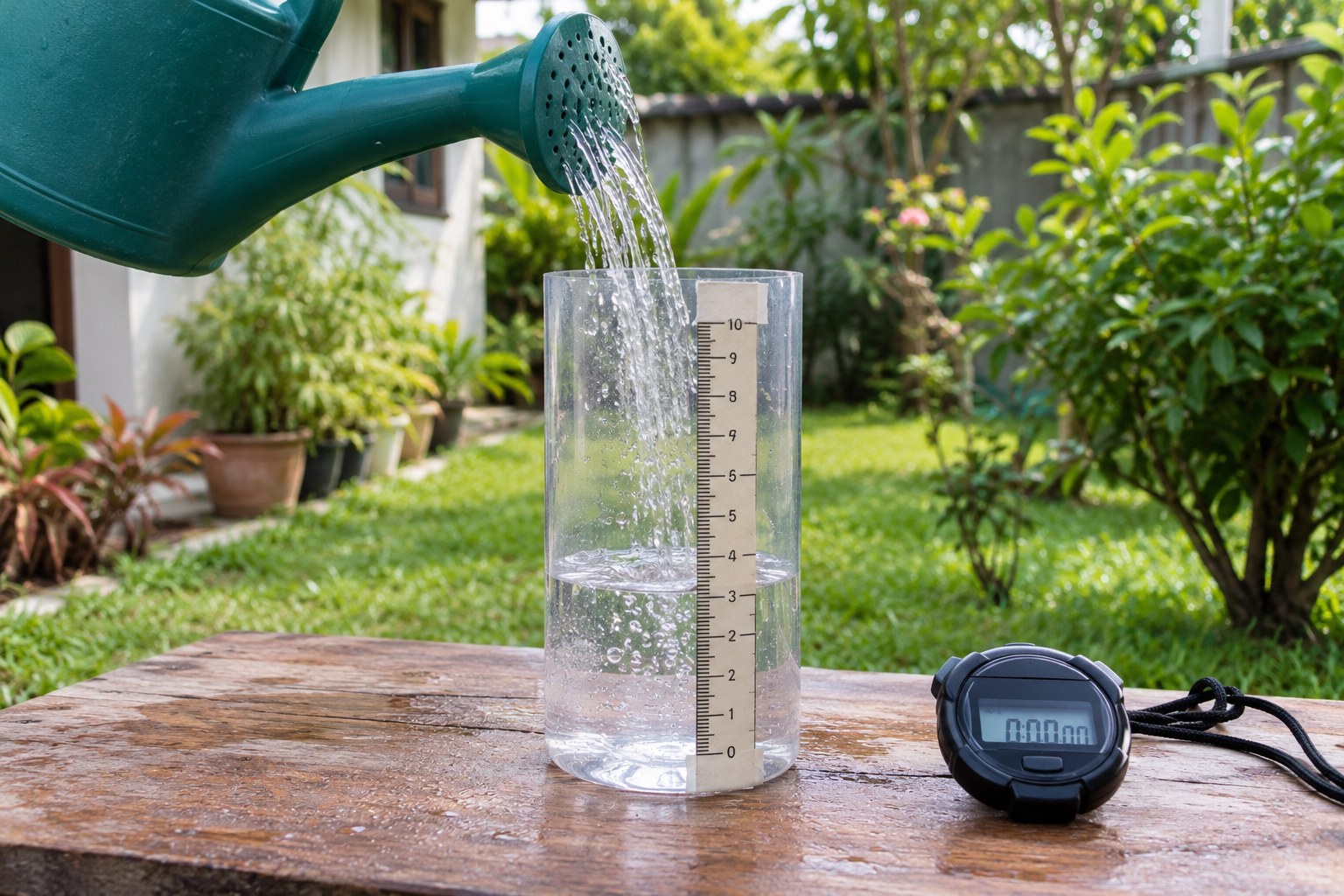
Your teen makes a backyard 'cloudburst' with a watering can, catches it in a straight-sided rain gauge, measures the depth over timed intervals, converts the results to inches per hour and compares them with real rainfall-rate categories and flash-flood records.
Objective
Your teen will measure rainfall depth over time, calculate unit rates, convert between inches per minute and inches per hour, and use the rates to explain why intense rain causes flash floods.
Standards
6.RP.3bMath · Grade 6 · Ratios & Proportional Relationships Solve unit rate problems including those involving unit pricing and constant speed.
6.RP.3dMath · Grade 6 · Ratios & Proportional Relationships Use ratio reasoning to convert measurement units; manipulate and transform units appropriately when multiplying or dividing quantities.
Materials
| Item | Quantity |
|---|
| Straight-sided clear container (like a large cup or plastic food tub) | 1 |
| Ruler that shows sixteenths or tenths of an inch | 1 |
| Watering can or a large cup with small holes poked in the bottom | 1 |
| Phone stopwatch | 1 |
| Bucket of water | 1 |
| Calculator, paper and pencil | 1 each |
Vocabulary
Rainfall rate
How fast rain is falling, measured as depth per unit of time, like inches per hour.
Unit rate
A rate with 1 in the denominator, like 0.4 inches per 1 minute.
Cloudburst
A sudden, very heavy rain over a small area.
Flash flood
A flood that rises quickly, usually within 6 hours of heavy rain.
Preparation
- Pick an outdoor spot or a bathtub where water can splash. Tape the ruler to the outside of the container with 0 at the inside bottom.
- Draw a data table with columns: Trial, Time (minutes), Depth (inches), Inches per minute, Inches per hour.
Introduction
Share a record: on June 22, 1947, in Holt, Missouri, about 12 inches of rain fell in just 42 minutes. Ask: how could we compare that to an ordinary rainy day? We need a rate.
Why would 2 inches of rain in 1 hour be more dangerous than 2 inches spread over a whole day?
How can you change inches per minute into inches per hour?
Steps
1Step 1
Make it rain
(10 min) Your teen holds the watering can at a steady height about 2 feet above the gauge and pours steadily for exactly 30 seconds while you time. They read the depth to the nearest sixteenth or tenth of an inch, record it and empty the gauge. Repeat for a 60-second trial and a 90-second trial at the same pour.
2Step 2
Find the unit rates
(10 min) For each trial your teen divides depth by time in minutes to get inches per minute, then multiplies by 60 minutes per hour to get inches per hour, writing the units in every step so they cancel. Compare the three trials: are the rates about the same?
3Step 3
Compare to real rain
(8 min) Using the rainfall categories below, your teen classifies their kitchen downpour and the Holt, Missouri record. They calculate the Holt rate in inches per minute and inches per hour.
4Step 4
Rain on a parking lot
(10 min) Your teen solves the flash-flood problem in the answer key: at a given rate, how deep would water get in a set time if none drains away? Discuss why pavement and dry, hard soil make flash floods worse.
5Step 5
Safety connection
(5 min) Your teen reads the flood-safety facts and writes one sentence explaining the Turn Around, Don't Drown rule using what they learned about how fast water can rise. Talk about why a road you can't see the bottom of may already be washed out.
Conclusion
Ask: why are rainfall rates more useful than rainfall totals for predicting flash floods? Look up your town's record rainfall day and calculate its average rate.
Make your own lesson plan in minutes
Describe a topic and Resource Portal AI writes the objectives, materials and steps for your group.
Try Resource Portal AI