Lesson planSuperhero Origin Story: Narrative Writing with Dialogue
Writing45 minutesGrades: 3rd, 4th, 5th
Overview
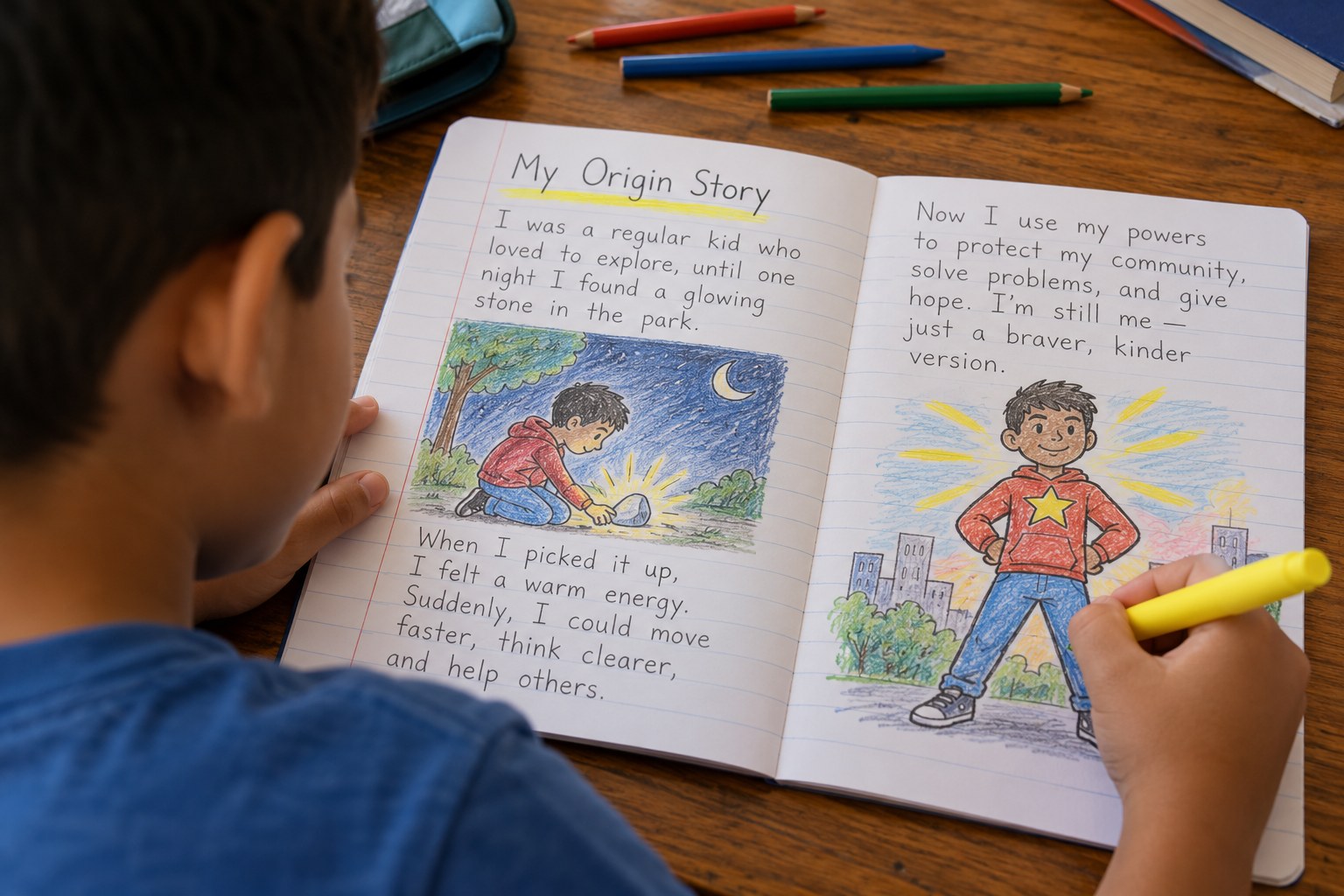
Write an original hero's origin story with dialogue.
Description
Your child invents an original hero and writes the hero's origin story: an ordinary kid, a moment that changes everything, and the first choice to use a new ability to help. They plan with a story map and use dialogue and description to show how the character feels.
Objective
Your child will write a narrative that introduces a character and situation, uses dialogue and description to show feelings, follows a logical sequence and ends with a conclusion.
Standards
Orient the reader by establishing a situationand introducing a narrator and/or characters; organize an event sequence that unfolds naturally.
Use dialogue and description to develop experiences and events or show the responses of characters to situations.
Provide a conclusion that follows from the narrated experiences or events.
Materials
| Item | Quantity |
|---|
| Origin story map (see Additional Sections), copied or drawn | 1 per child |
| Lined paper | 3 sheets per child |
| Pencil and eraser | 1 per child |
| Colored pencils for a quick character sketch | 1 set to share |
| Highlighter | 1 per child |
Vocabulary
Origin story
The part of a story that explains how a character became who they are.
Dialogue
The words characters say out loud, written inside quotation marks.
Turning point
The moment in a story when things change.
Flaw
A weakness or struggle that makes a character feel real.
Preparation
- Copy or draw the origin story map for each writer.
- Write two sample lines on paper to model dialogue: 'I can't let him fall,' Maya whispered. and 'Who's there?' called the night guard.
Introduction
Read this opening aloud: 'Nobody noticed Theo. Not at lunch, not on the bus, not even when he waved. Then came the Tuesday the school lights flickered and Theo discovered he could see in the dark.' Ask: what do you want to know next?
Why do readers like to know how a hero began?
Is a hero more interesting with no problems or with a weakness?
Steps
1Step 1
Build the hero
(8 min) Your child sketches their original hero as an ordinary kid first, then with their ability. Fill in the top of the story map: name, everyday life, the ability and one flaw or fear.
2Step 2
Map the origin
(7 min) Plan four parts on the map: ordinary life, the turning point when the ability appears, the first problem, and the choice to help. Talk through each part aloud before writing.
3Step 3
Draft with dialogue
(18 min) Your child writes the story, opening by showing the character's ordinary life. They include at least three lines of dialogue and two sentences that show feelings through actions, like 'Her hands shook as she reached for the rope.' The story should end by showing what changed for the hero.
4Step 4
Check the dialogue
(6 min) Your child highlights every line of dialogue and checks punctuation: quotation marks around spoken words, a comma or end mark inside the quotes, and a new paragraph each time a new character speaks. Fix any mistakes.
5Step 5
Author reading
(5 min) Your child reads the story aloud in their best storyteller voice. The listener names the turning point and one line of dialogue they liked.
Conclusion
Ask: 'How does your ending show what your hero learned?' Next time, write the hero's second adventure where the flaw causes a problem.
Make your own lesson plan in minutes
Describe a topic and Resource Portal AI writes the objectives, materials and steps for your group.
Try Resource Portal AI