Lesson planWhy January 1? Reading the History of the New Year's Calendar
Reading40 minutesGrades: 6th, 7th
Overview
Read how January 1 became New Year's Day and summarize the central idea.
Description
Your teen reads a short history of how January 1 became New Year's Day, from the 10-month Roman calendar to Julius Caesar and the Gregorian reform, answers evidence questions, writes an objective summary, and tests the leap-year rule.
Objective
Your teen will cite text evidence to support answers, determine the central ideas of an informational passage, write an objective summary, and apply the Gregorian leap-year rule.
Standards
RI.6.1ELA · Grade 6 · Reading: Informational Text Cite textual evidence to support analysis of what the text says explicitly as well as inferences drawn from the text.
RI.7.2ELA · Grade 7 · Reading: Informational Text Determine two or more central ideas in a text and analyze their development over the course of the text; provide an objective summary of the text.
Materials
| Item | Quantity |
|---|
| The passage from the 'Reading passage' section, printed or copied | 1 per teen |
| Pencil and two colors of highlighter or pen | 1 each |
| Lined paper | 2 sheets |
| Optional: a wall or phone calendar | 1 |
Vocabulary
Calendar reform
An official change to the way a calendar counts days, months or leap years.
Solar year
The time it takes Earth to go through one full cycle of seasons, about 365.2422 days.
Leap year
A year with an extra day, February 29, to keep the calendar in step with the seasons.
Central idea
The most important point an author develops in a text.
Objective summary
A short retelling of the main points without personal opinions.
Preparation
- Copy or print the passage and the questions. Number the paragraphs 1 to 4 if they are not already.
- Optional: find out which months have Latin number roots (Sept-, Oct-, Nov-, Dec-) to discuss in the hook.
Introduction
Ask your teen: 'If December means tenth month, why is it the twelfth month?' Let them guess, then say the answer is in a story about Roman officials, Julius Caesar, a pope and 11 missing days.
Who gets to decide when a year starts?
Why would a calendar that's off by just 11 minutes a year become a problem?
Steps
1Step 1
Preview and predict
(5 min) Your teen reads the title and the first sentence of each paragraph, then predicts in one sentence what the passage will explain. Point out that informational texts often move in time order.
2Step 2
Read and annotate
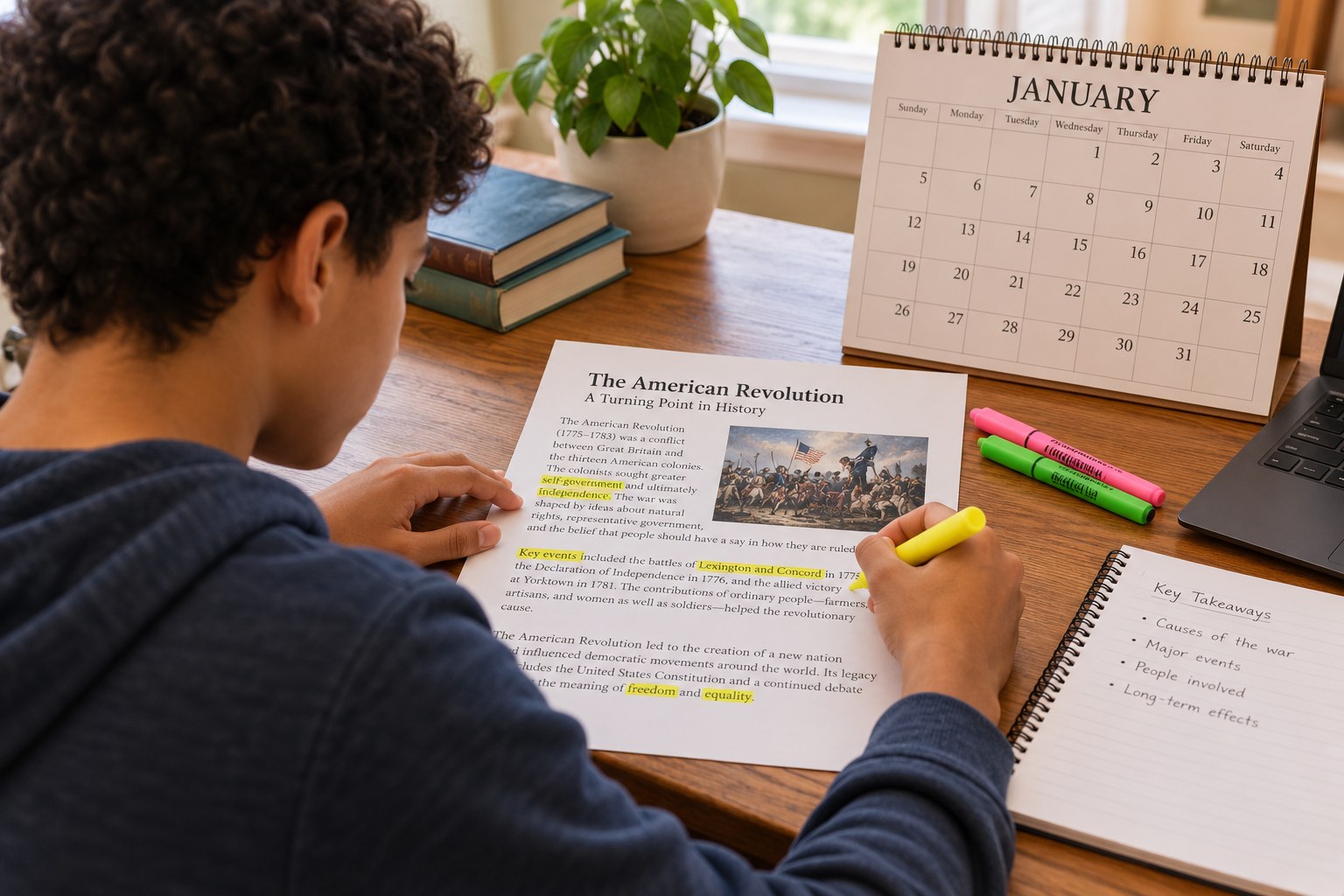
(12 min) Your teen reads the full passage, highlighting dates and numbers in one color and causes of calendar changes in another. In the margin, they write a 3-to-5-word note summing up each paragraph.
3Step 3
Answer with evidence
(10 min) Your teen answers the 5 questions in writing, quoting or pointing to a specific sentence for each answer. Check together with the answer key and discuss any answers that need stronger evidence.
4Step 4
Write the summary
(8 min) Your teen writes a 4-to-5-sentence objective summary that states the central idea and the key events in order, with no opinions. Read it back and cross out any 'I think' or extra details.
5Step 5
Test the leap-year rule
(5 min) Using the Gregorian rule from the passage, your teen decides whether 1900, 2000, 2028 and 2100 are leap years. Check with the answer key and talk about why the 400-year rule fixes the 11-minute error.
Conclusion
Ask: what is the central idea in one sentence? Share one surprising fact from the passage at your New Year's celebration.
Make your own lesson plan in minutes
Describe a topic and Resource Portal AI writes the objectives, materials and steps for your group.
Try Resource Portal AI