Lesson planMini Lightning Lab: Make Static Sparks with a Balloon
Science30 minutesGrades: K, 1st, 2nd
Overview
Make tiny lightning sparks with a balloon.
Description
Your child charges a balloon by rubbing it on hair or a wool sock, watches it lift paper bits and bend a stream of water, and listens for tiny crackles in a dark room, then explains how lightning is a giant version of the same spark.
Objective
Your child will create static electricity, observe what it does and answer the question 'How is a balloon spark like lightning?' using what they saw.
Standards
W.1.8ELA · Grade 1 · Writing With guidance and support from adults, recall information from experiences or gather information from provided sources to answer a question.
W.2.8ELA · Grade 2 · Writing Recall information from experiences or gather information from provided sources to answer a question.
W.K.8ELA · Grade K · Writing With guidance and support from adults, recall information from experiences or gather information from provided sources to answer a question.
Materials
| Item | Quantity |
|---|
| Balloon, blown up and tied (or a plastic comb if anyone has a latex allergy) | 1 per child |
| Wool sock, sweater or a head of clean, dry hair | 1 |
| Tissue paper or paper torn into tiny pieces | a small pile |
| Kitchen faucet with a thin stream of water | 1 |
| Paper and crayons for a lab drawing | 1 each per child |
Vocabulary
Static electricity
Electricity that builds up on something when it is rubbed.
Spark
A tiny flash or crackle when built-up electricity jumps.
Lightning
A giant spark of electricity in a storm cloud.
Charge
To build up static electricity on something.
Preparation
- Blow up and tie the balloons (an adult should do this). Tear tissue paper into pieces about the size of a fingernail.
- Static works best on a dry day. Pick a room you can make dark for the crackle test.
Introduction
Rub a balloon on your own head and hold it over your hair so it stands up. Ask: what invisible thing is pulling my hair? Today you'll find out, and it is the same thing that makes lightning!
Have you ever gotten a little shock touching a doorknob?
What do you think lightning is made of?
Steps
1Step 1
Charge the balloon
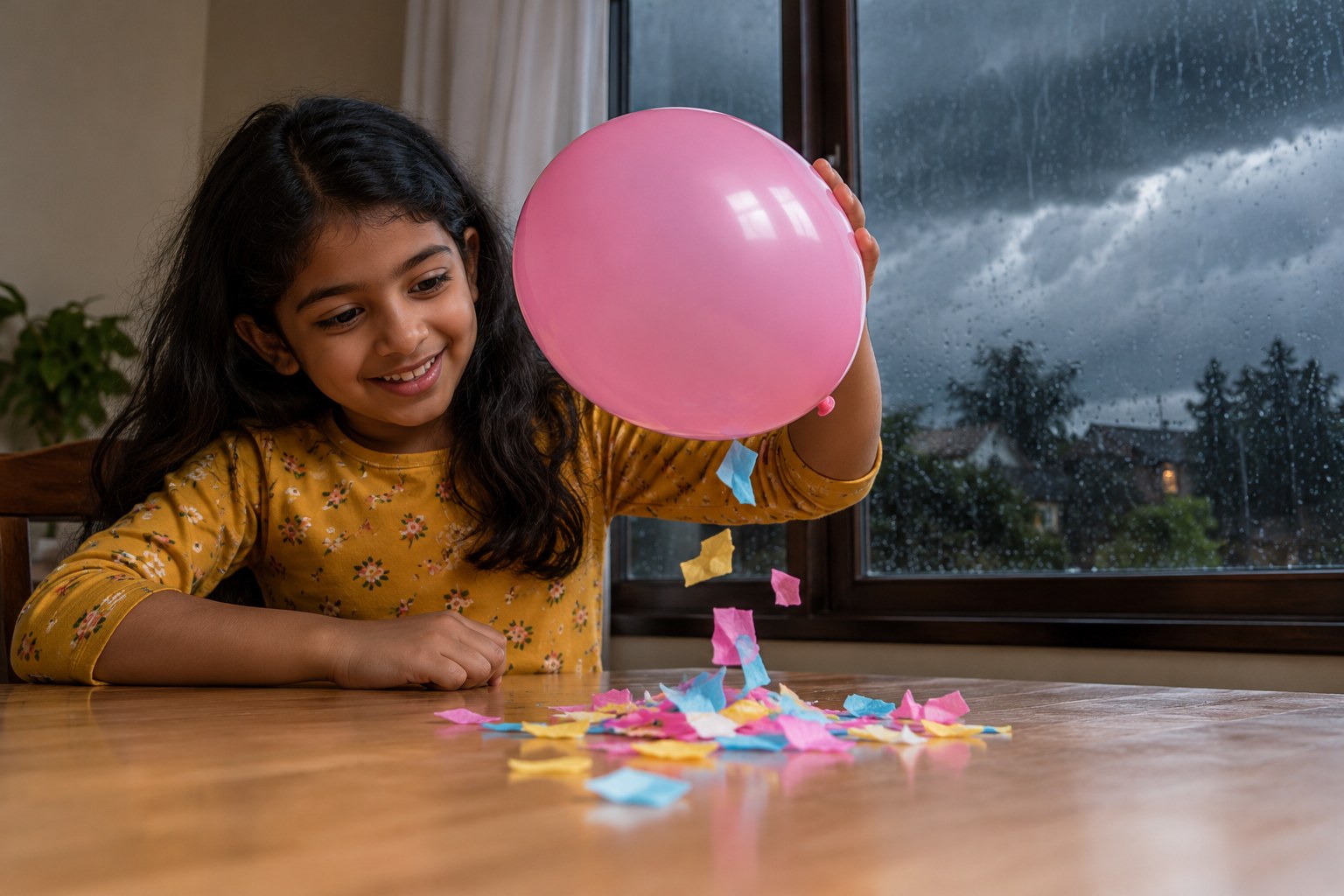
(5 min) Your child rubs the balloon quickly on their hair or the wool sock about 20 times. Then they hold it near their hair or arm and notice what happens.
2Step 2
Paper jump test
(6 min) Your child holds the charged balloon just above the tissue paper bits and watches them jump up and stick. Try it again without rubbing first and compare.
3Step 3
Bend the water
(5 min) Turn on the faucet to a thin, steady stream. Your child charges the balloon and slowly brings it close to the water, without touching, and watches the stream bend toward it.
4Step 4
Crackle in the dark
(5 min) Make the room dark. Your child rubs the balloon hard and then slowly touches it to a doorknob or a metal spoon, listening and looking closely for a tiny crackle or flicker. Explain that lightning is a giant spark like this, jumping between a cloud and the ground or between clouds.
5Step 5
Answer the big question
(8 min) Your child draws what they saw in the paper and water tests. Ask: how is a balloon spark like lightning? Kindergartners tell you their answer and you write it; first and second graders write 1-3 sentences using words from the lab.
Conclusion
Ask: what did you do to make static electricity? What did it do? Remind your child that real lightning is very powerful and is never safe to play with: when thunder roars, go indoors.
Make your own lesson plan in minutes
Describe a topic and Resource Portal AI writes the objectives, materials and steps for your group.
Try Resource Portal AI