Lesson planAncient Egypt Number Hieroglyphs: Add Like a Scribe
Math40 minutesGrades: 3rd, 4th, 5th
Overview
Write and add numbers with Egyptian hieroglyph numerals.
Description
Your child learns the Egyptian hieroglyph numerals for 1, 10, 100, 1,000 and beyond, translates numbers between Egyptian and our base-ten numerals, and adds and subtracts with Egyptian symbols, trading 10 of a symbol for the next one up.
Objective
Your child will read and write multi-digit numbers in Egyptian numerals and in expanded form, and add and subtract multi-digit numbers, connecting regrouping to trading 10 symbols for one larger symbol.
Standards
4.NBT.2Math · Grade 4 · Number & Operations in Base Ten Read and write multi-digit whole numbers using base-ten numerals, number names, and expanded form. Compare two multi-digit numbers based on meanings of the digits in each place, using >, =, and < symbols to record the results of comparisons.
4.NBT.4Math · Grade 4 · Number & Operations in Base Ten Fluently add and subtract multi-digit whole numbers using the standard algorithm.
Materials
| Item | Quantity |
|---|
| Egyptian numeral key (see Additional Sections), copied on paper | 1 per child |
| Paper and pencil | 2 sheets per child |
| Index cards or scrap paper cut into cards | 10 per pair |
| Colored pencils | 1 set to share |
Vocabulary
Numeral
A symbol or group of symbols that stands for a number.
Place value
The value of a digit based on its position, like the 3 in 300.
Expanded form
A number written as the sum of each digit's value, like 2,000 + 300 + 40 + 5.
Regroup
To trade 10 of one unit for 1 of the next larger unit, or the other way around.
Preparation
- Copy the numeral key so each child has the 7 symbols: stroke, heel bone, coil of rope, lotus, finger, tadpole and kneeling figure with raised arms.
- Write the practice problems from the answer key on a sheet, leaving out the answers.
Introduction
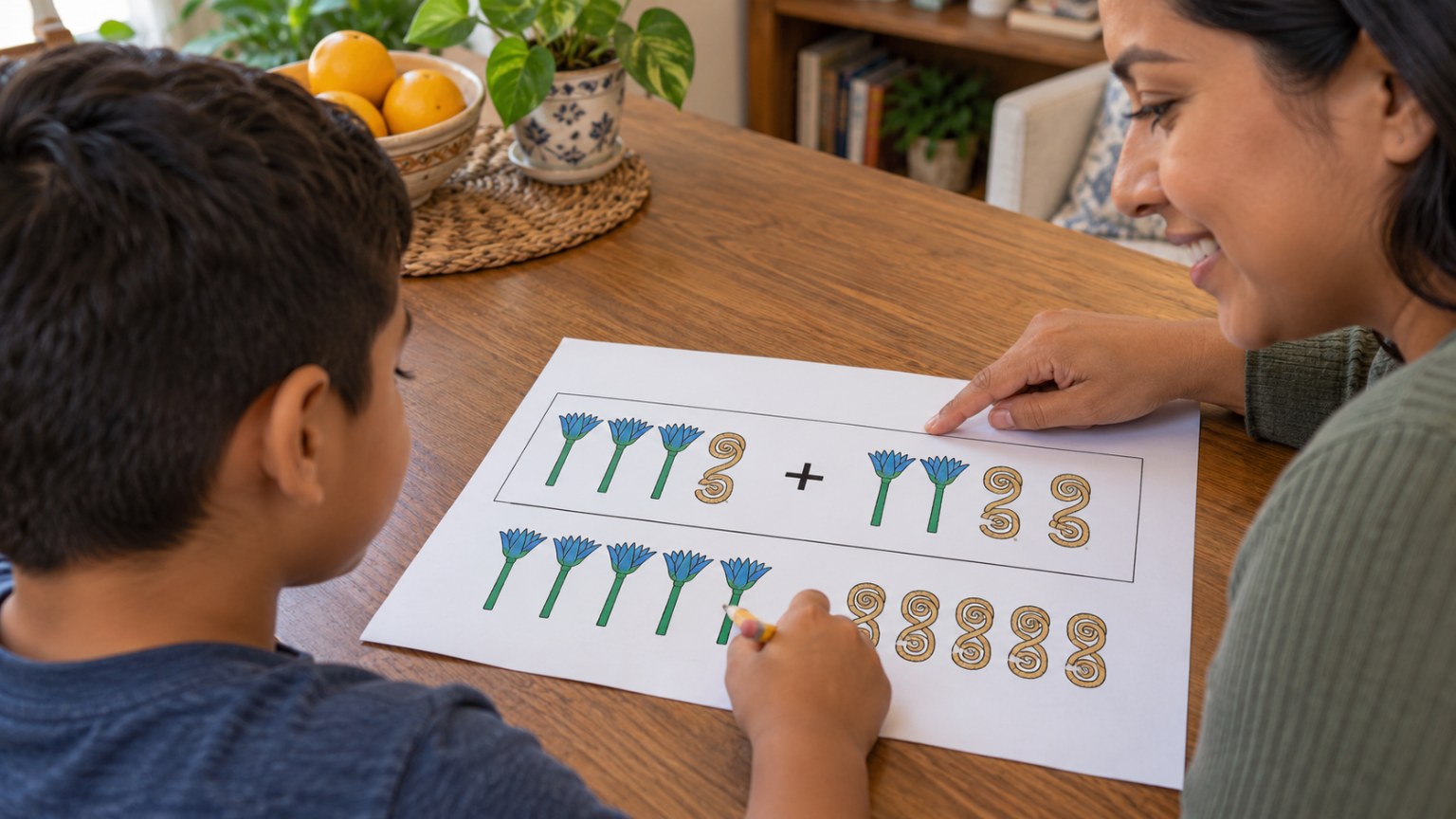
Draw 3 lotus flowers, 2 coils of rope, 4 upside-down U shapes and 5 short lines. Ask: could this be a number? Tell your child an Egyptian scribe would read it instantly as 3,245.
Why does the 3 in 3,245 mean three thousand and not three?
What would happen if a number system had no zero?
Steps
1Step 1
Learn the symbols
(6 min) Go over the numeral key and point out that each symbol is worth 10 times the one before it. Your child draws each symbol 3 times and says its value aloud.
2Step 2
Translate both ways
(9 min) Your child writes 4 numbers in Egyptian symbols (like 1,326 and 21,436) and then writes each in expanded form. Then you draw 3 numbers in symbols and your child translates them to standard numerals.
3Step 3
Add like a scribe
(10 min) Your child adds 1,256 + 2,378 by drawing both numbers in symbols, combining like symbols, and trading every 10 strokes for 1 heel bone and every 10 heel bones for 1 coil. Then they solve the same problem with the standard algorithm and compare: each trade is the same as carrying a 1.
4Step 4
Subtract with trades
(8 min) Your child solves 3,402 - 1,275 in symbols by trading 1 coil for 10 heel bones or 1 heel bone for 10 strokes when there aren't enough to take away. Check with the standard algorithm.
5Step 5
Card challenge
(7 min) Each player writes 5 numbers in Egyptian symbols on cards, shuffles them, and the partner flips two and adds them in standard numerals. The writer checks the answer, then players switch roles.
Conclusion
Ask: which system is faster for writing 9,999, Egyptian or ours, and why? Help your child see that place value and zero let us write any number with only 10 digits.
Make your own lesson plan in minutes
Describe a topic and Resource Portal AI writes the objectives, materials and steps for your group.
Try Resource Portal AI