Lesson planBug Leg Multiplication: Insect and Spider Arrays
Math40 minutesGrades: 3rd, 4th
Overview
Multiply bug legs with arrays and word problems.
Description
Your child builds arrays of pipe-cleaner or drawn bugs to multiply by 6 (insect legs) and 8 (spider legs), solves bug word problems including a mystery-leg division puzzle, and uses the distributive property to break apart tricky facts like 7 × 8.
Objective
Your child will interpret products as equal groups of legs, solve multiplication and division word problems about insects and spiders, and use the commutative and distributive properties as strategies.
Standards
3.OA.1Math · Grade 3 · Operations & Algebraic Thinking Interpret products of whole numbers, e.g., interpret 5 × 7 as the total number of objects in 5 groups of 7 objects each.
3.OA.3Math · Grade 3 · Operations & Algebraic Thinking Use multiplication and division within 100 to solve word problems in situations involving equal groups, arrays, and measurement quantities, e.g., by using drawings and equations with a symbol for the unknown number to represent the problem.
3.OA.5Math · Grade 3 · Operations & Algebraic Thinking Apply properties of operations as strategies to multiply and divide.
Materials
| Item | Quantity |
|---|
| Toothpicks, cotton swabs or pipe-cleaner pieces as 'legs' | about 60 |
| Pom-poms, buttons or paper circles as 'bug bodies' | about 10 |
| Paper and pencil | 1 each per child |
| Bug problem cards (below), written on index cards | 7 |
| Optional: a die for random problems | 1 |
Vocabulary
Equal groups
Groups that each have the same number of things.
Array
Objects arranged in equal rows and columns.
Commutative property
You can multiply numbers in any order and get the same product.
Distributive property
Breaking a factor into parts, multiplying each part, then adding.
Preparation
- Write each bug problem on its own index card.
- Count out the legs and bodies into two bowls.
Introduction
Ask: 'If 4 ants walk across the counter, how many legs is that?' Let your child solve it any way they like, then ask whether there's a faster way than counting by ones.
Why is counting legs a perfect job for multiplication?
Which is faster to count: legs on 6 spiders or legs on 8 ants?
Steps
1Step 1
Build bugs
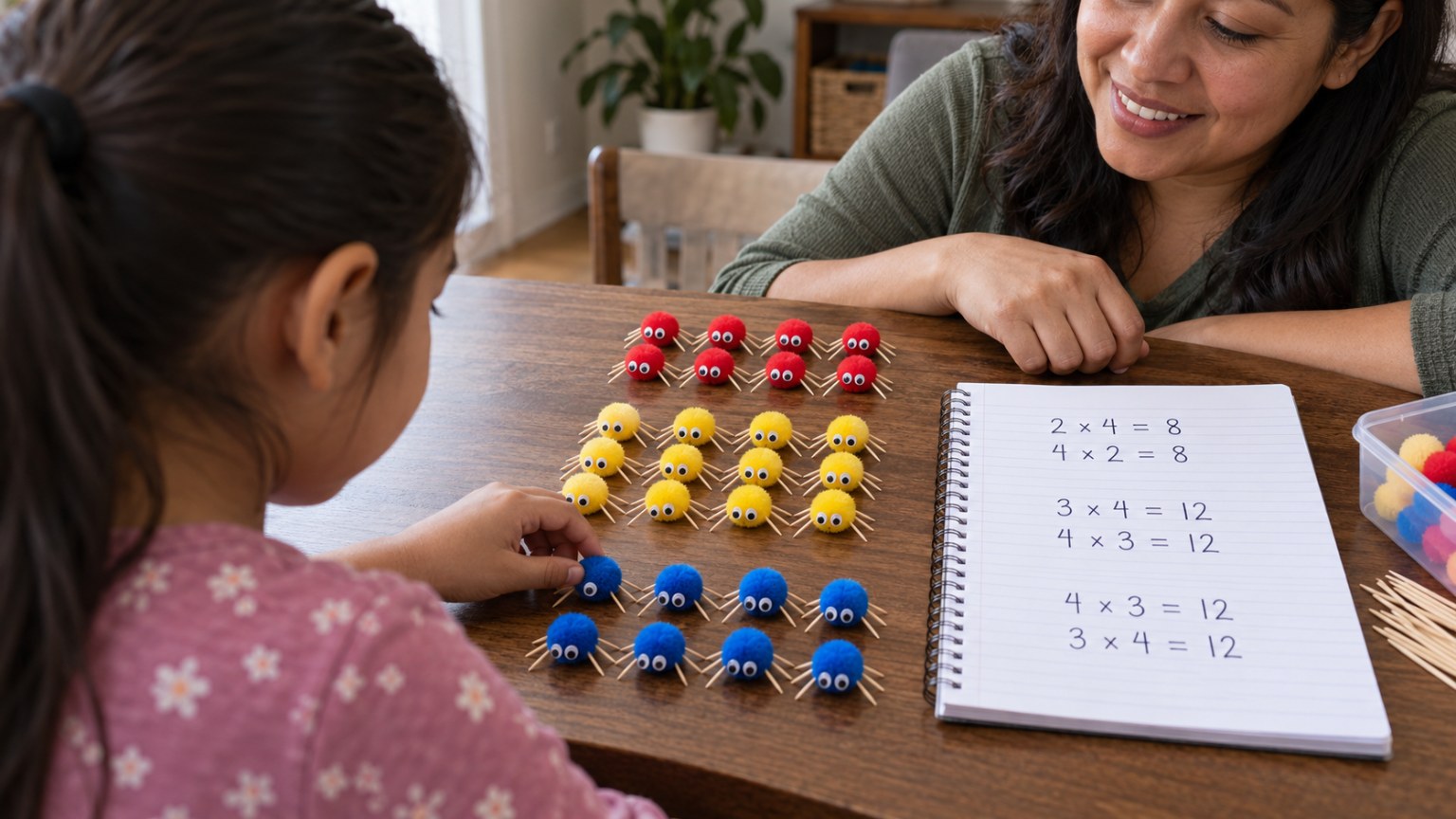
(8 min) Your child builds three 'insects' with 6 legs each and two 'spiders' with 8 legs each using the bodies and toothpicks. They write a multiplication sentence for each group, such as 3 × 6 = 18 and 2 × 8 = 16, and explain what each number means.
2Step 2
Draw leg arrays
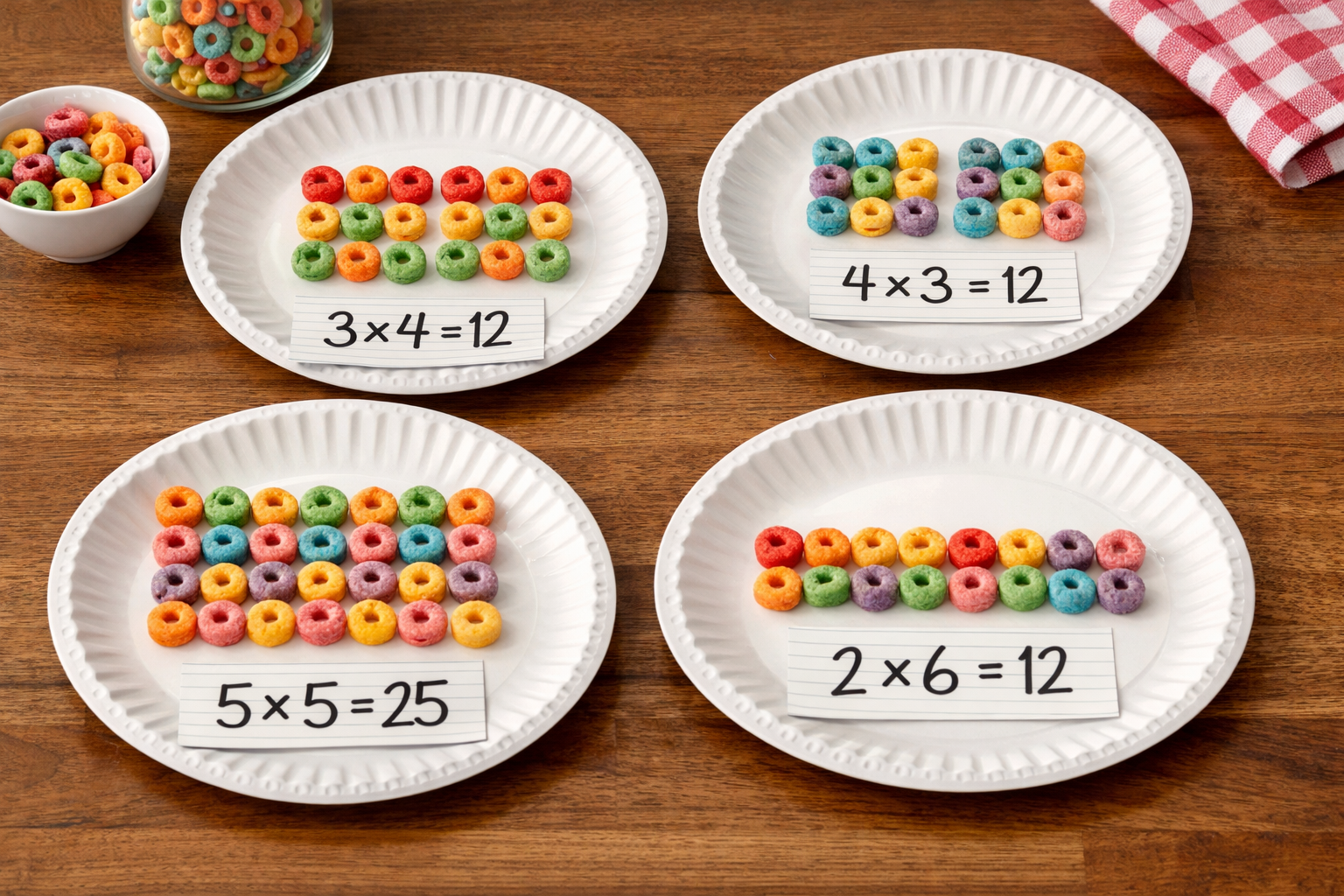
(8 min) Your child draws an array with one row of 6 legs for each insect, then compares 6 spiders (6 rows of 8) with 8 insects (8 rows of 6). Both make 48, which shows the commutative property.
3Step 3
Break apart a spider fact
(7 min) Show how to solve 7 × 8 by splitting each spider's 8 legs into 5 + 3: 7 × 5 = 35 and 7 × 3 = 21, then 35 + 21 = 56. Your child tries the same trick for 6 × 8 and 9 × 6.
4Step 4
Solve the problem cards
(12 min) Your child solves the bug problem cards, drawing a picture or array for each and writing an equation with a symbol for the unknown. Check with the answer key and talk through any mistakes.
5Step 5
Make your own problem
(4 min) Your child writes one new bug word problem for you to solve, mixing insects and spiders. Solve it together and check each other's work.
Conclusion
Ask: 'Which property helped most today and why?' Count real legs on the next bug you see (from a safe distance) and make up a multiplication problem about it.
Make your own lesson plan in minutes
Describe a topic and Resource Portal AI writes the objectives, materials and steps for your group.
Try Resource Portal AI