Twin-Bottle Tornado: Time the Vortex and Average the Trials
Overview
Build a bottle tornado and average decimal drain times.
Description
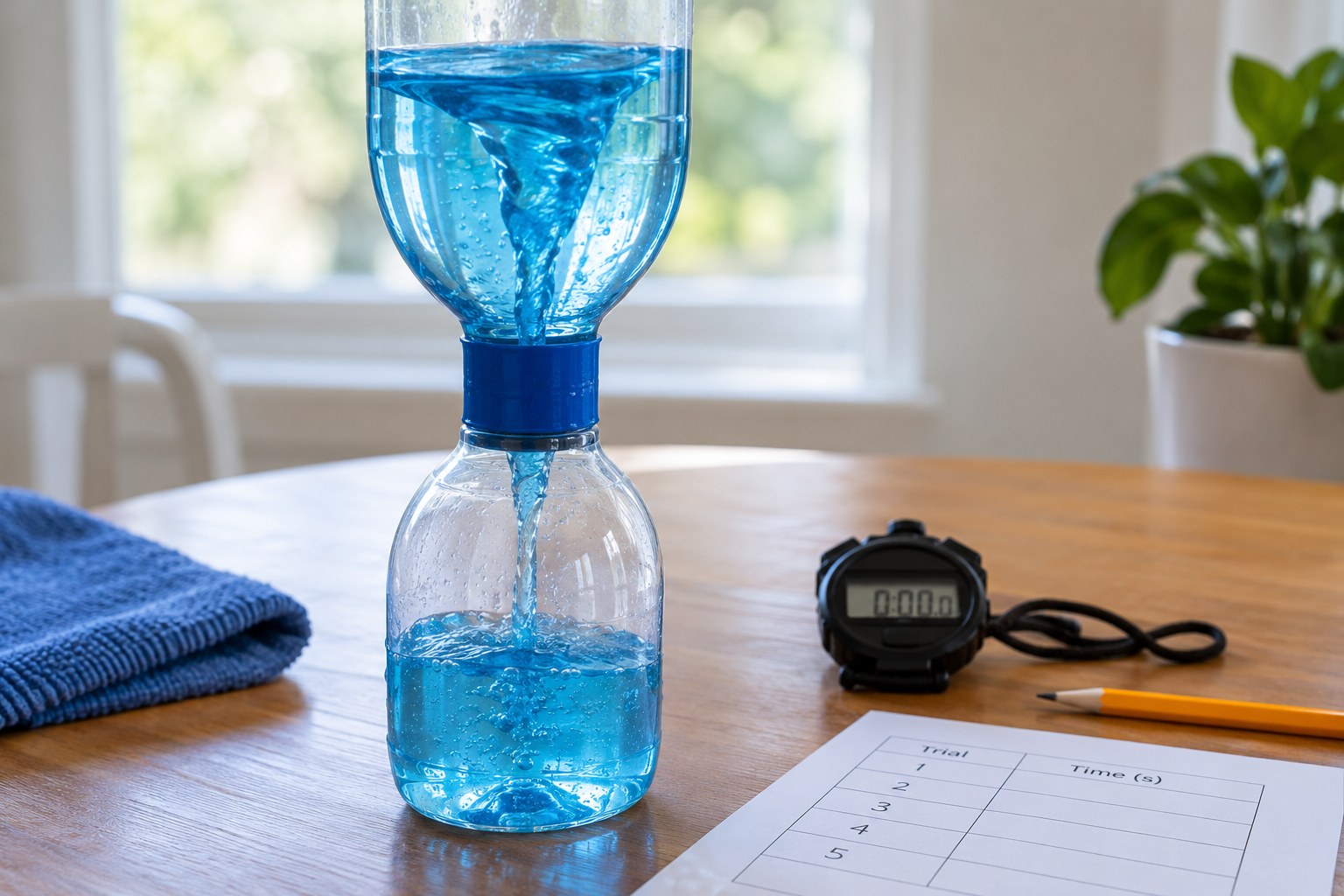
Your child builds a tornado in a bottle from two plastic bottles, times how long the water takes to drain with and without a spinning vortex, and averages three trials to the hundredths place to find out whether the tornado shape really drains faster.
Objective
Your child will build a working vortex model, record drain times in seconds to the hundredths, find the average of three trials by adding and dividing decimals, and use the averages to explain how a vortex moves water and air.
Standards
Materials
| Item | Quantity |
|---|---|
| Clear 2-liter plastic bottles with caps removed, labels peeled off | 2 |
| Tornado tube connector, or duct tape plus a metal washer | 1 |
| Water with a drop of food coloring and a pinch of glitter (optional) | about 1.5 liters |
| Phone stopwatch or kitchen timer that shows hundredths of a second | 1 |
| Paper, pencil and calculator for checking | 1 each |
| Towel or tray | 1 |
Vocabulary
Preparation
- Fill one bottle about two-thirds full with the colored water. Join the bottles neck to neck with the connector, or put the washer between the necks and wrap tightly with duct tape until it does not leak.
- Draw a data table with two rows (no swirl, swirl) and columns for Trial 1, Trial 2, Trial 3, Total and Average.
Introduction
Flip the bottles over without swirling and let your child watch the water glug slowly. Then ask: what if we made it spin like a tornado? Do you think it will be faster or slower?
Where have you seen a spinning vortex before (a bathtub drain, a dust devil, a whirlpool)?
Why would scientists repeat a test three times instead of just once?
Steps
Conclusion
Ask: was your prediction right? How did averaging help when the trials were not exactly the same? Explain why a vortex in the bottle is a model of a tornado but not a real one.
Make your own lesson plan in minutes
Describe a topic and Resource Portal AI writes the objectives, materials and steps for your group.
Try Resource Portal AI