Lesson planHay Bale Barn Loft: Stacking Bales to Find Volume
Math40 minutesGrades: 5th
Overview
Pack a box barn with cube bales, then plan a real hay barn.
Description
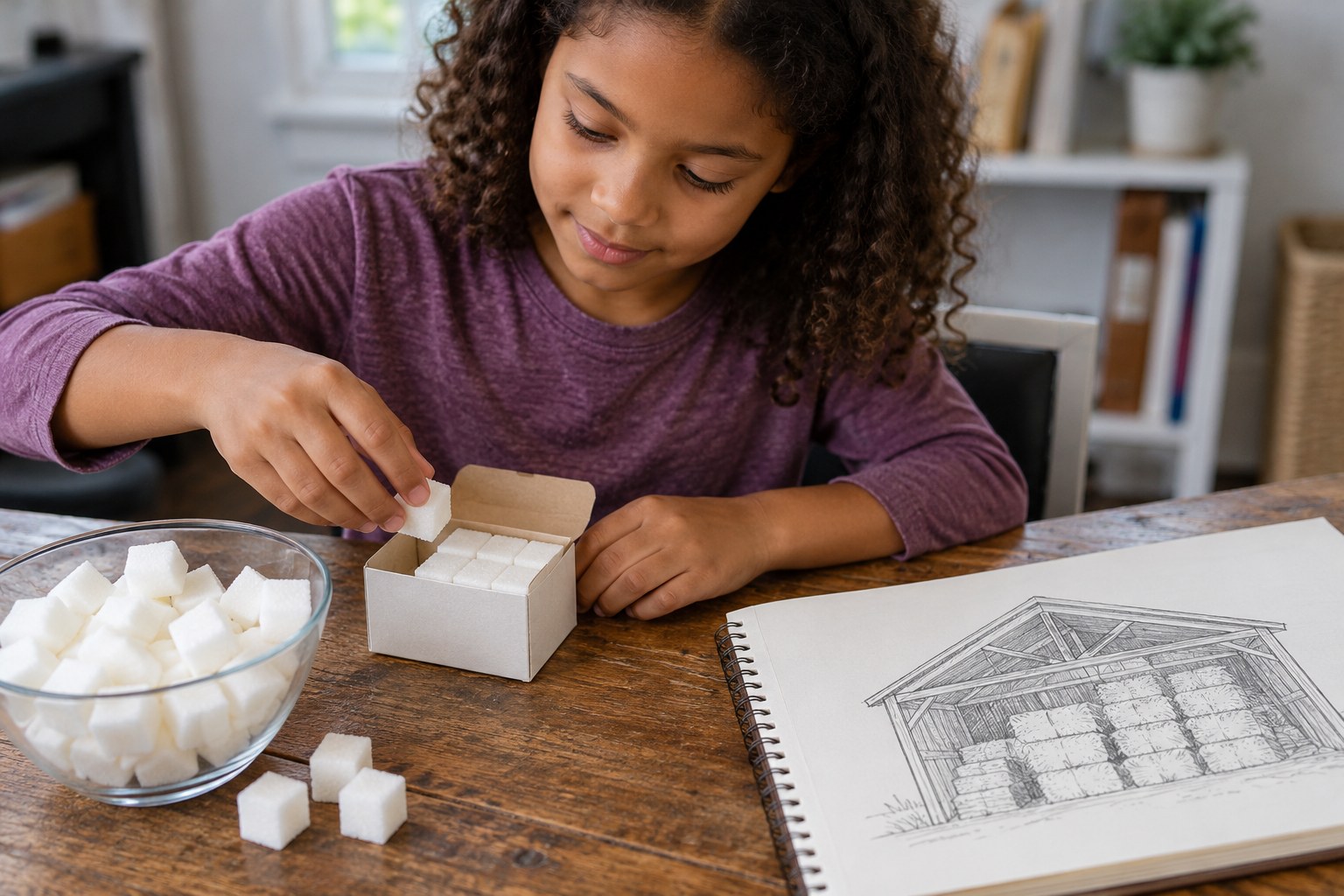
Your child models a hay barn by packing a small box with sugar cubes or same-size blocks as unit cubes, counts layers to find its volume, then uses V = l × w × h to plan how many giant 3-by-4-by-8-foot hay bales fit in a real Valley hay barn bay and how much space they fill.
Objective
Your child will measure volume by counting unit cubes in layers, connect the count to the formula V = l × w × h, and solve a real hay-storage problem with whole-number dimensions.
Standards
5.MD.3aMath · Grade 5 · Measurement & Data A cube with side length 1 unit, called a "unit cube," is said to have "one cubic unit" of volume, and can be used to measure volume.
5.MD.4Math · Grade 5 · Measurement & Data Measure volumes by counting unit cubes, using cubic cm, cubic in, cubic ft, and improvised units.
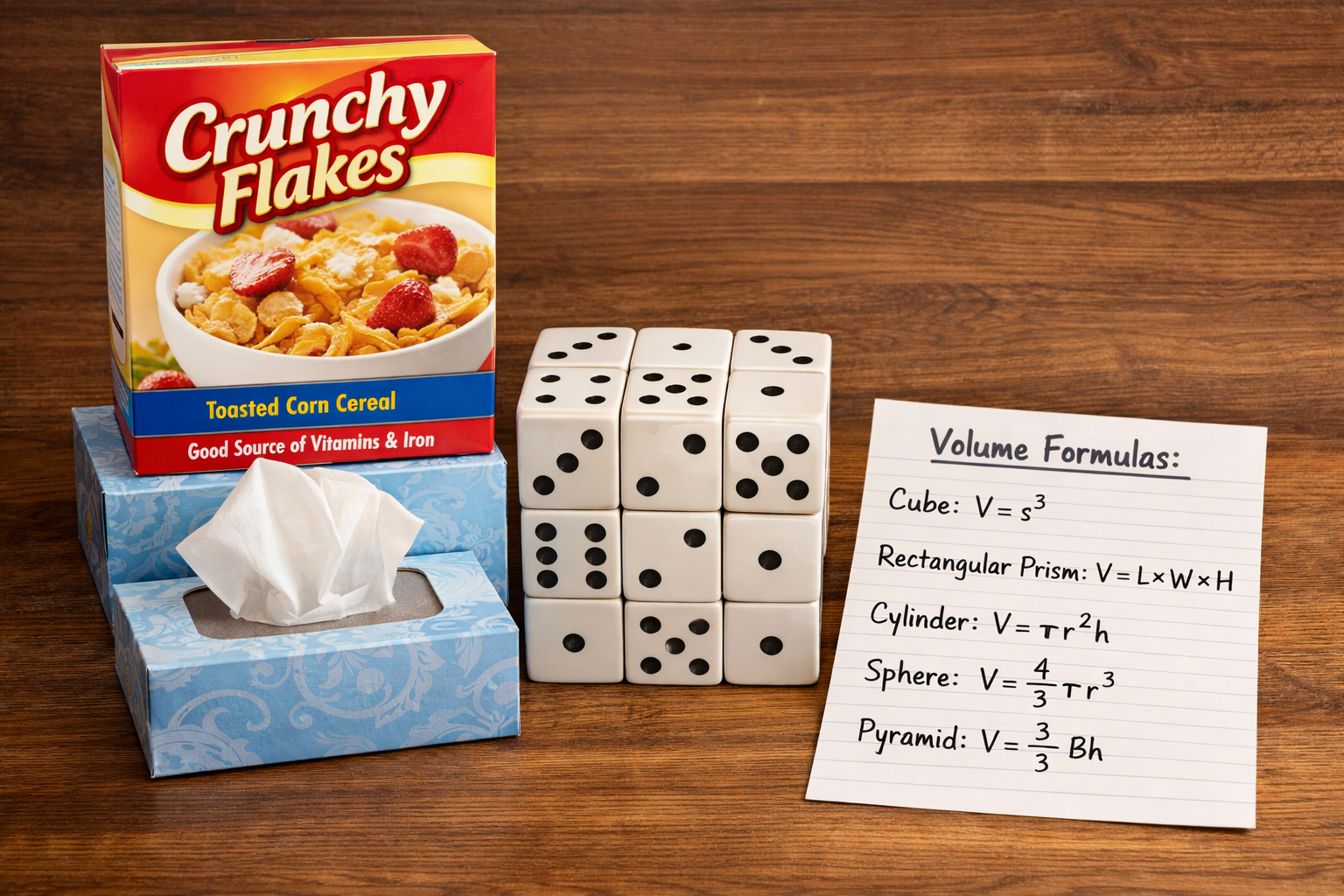
5.MD.5bMath · Grade 5 · Measurement & Data Apply the formulas V = l × w × h and V = b × h for rectangular prisms to find volumes of right rectangular prisms with whole-number edge lengths in the context of solving real world and mathematical problems.
Materials
| Item | Quantity |
|---|
| Small box (tea, jewelry or snack box) | 1 per child |
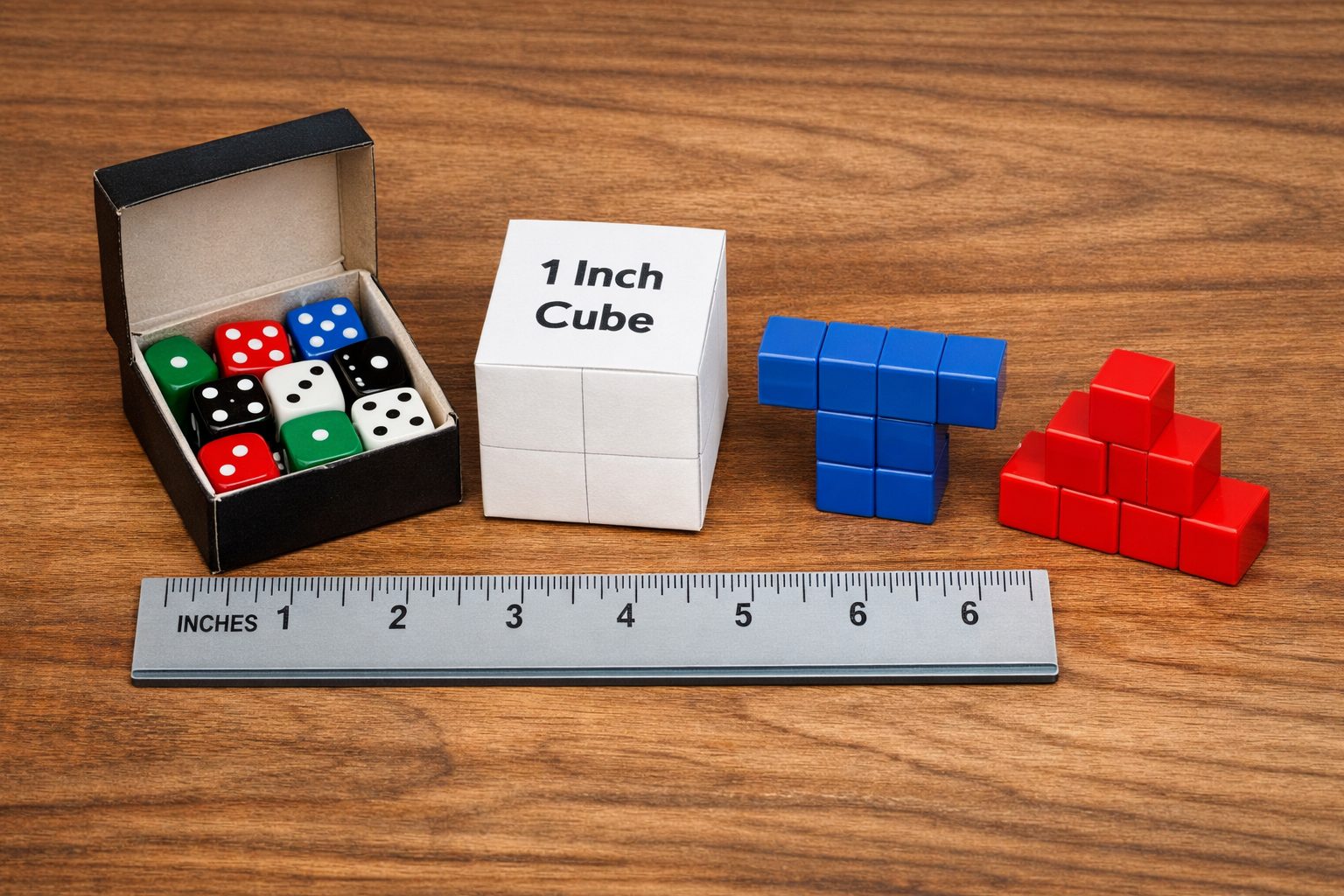
| Sugar cubes, dice or same-size cube blocks | about 60 |
| Ruler | 1 |
| Paper and pencil | 1 each |
| Calculator (for checking only) | 1 |
Vocabulary
Volume
The amount of space a 3-D object takes up, measured in cubic units.
Unit cube
A cube 1 unit long on every side; it has a volume of 1 cubic unit.
Cubic foot
The space of a cube 1 foot long, 1 foot wide and 1 foot tall.
Alfalfa
A leafy plant grown and dried as hay to feed dairy cows and other animals.
Preparation
- Find a box that cubes fit into neatly (or trim one). Count out cubes into a bowl.
- Copy the Barn Bay Problem card from Additional Sections onto paper.
Introduction
Show a photo of a huge stack of hay bales by a Valley dairy (or describe it) and say, 'A farmer has to know exactly how much hay will fit in the barn before harvest. Let's figure it out like a farm planner.'
Why might a farmer need to store hay instead of feeding fresh grass?
How could you find out how many cubes fill a box without counting every single one?
Steps
1Step 1
Bottom layer
(7 min) Your child fills only the bottom of the box with one layer of cubes and counts them. Record the length and width in cubes and the number in the layer, and notice that length × width gives the layer count.
2Step 2
Stack the layers
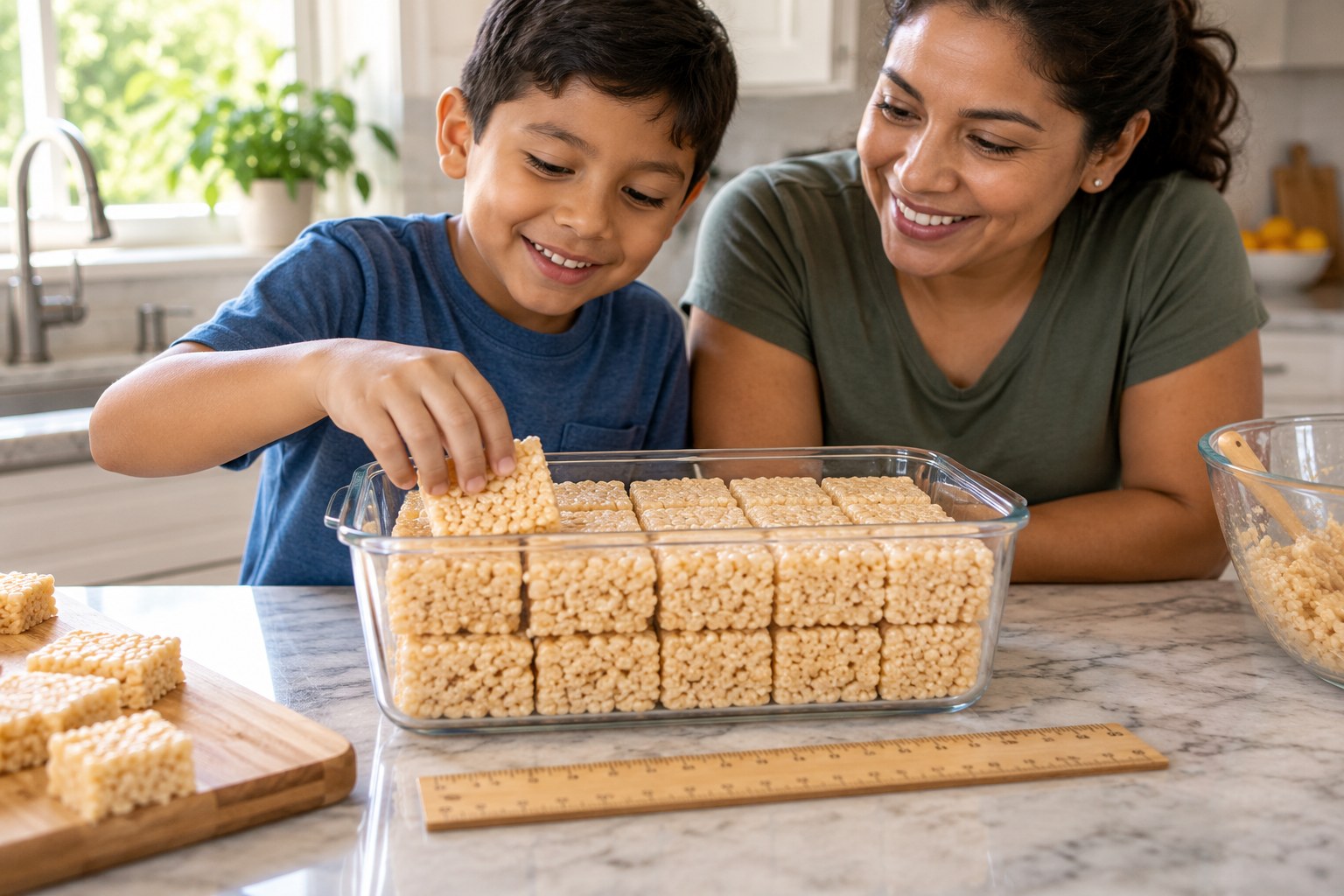
(8 min) Your child predicts how many layers will fill the box, then stacks layers to check and counts the total cubes. Write the volume as cubic units and match it to length × width × height.
3Step 3
Real bale size
(5 min) Explain that big square hay bales on Valley farms measure about 3 feet tall, 4 feet wide and 8 feet long. Your child finds the volume of one bale with the formula: 3 × 4 × 8 = 96 cubic feet.
4Step 4
Plan the barn bay
(12 min) Your child solves the Barn Bay Problem: a bay 24 feet long, 16 feet wide and 12 feet tall. They find how many bales fit along each side (24 ÷ 8, 16 ÷ 4, 12 ÷ 3), multiply for the total bales, and check that bales × 96 equals the bay's volume.
5Step 5
Turn the bales
(6 min) Challenge: if the bales are turned so the 8-foot side runs along the 16-foot wall, does the same number still fit? Your child sketches it and explains why or why not.
Conclusion
Your child used the same volume math a farm manager uses to plan storage. Hay grown in summer has to last dairy cows through winter, so planning space matters.
Make your own lesson plan in minutes
Describe a topic and Resource Portal AI writes the objectives, materials and steps for your group.
Try Resource Portal AI