Lesson planTurkey Timeline: Thaw and Roast Rates for Thanksgiving Dinner
Math40 minutesGrades: 6th, 7th
Overview
Use unit rates to plan when the turkey goes in the oven.
Description
Your teen uses real USDA turkey thawing and roasting guidelines to calculate unit rates, test whether thawing time and roasting time are proportional to weight, convert hours to days, and build a backward schedule so a 16-pound turkey is safely ready for a 4:00 PM Thanksgiving dinner.
Objective
Your teen will compute unit rates from guideline data, decide whether each relationship is proportional, convert between hours, minutes and days, and work backward from a deadline to build a cooking schedule.
Standards
6.RP.3bMath · Grade 6 · Ratios & Proportional Relationships Solve unit rate problems including those involving unit pricing and constant speed.
6.RP.3dMath · Grade 6 · Ratios & Proportional Relationships Use ratio reasoning to convert measurement units; manipulate and transform units appropriately when multiplying or dividing quantities.
7.RP.2aMath · Grade 7 · Ratios & Proportional Relationships Decide whether two quantities are in a proportional relationship, e.g., by testing for equivalent ratios in a table or graphing on a coordinate plane and observing whether the graph is a straight line through the origin.
Materials
| Item | Quantity |
|---|
| The USDA turkey timetable in the section below | 1 copy |
| Calculator | 1 |
| Graph paper and pencil | 2 sheets |
| Calendar for November (paper or phone) | 1 |
Vocabulary
Unit rate
A rate per one unit, such as hours per pound.
Proportional relationship
Two quantities whose ratio is always the same, so the graph is a straight line through the origin.
Backward planning
Starting from the deadline and subtracting each task's time to find the start time.
Internal temperature
The temperature at the thickest part of food; turkey is safe at 165 degrees F.
Preparation
- Copy the timetable and the 'Planning questions' section.
- If your family cooks something other than turkey (ham, tamales, a vegetarian roast), have the package or recipe handy so your teen can extend the plan to it.
Introduction
Ask: 'A frozen 16-pound turkey sitting in our freezer on Thanksgiving morning: can we eat it at 4:00 PM?' Let your teen guess before doing any math.
If a 4-pound turkey takes 1 day to thaw, how long would an 8-pound one take?
Do you think a turkey twice as heavy takes twice as long to roast?
Steps
1Step 1
Find thawing rates
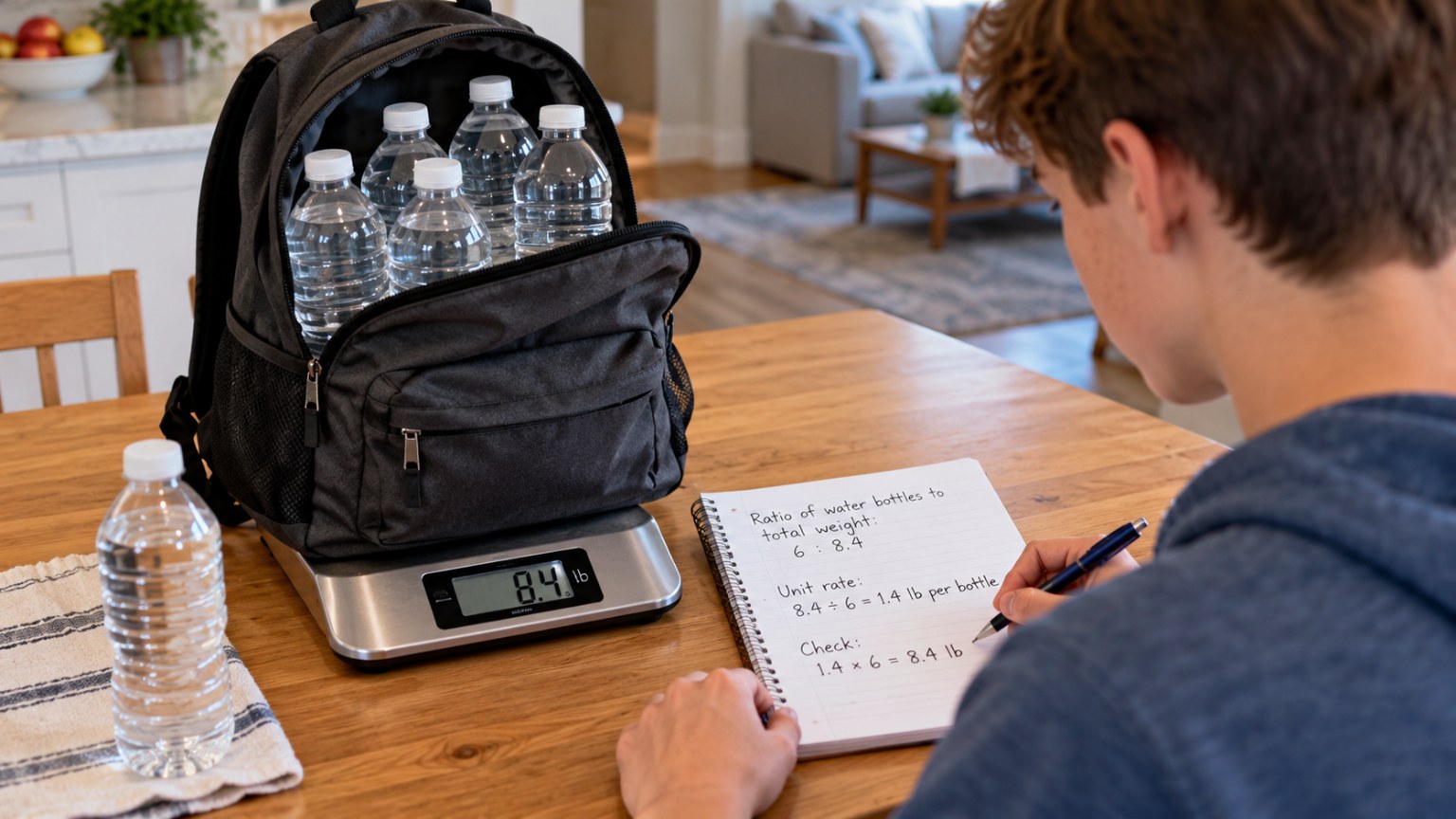
(8 min) Using the guideline of 24 hours of refrigerator thawing for every 4 to 5 pounds, your teen finds the unit rate in hours per pound for both 4 and 5 pounds. They calculate the thaw time for 12-, 16- and 20-pound turkeys and convert the results to days and hours.
2Step 2
Proportional or not?
(10 min) Your teen makes a table of weight and refrigerator thaw time and a second table of weight and roasting time (using the middle of each range), finding hours per pound for each row. They graph both and decide which relationship is proportional and which is not, explaining why using the unit rates.
3Step 3
Cold-water emergency
(6 min) The cold-water method takes about 30 minutes per pound with water changed every 30 minutes. Your teen finds how many hours a 16-pound turkey needs and whether it could thaw on Thanksgiving morning in time for dinner.
4Step 4
Build the schedule
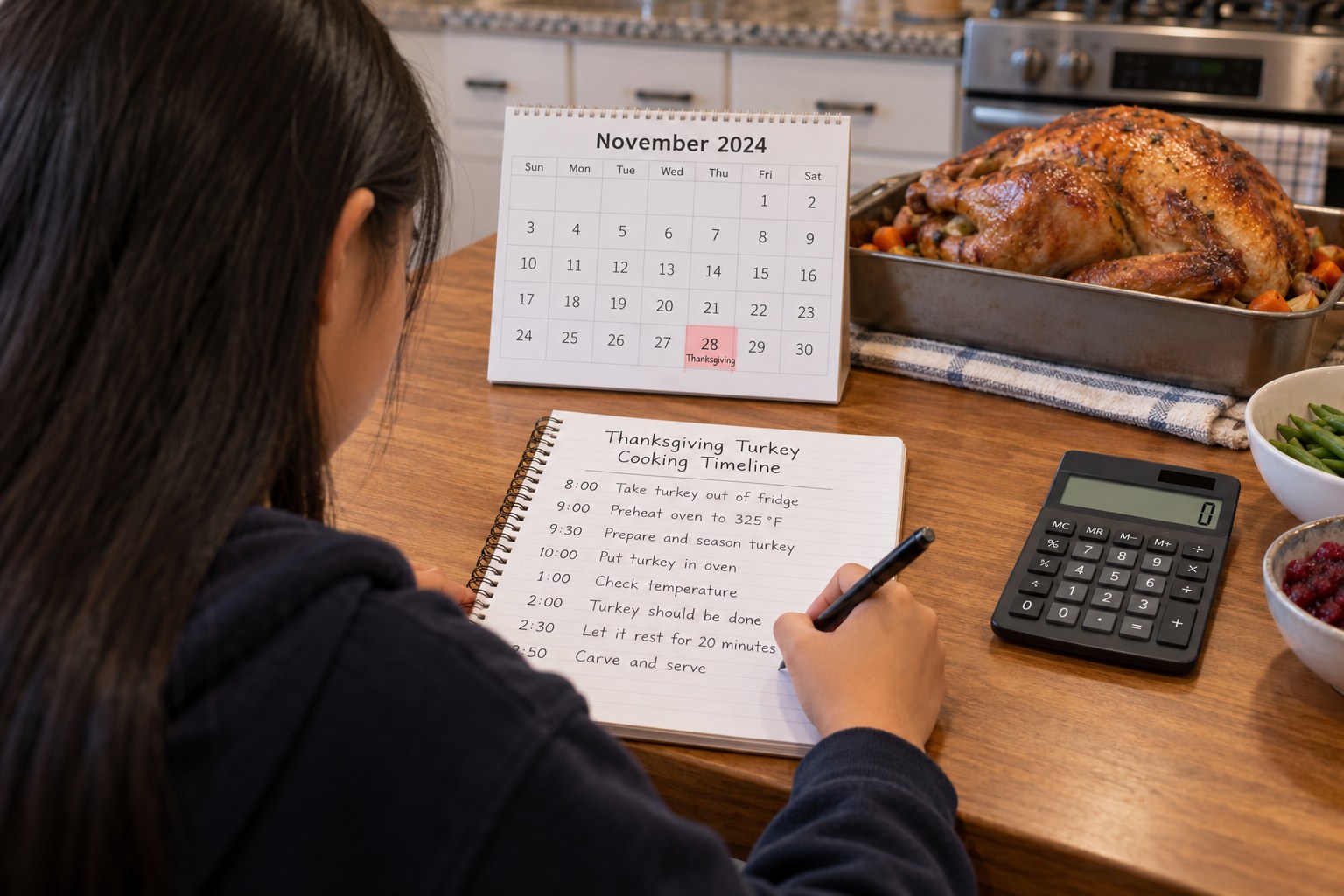
(12 min) Working backward from a 4:00 PM dinner, your teen subtracts 30 minutes for resting and carving, the longest roasting time for a 16-pound turkey, and 20 minutes to preheat. They mark on the calendar the day the turkey must move from freezer to fridge and write out the full timeline.
Conclusion
Ask your teen: 'Why does the guideline give a range, and why do cooks still use a thermometer?' Roasting time depends on more than weight (oven, shape, stuffing), which is why it isn't proportional and why 165 degrees F is the real test.
Make your own lesson plan in minutes
Describe a topic and Resource Portal AI writes the objectives, materials and steps for your group.
Try Resource Portal AI