Robot Wheel Math: Circumference Tells the Robot How Far to Go
Overview
Use C = πd to program how far a robot wheel drives.
Description
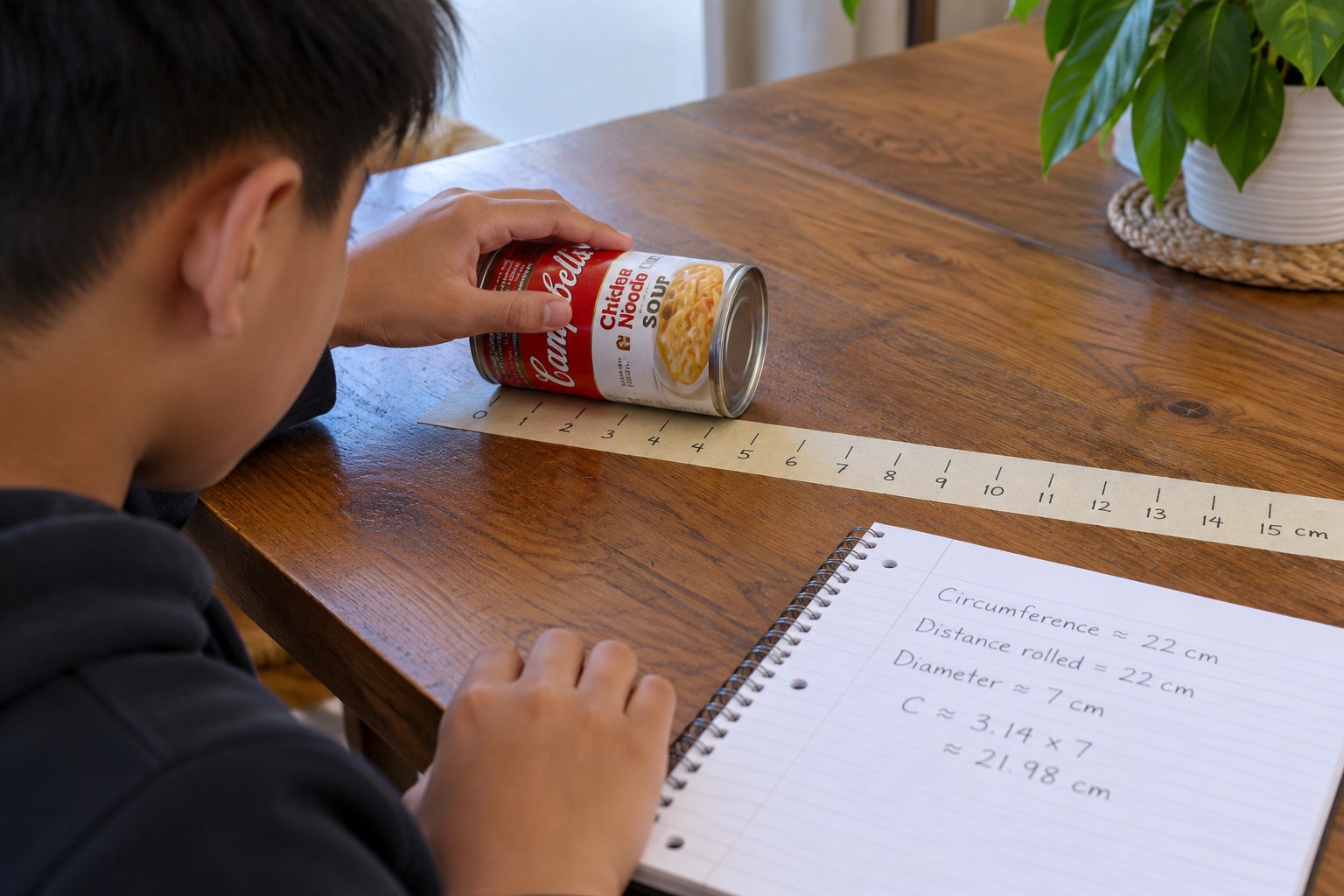
Your teen uses cans and lids as robot wheels, measures their diameters, calculates circumference with C = πd, and writes a 'motor program' giving the number of wheel rotations needed to drive a set distance. Then they roll the wheels along a tape track to test their predictions.
Objective
Your teen will use the circumference formula to find how far a wheel travels in one rotation, calculate rotations needed for a target distance, test by rolling, and explain sources of error.
Standards
Materials
| Item | Quantity |
|---|---|
| Cylinders to act as wheels: soup can, jar lid, roll of tape, oatmeal canister | 3-4 |
| Ruler or tape measure in centimeters | 1 |
| Masking tape and a marker | 1 roll |
| Calculator | 1 |
| Paper and pencil | 1 each |
| Smooth floor or table about 2 meters long | 1 |
Vocabulary
Preparation
- Lay a 2-meter strip of masking tape on the floor and mark 0, 50 cm, 100 cm, 150 cm and 200 cm.
- Put a small tape flag on the edge of each wheel so rotations are easy to count.
Introduction
Roll a can one full turn along the floor and mark where it stops. Ask: 'A robot only knows how many times its wheels turned. How can it figure out how far it went?'
Would a bigger wheel go farther in one turn? How much farther?
Why might a robot measure distance by counting wheel turns?
Steps
Conclusion
Ask: which wheel was most accurate, and why? Real robots use wheel encoders and this exact math, then correct errors using other sensors.
Make your own lesson plan in minutes
Describe a topic and Resource Portal AI writes the objectives, materials and steps for your group.
Try Resource Portal AI