Full lesson previewCastle Kitchen Pottage: Scaling a Medieval Stew with Ratio Tables
Cooking50 minutesGrades: 6th, 7th, 8th
Overview
Scale and cook a medieval pottage using ratio tables.
Description
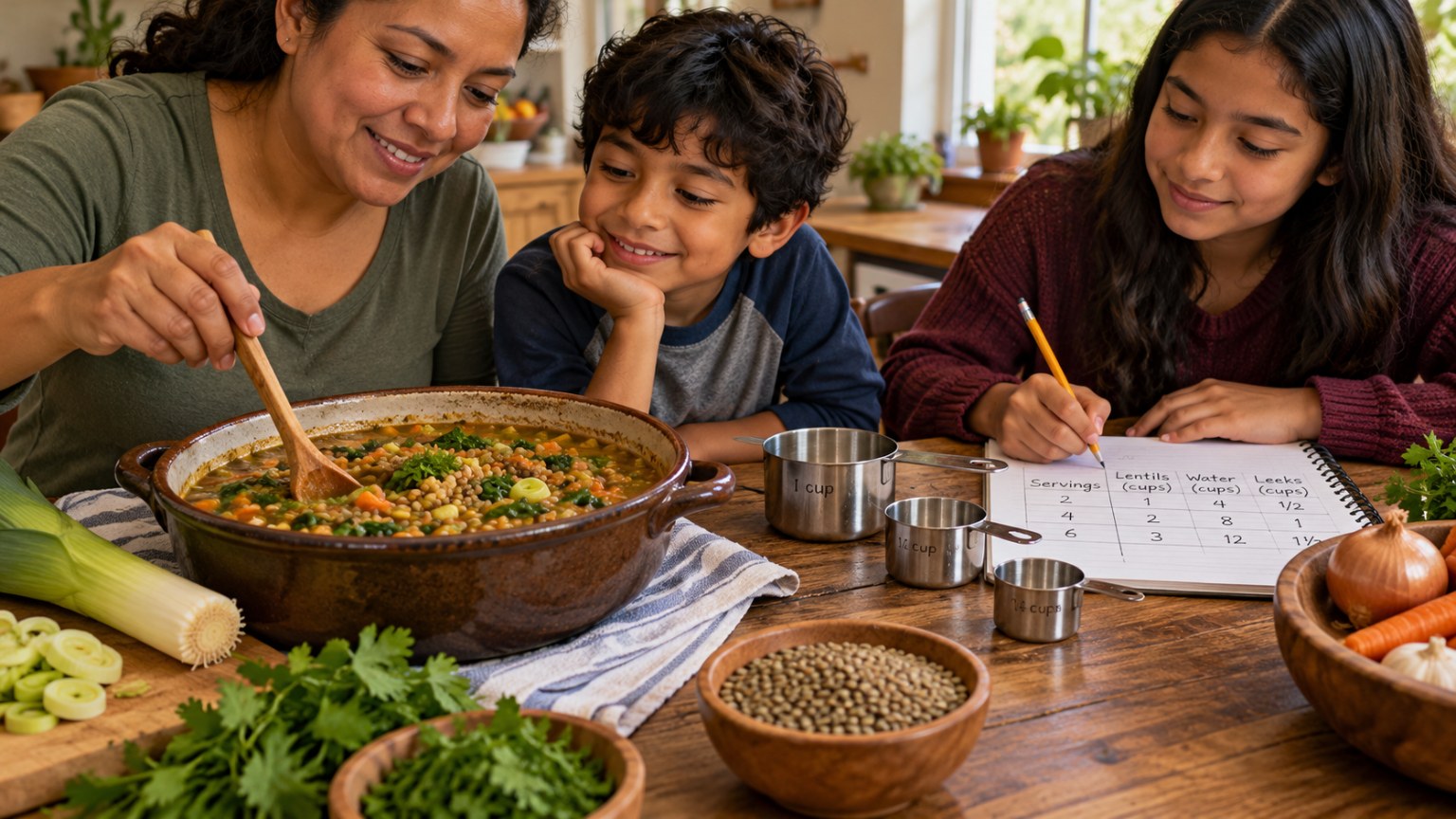
Your teen cooks pottage, the thick vegetable-and-grain stew that fed most people in medieval Europe, after scaling the recipe from 4 servings to 6 and 10 with a ratio table and converting cups to fluid ounces, tablespoons and milliliters to check whether the big batch fits the pot.
Objective
Your teen will make a ratio table to scale a recipe, use ratio reasoning to convert measurement units, and cook the pottage safely while explaining what medieval people did and did not eat.
Standards
6.RP.3aMath · Grade 6 · Ratios & Proportional Relationships Make tables of equivalent ratios relating quantities with whole number measurements, find missing values in the tables, and plot the pairs of values on the coordinate plane. Use tables to compare ratios.
6.RP.3dMath · Grade 6 · Ratios & Proportional Relationships Use ratio reasoning to convert measurement units; manipulate and transform units appropriately when multiplying or dividing quantities.
Materials
| Item | Quantity |
|---|
| Red lentils or yellow split peas, rinsed | 3/4 cup |
| Rolled oats | 1/2 cup |
| Leek (or a second onion) | 1 |
| Onion | 1 |
| Green cabbage, chopped | 2 cups |
| Water or vegetable broth | 5 cups |
| Butter or oil | 1 tablespoon |
| Salt | 1 teaspoon |
| Fresh parsley, chopped (or 2 teaspoons dried) | 2 tablespoons |
| Dried thyme | 1/2 teaspoon |
| Large pot, cutting board, sharp knife, measuring cups and spoons, wooden spoon | 1 each |
| Paper, pencil and calculator | 1 each |
Vocabulary
Pottage
A thick stew of vegetables, grains or beans cooked slowly in one pot; a daily food in medieval Europe.
Ratio table
A table of equivalent ratios showing how quantities grow together.
Scale factor
The number every ingredient amount is multiplied by to change the number of servings.
Worts
An old English word for garden vegetables and herbs used in pottage.
Preparation
- Check for allergies (oats may contain gluten unless labeled gluten-free; lentils and peas are legumes). Choose broth without allergens if needed.
- Rinse the lentils or split peas. Set out the equipment. An adult supervises all knife and stove work; teens who are new to knives can have an adult do the chopping.
Introduction
Ask your teen: what do you think most people ate every day 700 years ago, the ones working in the castle fields and kitchens, not the lords at the feast? Mostly a pot of stew called pottage, kept bubbling over the fire. Today your teen cooks one and has to make it big enough for a crowd.
Which ingredients in your kitchen did NOT exist in medieval Europe?
If a recipe serves 4, how would you make it serve 10 without guessing?
Steps
1Step 1
Castle kitchen history
(5 min) Read the About section together. Your teen sorts the pantry ingredients into "medieval" and "not medieval" piles (for example, potatoes, tomatoes, corn and chili peppers are not medieval in Europe).
2Step 2
Build the ratio table
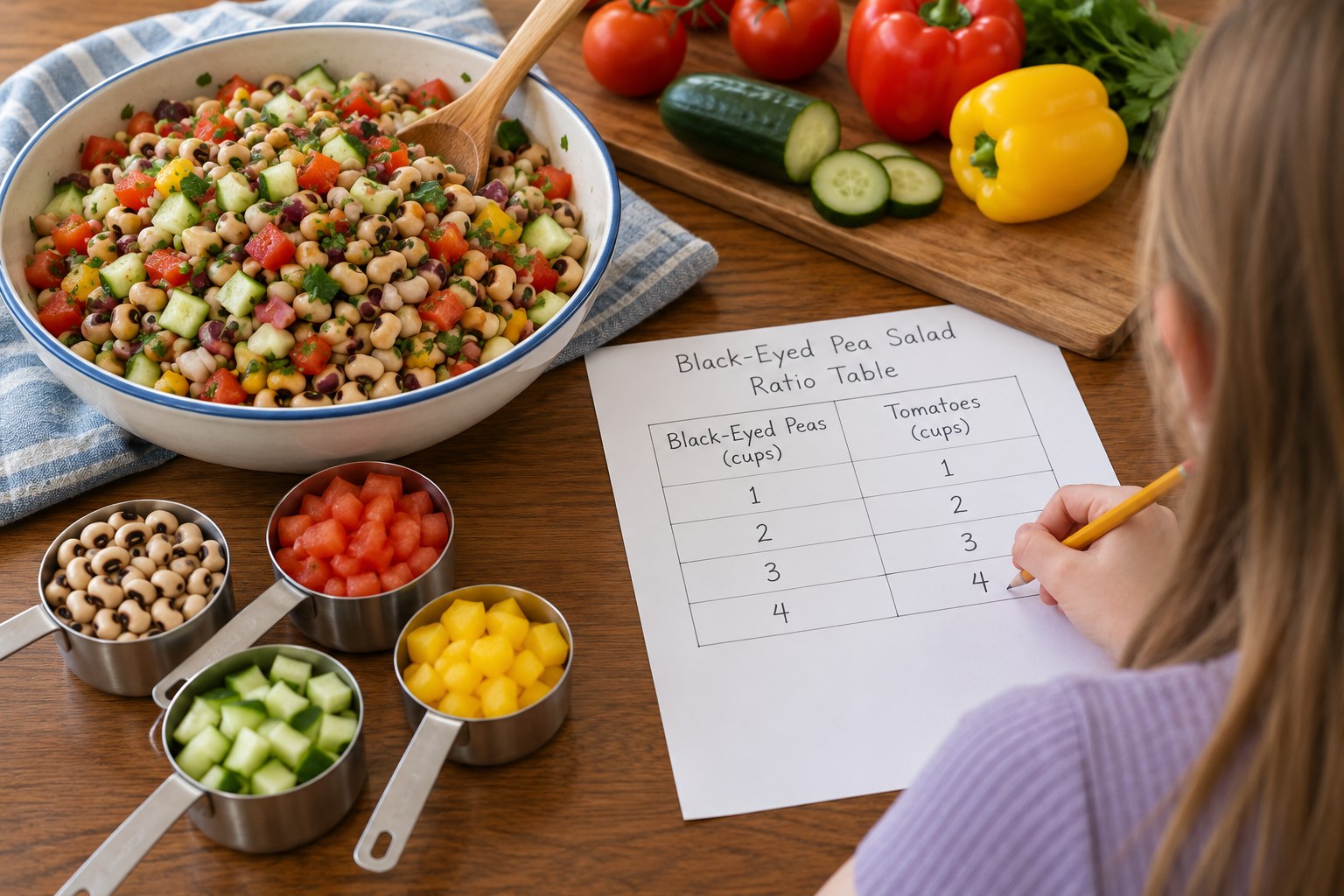
(10 min) Your teen makes a ratio table with columns for 4, 6 and 10 servings and finds the scale factors (1.5 and 2.5). They fill in every ingredient, writing fractions in simplest form, such as 3/4 cup lentils x 2.5 = 1 7/8 cups.
3Step 3
Convert the units
(7 min) Your teen converts the liquids using ratio reasoning: 1 cup = 8 fluid ounces = 16 tablespoons, about 237 milliliters, and 4 cups = 1 quart. They decide whether the 10-serving batch (12 1/2 cups of water plus vegetables) fits in your pot by checking its size in quarts.
4Step 4
Prep the worts
(10 min) With adult supervision, your teen slices the leek and onion and chops the cabbage, then measures the 4-serving amounts. They melt the butter in the pot over medium heat and soften the leek and onion for about 5 minutes, stirring.
5Step 5
Simmer the pottage
(16 min) Your teen adds the water, lentils, cabbage, oats, salt and thyme, brings it to a boil and lowers the heat to simmer for about 15 to 20 minutes, stirring now and then, until the lentils are soft and the stew is thick. While it simmers, they check two rows of their ratio table with you, then stir in the parsley and taste.
Conclusion
Serve the pottage and ask: how does it compare to the food you eat every day? If your family wanted 25 servings for a feast, what would the scale factor be? (6.25.)
Make your own lesson plan in minutes
Describe a topic and Resource Portal AI writes the objectives, materials and steps for your group.
Try Resource Portal AI