Lesson planBalloon-Powered Racer: Design, Race and Redesign
STEAM60 minutesGrades: 9th
Overview
Build, race and redesign a balloon car, then plot the results.
Description
Your teen builds a balloon-powered racer from a plastic bottle or cardboard, straws, skewers and bottle-cap wheels, then races it 5 times down a hallway or driveway and measures each distance. They change one variable, such as wheel size, weight or nozzle, race 5 more times, and compare the two designs with dot plots and box plots.
Objective
Your teen will apply Newton's third law in a working racer, run a one-variable redesign, and represent the results with dot plots and box plots on a number line.
Standards
S-ID.1Math · Grade HS · High School: Statistics & Probability — Interpreting Categorical & Quantitative Data Represent data with plots on the real number line (dot plots, histograms, and box plots).
Materials
| Item | Quantity |
|---|
| Small plastic bottle or rectangle of stiff cardboard (car body) | 1 |
| Drinking straws | 3 |
| Wooden skewers | 2 |
| Bottle caps for wheels | 4 |
| Balloons | 3 |
| Masking tape | 1 roll |
| Rubber band | 1 |
| Tape measure | 1 |
| Sheet of graph paper | 1 |
| Notebook and pencil | 1 each |
Vocabulary
Newton's third law
For every action force there is an equal and opposite reaction force: air pushed backward out of the balloon pushes the car forward.
Independent variable
The one thing you change on purpose in a test, such as wheel size.
Box plot
A graph showing the minimum, first quartile, median, third quartile and maximum of a data set.
Friction
A force that resists motion between surfaces, including the axles rubbing inside the straws.
Preparation
- Help your teen poke holes in the 4 bottle caps with a skewer or nail (an adult should do any poking with a sharp tool).
- Find a smooth hallway or driveway at least 4 meters long and mark a start line with masking tape.
Introduction
Ask your teen: rockets in space have nothing to push against. So how does pushing air out the back move anything forward?
Which do you think matters most: less weight, bigger wheels, or a narrower nozzle?
Why change only one thing between versions?
Steps
1Step 1
Build version 1
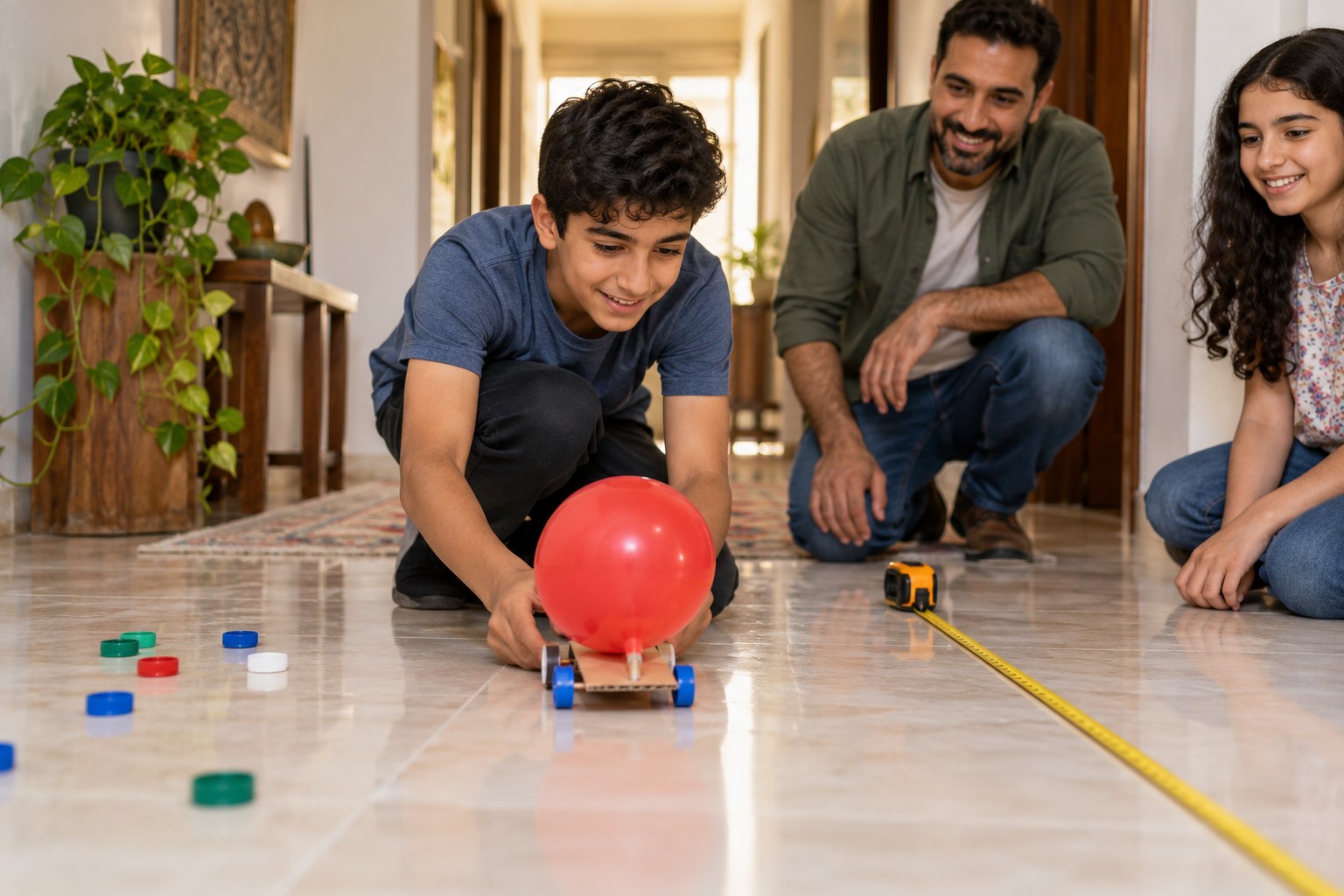
(15 min) Your teen tapes 2 of the drinking straws across the car body as axle housings, slides a wooden skewer through each and pushes a bottle cap onto each end. They tape the third straw into the neck of a balloon with the rubber band and masking tape so it seals, then tape the balloon to the top of the body with the straw pointing out the back.
2Step 2
Race version 1 five times
(10 min) Your teen blows up the balloon to the same size each time (measured by eye against a mark on the wall), sets the car at the start line and lets go. They record 5 distances with the tape measure in the notebook.
3Step 3
Change one variable
(12 min) Your teen picks one independent variable to change, such as swapping in larger cardboard wheels, removing extra tape to reduce weight, or narrowing the nozzle, and writes a prediction in the notebook. They rebuild and race 5 more times, using a fresh balloon if the first one stretches out.
4Step 4
Plot both designs
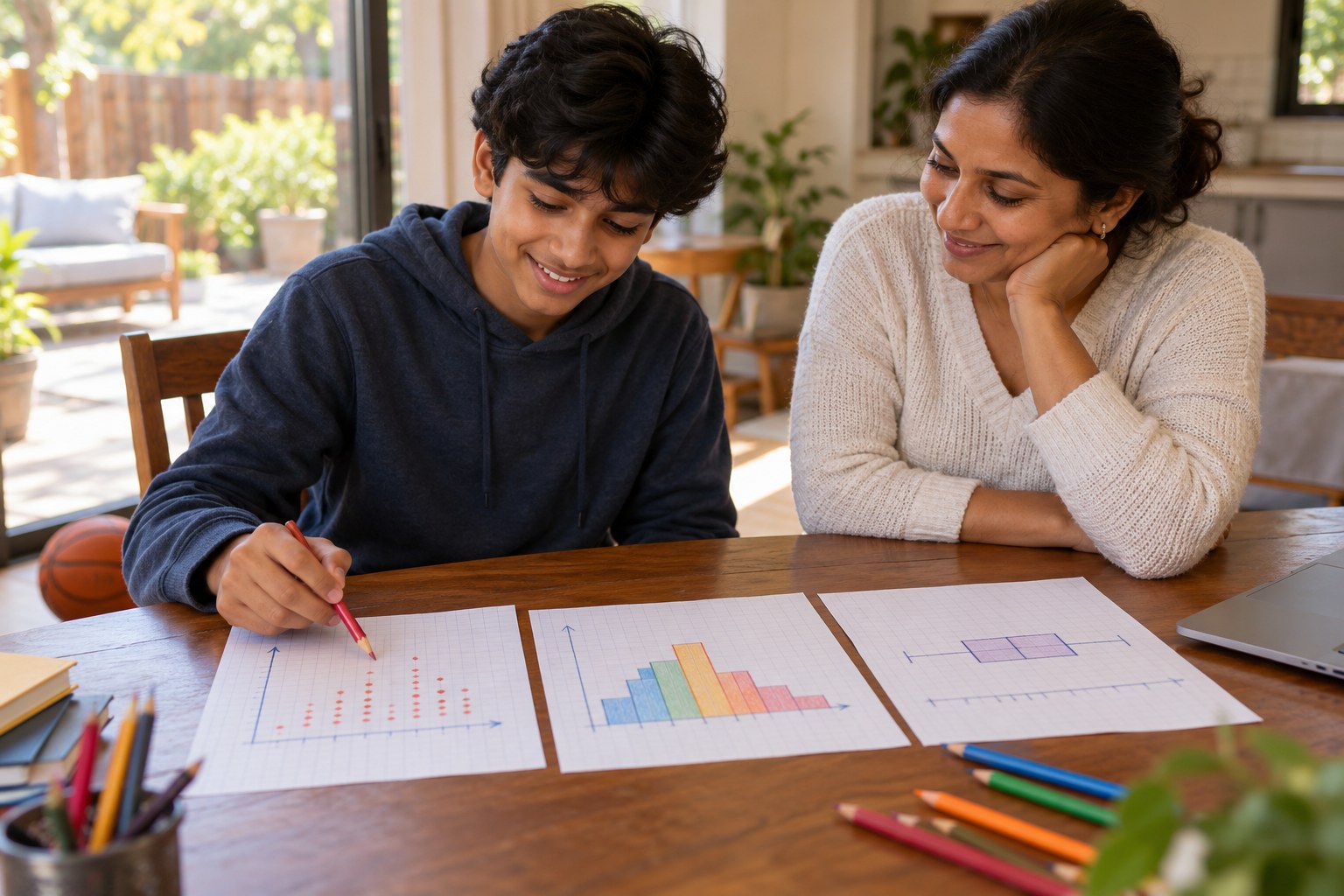
(15 min) On the graph paper your teen draws dot plots of both designs on the same number line, then finds each five-number summary and draws two box plots. They work the sample-data problems in Additional Sections and check them with the answer key.
5Step 5
Explain the result
(8 min) Your teen writes three sentences in the notebook explaining whether the change helped, using the medians and spread, and how Newton's third law and friction explain it. They name the next variable they would test.
Conclusion
Ask your teen: 'Did your redesign do what you predicted?' Engineers often learn the most from a change that did not help.
Make your own lesson plan in minutes
Describe a topic and Resource Portal AI writes the objectives, materials and steps for your group.
Try Resource Portal AI