Free lesson planGarage Target Kicks: A Stats-Backed Column with a Counterclaim
Sports45 minutesGrades: 8th
Overview
Kick at taped targets, then argue it in a column.
Description
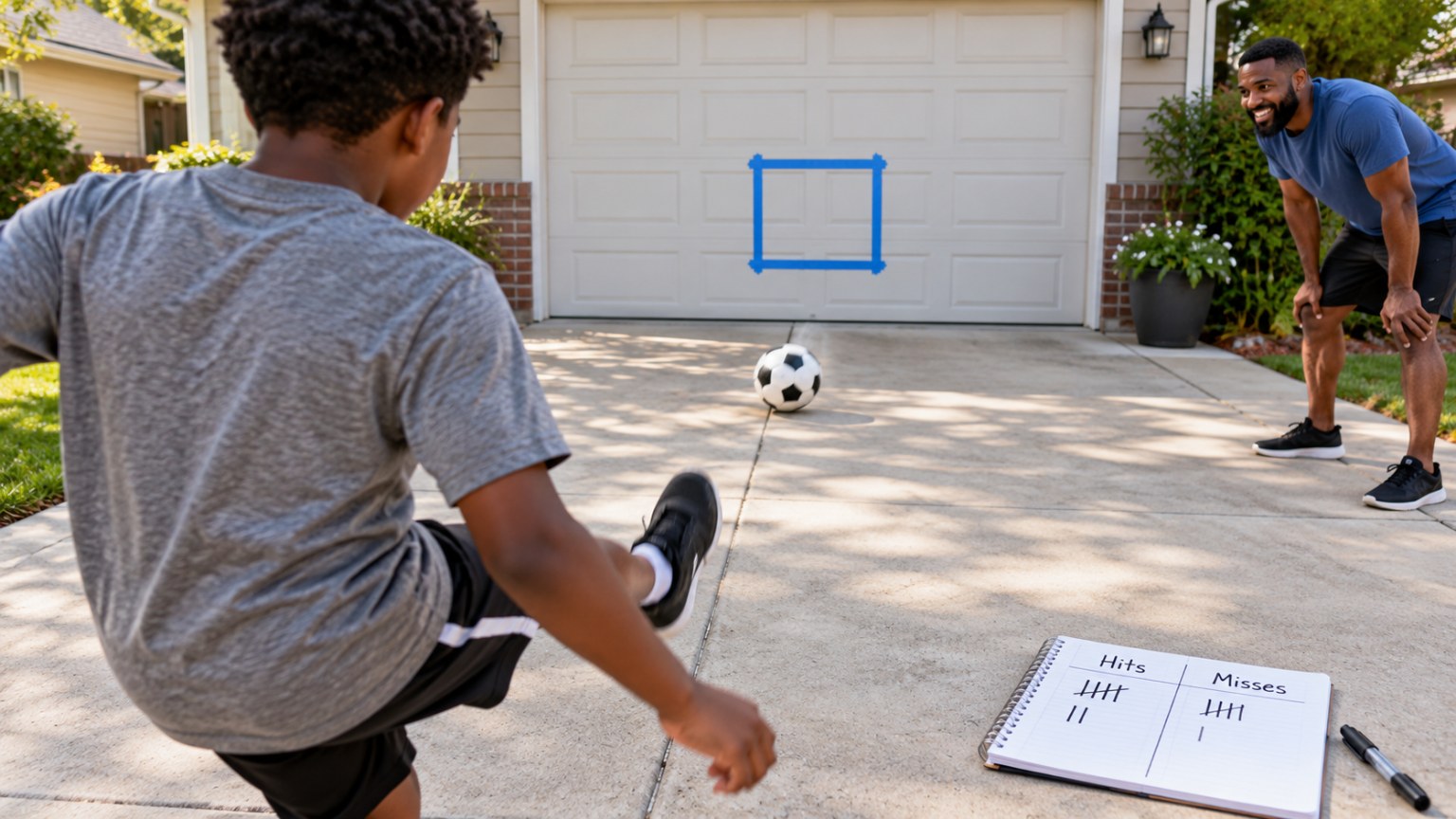
Your teen tapes two target squares on a garage door or fence, takes 10 kicks with the inside of the foot and 10 with the laces (and gets a family member to do the same), calculates hit percentages and writes a sports column arguing which technique a young player should practice, using transitions to connect claim, counterclaim and evidence and ending with a strong conclusion.
Objective
Your teen will collect and calculate accuracy data, then write an argument that uses words, phrases and clauses to show how claims, counterclaims, reasons and evidence connect, and end with a concluding section that follows from the argument.
Standards
Use words, phrases, and clauses to create cohesion and clarify the relationships among claim(s), counterclaims, reasons, and evidence.
Provide a concluding statement or section that follows from and supports the argument presented.
Materials
| Item | Quantity |
|---|
| Soccer ball or playground ball | 1 |
| Painter's tape | 1 roll |
| Tape measure | 1 |
| Notebook paper | 2 sheets per teen |
| Pen or pencil | 1 per teen |
| Calculator or phone calculator | 1 |
Vocabulary
Instep drive
A kick struck with the laces part of the shoe, used for power and distance.
Push pass
A kick struck with the inside of the foot, used for short, accurate passes and shots.
Accuracy rate
The percent of attempts that hit the target: hits divided by attempts, times 100.
Counterclaim
An opposing argument that a writer states fairly and then answers.
Preparation
- Find a garage door, fence or outside wall where a ball can be kicked safely, away from windows, cars and the street.
- Read the transition bank and sample column in Additional Sections.
Introduction
Ask your teen: if a coach could teach a 10-year-old only one kick this season, should it be the powerful laces shot or the accurate inside-foot pass?
Is power or accuracy more important for winning games at a young age?
How could data from our driveway help answer that?
Steps
1Step 1
Set up the targets
(5 min) Your teen uses the painter's tape to mark two 2-foot squares in the lower left and lower right corners of the garage door or fence, then measures a kicking line 20 feet away with the tape measure and marks it with tape. They draw a tally chart on the first sheet of notebook paper with columns for Kicker, Technique, Hits and Attempts.
2Step 2
Kick and record
(12 min) Your teen takes 10 push-pass kicks with the soccer ball from the tape line, alternating corners, then 10 instep kicks, while you tally hits on the notebook sheet. A family member then does the same 20 kicks, and your teen tallies; if no one else is available, your teen does a second round of 20.
3Step 3
Run the numbers
(5 min) Your teen uses the calculator to find the accuracy rate for each kicker and technique (hits divided by attempts, times 100) and a combined rate for each technique. They circle the biggest difference on the notebook sheet and write one sentence about what it shows.
4Step 4
Draft the column
(15 min) On the second sheet of notebook paper, your teen writes a 4-paragraph sports column: a claim about which kick young players should practice first, a paragraph of evidence from the data, a paragraph that states the counterclaim fairly and answers it, and a conclusion. They must use at least 4 transitions from the transition bank in Additional Sections and underline each one.
5Step 5
Strengthen the ending
(5 min) Your teen reads only the conclusion aloud and checks it against the 3-part conclusion test in Additional Sections. If any part is missing, they revise the conclusion before reading the whole column to the family.
Conclusion
Ask your teen whether the data surprised them, and what they would need to test to convince a real coach.
Make your own lesson plan in minutes
Describe a topic and Resource Portal AI writes the objectives, materials and steps for your group.
Try Resource Portal AI