Little Paleontologist Dinosaur Fossil Dig
Overview
Dig up dinosaur "bones" with a brush, just like a paleontologist.
Description
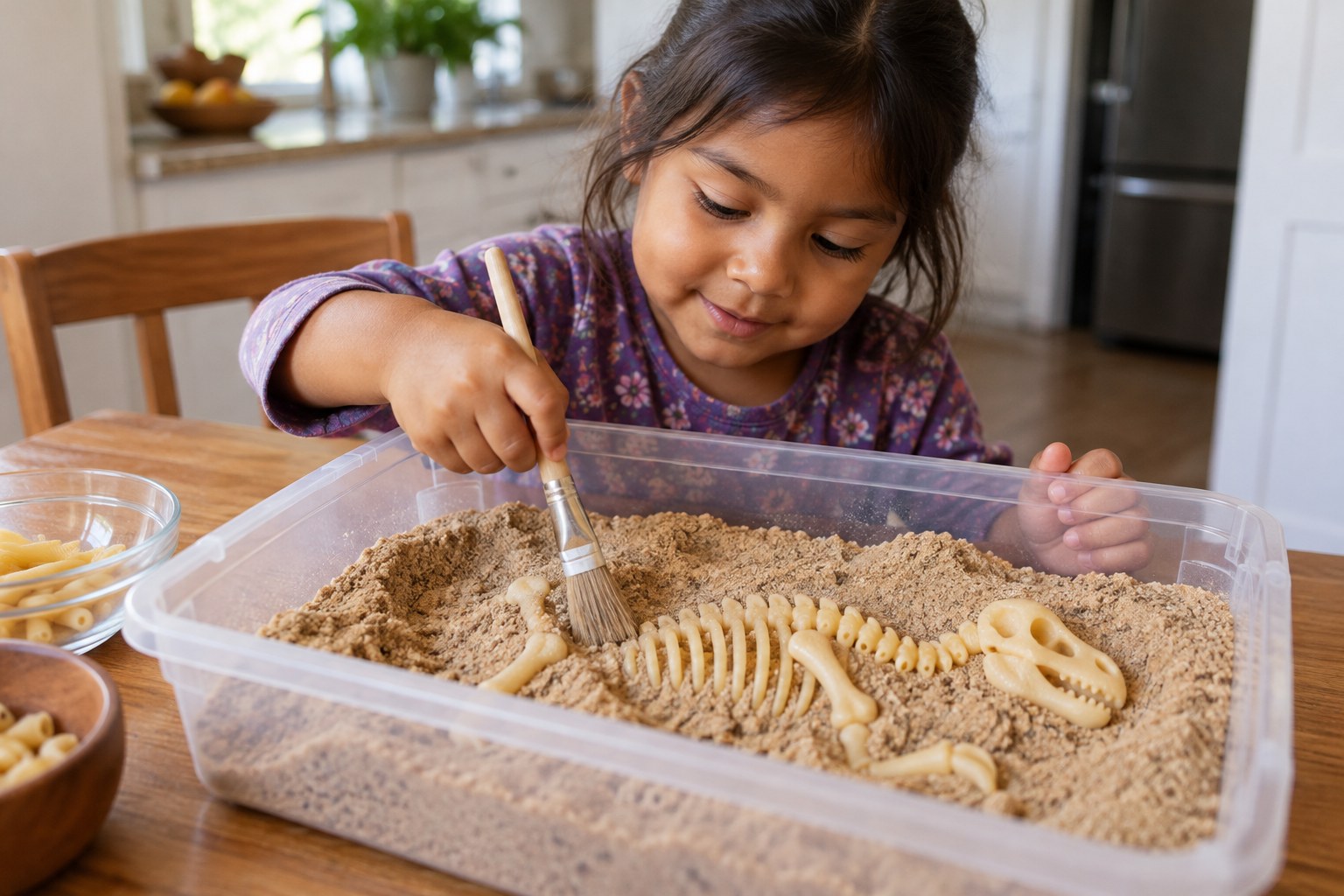
Your child becomes a paleontologist, gently uncovering hidden "dinosaur bones" (dry pasta or cardboard bones) in a bin of sand, rice or dirt with a paintbrush and spoon, then lays the bones out to see what they found.
Objective
Your child will use gentle tools to uncover hidden objects, describe what they found using words like big, small, long and curved, and say that fossils tell us about dinosaurs.
Materials
| Item | Quantity |
|---|---|
| Shallow bin, baking dish or cardboard box lid | 1 per 1-2 children |
| Play sand, dry rice, dry oats or garden soil | enough to fill the bin about 3 inches deep |
| Large dry pasta shapes (rigatoni, shells, lasagna pieces) or bone shapes cut from cardboard | 10-15 pieces per bin |
| Clean paintbrushes or pastry brushes | 1 per child |
| Spoons or small plastic scoops | 1 per child |
| Towel or old sheet under the bin | 1 |
Vocabulary
Preparation
- Spread the towel or sheet on the floor or table and set the bin on top.
- Bury the pasta or cardboard "bones" in the sand, rice or soil, leaving one or two just peeking out.
- If using pasta, choose large shapes and stay close by, since small pieces are not for mouths.
Introduction
Whisper: "I heard there are dinosaur bones hiding in this box. Real dinosaur hunters dig very slowly so they do not break anything. Can you be that careful?"
What do you think a dinosaur bone looks like?
Why should we dig slowly and gently?
Steps
Conclusion
Ask: what did a paleontologist do today? Remind your child that real dinosaur bones are found in rock and that museums show them so everyone can learn.
Make your own lesson plan in minutes
Describe a topic and Resource Portal AI writes the objectives, materials and steps for your group.
Try Resource Portal AI