Liberty Bell Sound Lab: Why Does a Crack Change the Ring?
Overview
Tap kitchen bells and discover why the Liberty Bell sounds different.
Description
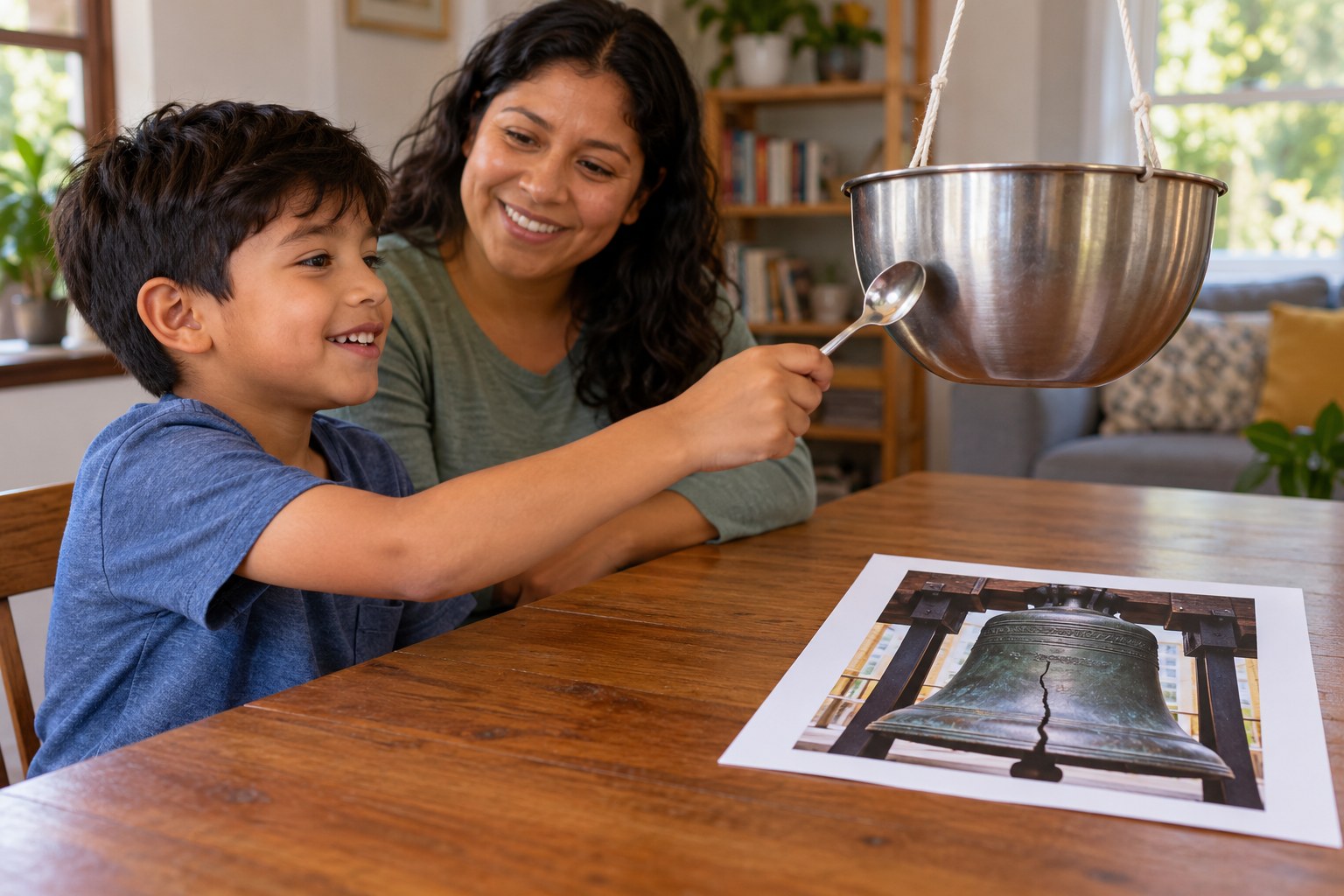
Your child learns about the famous cracked Liberty Bell, then taps pots, glasses and metal bowls to feel vibrations, and tests how holding, filling or 'cracking' (with a strip of tape or a rubber band) changes the ring.
Objective
Your child will show that vibrating materials make sound, and explain that touching, filling or damaging a bell changes how long and how clearly it rings.
Materials
| Item | Quantity |
|---|---|
| Metal mixing bowls, pots or pot lids of different sizes | 3 |
| Metal spoon and wooden spoon | 1 each |
| Glass jars or drinking glasses (adult supervises) | 2 |
| Water | about 2 cups |
| Masking tape or a thick rubber band | 1 |
| String about 2 feet long | 1 piece |
Vocabulary
Preparation
- Clear a table and set out the bowls, jars and spoons. Place glass jars on a towel so they can't roll.
- Look up a photo of the Liberty Bell to show your child, or describe it using the background section.
Introduction
Hold up a metal pot by its handle and tap it with a metal spoon. Let it ring. Then tap it again and grab it with your hand. Ask: where did the sound go?
What do you feel when you touch a bell right after it rings?
Why would a crack change the way a bell sounds?
Steps
Conclusion
Ask: what makes a sound? (Something vibrating.) What did the 'crack' do to the ring? Listen for church bells, wind chimes or school bells this week.
Make your own lesson plan in minutes
Describe a topic and Resource Portal AI writes the objectives, materials and steps for your group.
Try Resource Portal AI