Full lesson previewSummer Evening Soundscape: Layer Sounds and Present a Listening Map
Music45 minutesGrades: 6th, 7th, 8th
Overview
Compose a summer-night soundscape and present it with a listening map.
Description
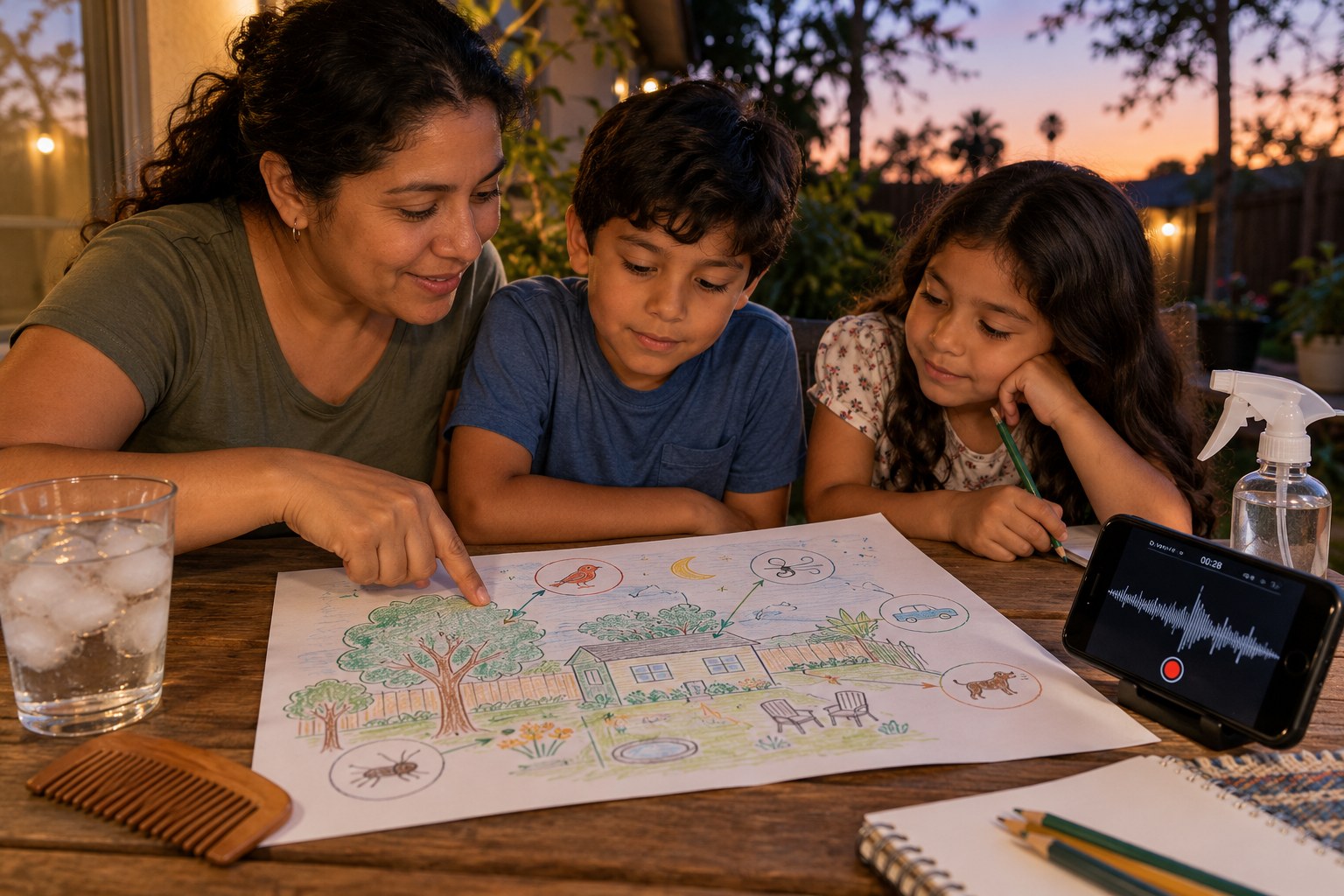
Your teen listens to a summer evening, recreates its sounds with household objects (sprinkler hiss, ice clinking, cricket chirps), composes a 60-second layered soundscape, and presents it with a visual listening map that shows when each sound enters.
Objective
Your teen will compose a layered soundscape and present it with a visual display and recording that clarify how the piece is built.
Standards
SL.6.5ELA · Grade 6 · Speaking & Listening Include multimedia components (e.g., graphics, images, music, sound) and visual displays in presentations to clarify information.
SL.7.5ELA · Grade 7 · Speaking & Listening Include multimedia components and visual displays in presentations to clarify claims and findings and emphasize salient points.
Materials
| Item | Quantity |
|---|
| Household sound makers: glass with ice, spray bottle, comb, paper bag, rice in a jar, fan, wooden spoons | 5-8 items |
| Phone or tablet to record | 1 |
| Large paper and colored markers | 1 sheet and 1 set |
| Timer | 1 |
Vocabulary
Soundscape
A piece of music built from environmental sounds instead of, or along with, melodies.
Layer
One sound part stacked on top of others.
Texture
How thick or thin music sounds, depending on how many layers play at once.
Listening map
A drawing that shows when and how sounds happen over time, like a graphic score.
Preparation
- Plan a few minutes outside or by an open window around dusk to listen. If evenings are too hot, listen through a screen door.
- Gather the sound makers on a table.
Introduction
Have your teen close their eyes for 60 seconds on a summer evening and count every different sound they hear. Ask: which sounds tell you it is summer, not winter?
Which summer sounds are made by nature, and which by people?
How could a comb or a spray bottle become a cricket or a sprinkler?
Steps
1Step 1
Listen and list
(8 min) Your teen sits outside or at a window and lists every sound heard, labeling each as high or low, steady or patterned, near or far. If crickets are chirping, count chirps for 14 seconds and use the 'Cricket thermometer' section to estimate the temperature.
2Step 2
Recreate the sounds
(10 min) Your teen experiments with the sound makers to imitate 4-6 sounds from the list, such as running a fingernail along a comb for crickets, short sprays for a sprinkler or swirling ice in a glass. They pick the best version of each.
3Step 3
Map the piece
(10 min) On large paper, your teen draws a 60-second timeline and gives each sound its own row and symbol. They plan a shape for the piece, such as one sound at a time building to a full texture and then fading.
4Step 4
Rehearse and record
(8 min) Your teen performs the piece following the map, with family members playing extra layers if needed. Record it on the phone, listen back and make one change.
5Step 5
Present
(8 min) Your teen plays the recording while pointing along the listening map, then explains in 1-2 minutes how the layers create a summer evening. Listeners say which moment felt most like summer.
Conclusion
Ask: what did you notice about summer evenings that you never noticed before? Try a different time of day, like a hot summer noon, and compare the two soundscapes.
Make your own lesson plan in minutes
Describe a topic and Resource Portal AI writes the objectives, materials and steps for your group.
Try Resource Portal AI