Full lesson preview

Stars and Stripes Math: Count the Flag in Tens and Ones
Math30 minutesGrades: K, 1st, 2nd
Stars and Stripes Math: Count the Flag in Tens and Ones

Overview

Count 13 stripes and 50 stars on a flag using tens.

Description

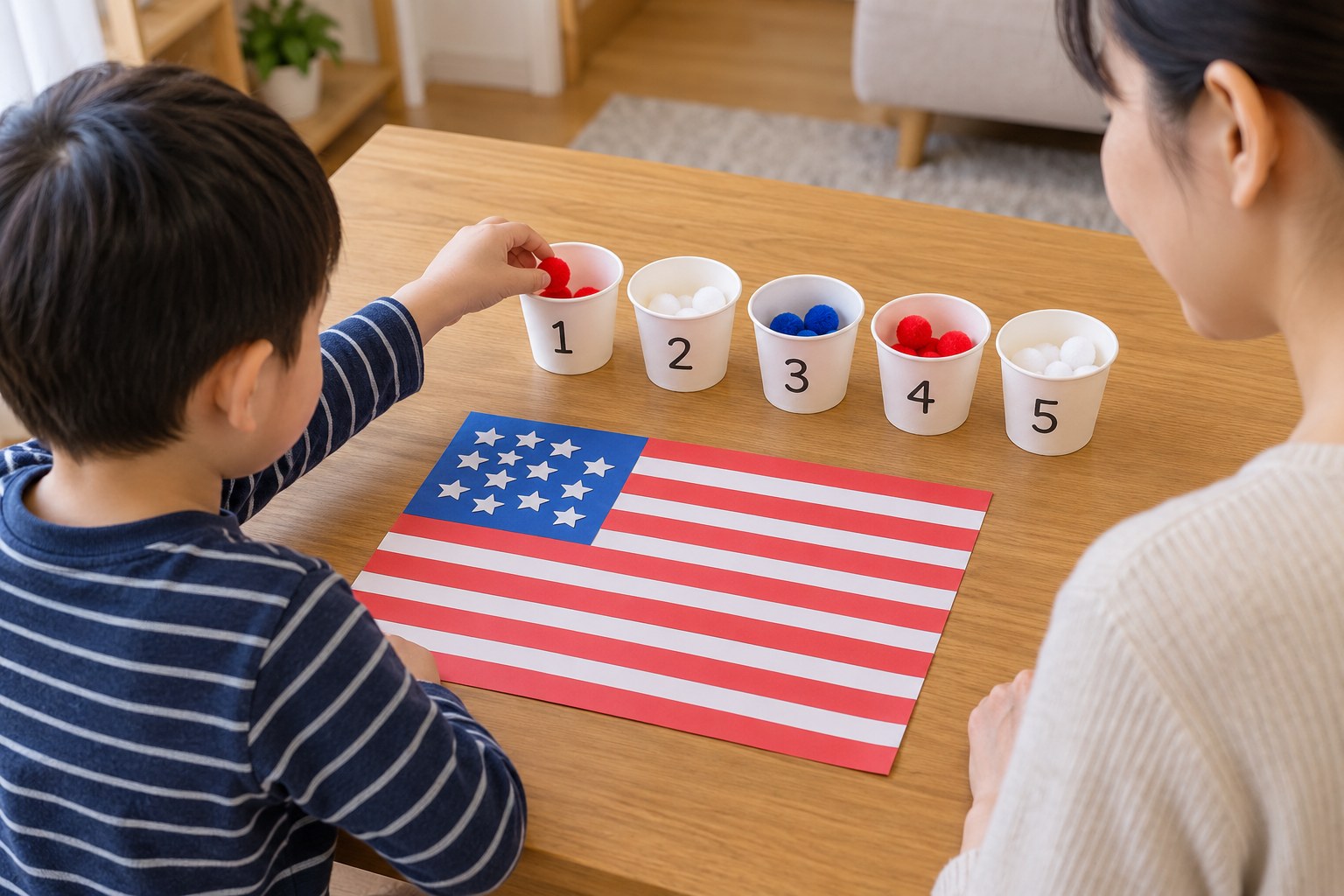
Your child builds a paper United States flag with 13 stripes and 50 stars, bundling the stars into groups of ten and the stripes into a ten and some ones, to discover how tens and ones make counting big numbers faster.

Objective

Your child will count out 13 stripes and 50 stars, group them into tens, and explain that 13 is one ten and three ones and 50 is five tens.

Standards

1.NBT.2aMath · Grade 1 · Number & Operations in Base Ten
10 can be thought of as a bundle of ten ones — called a "ten."
1.NBT.2bMath · Grade 1 · Number & Operations in Base Ten
The numbers from 11 to 19 are composed of a ten and one, two, three, four, five, six, seven, eight, or nine ones.
1.NBT.2cMath · Grade 1 · Number & Operations in Base Ten
The numbers 10, 20, 30, 40, 50, 60, 70, 80, 90 refer to one, two, three, four, five, six, seven, eight, or nine tens (and 0 ones).
K.CC.5Math · Grade K · Counting & Cardinality
Count to answer "how many?" questions about as many as 20 things arranged in a line, a rectangular array, or a circle, or as many as 10 things in a scattered configuration; given a number from 1—20, count out that many objects.

Materials

ItemQuantity
Red and white paper strips about 1 inch wide and 11 inches long (or red marker on white paper)7 red and 6 white
Blue construction paper rectangle about 6 by 5 inches1 per child
Star stickers, or stars drawn on white paper and cut out50 per child
Large paper or poster board as the flag base1 per child
Glue stick1 per child
Small cups or sticky notes for groups of ten5 per child

Vocabulary

Stripe
A long band of color; the flag has 13 stripes for the first 13 colonies.
Ten
A group made of exactly 10 ones.
Ones
Single things that are not part of a full group of ten.
Colony
One of the 13 places ruled by Great Britain that became the first states.

Preparation

Introduction

Show a picture of the United States flag. Ask: how many stars do you think are on it? How could we count them without losing our place?
Why might the flag have 13 stripes?
What is a quicker way to count lots of things than one at a time?

Steps

1Step 1
Why 13 and 50?
(4 min) Tell your child that on July 4, 1776, leaders from 13 colonies said they would be a new, free country, and that is why we celebrate the Fourth of July. Explain that the flag has 13 stripes for those first 13 colonies and 50 stars for the 50 states today.
2Step 2
Count the stripes
(6 min) Your child counts out the red and white strips one by one, then glues them on the paper alternating red and white, starting and ending with red. Count them together and ask: can we make a group of 10 and see how many are left over?
3Step 3
Ten and some more
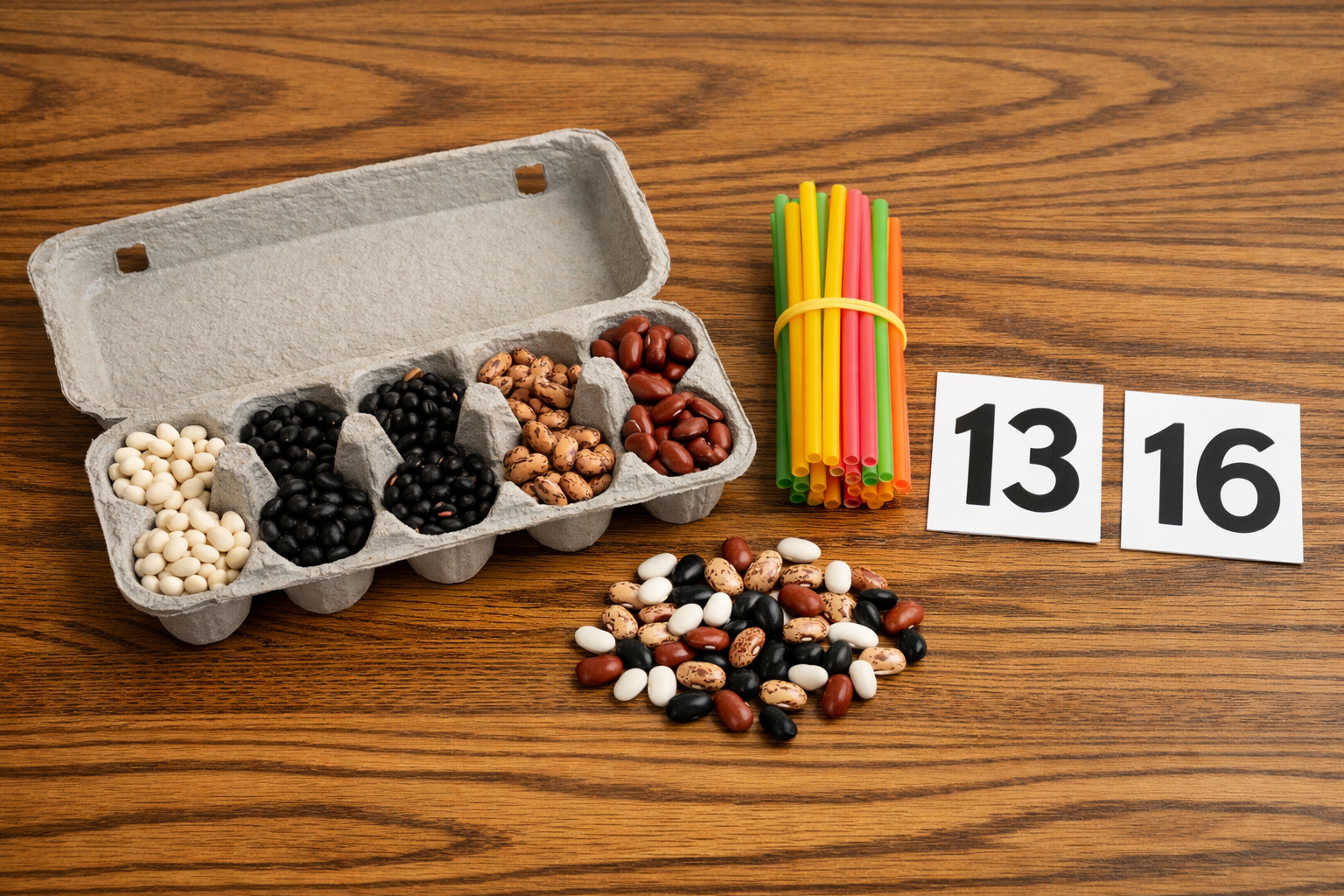
(4 min) Slide 10 strip ends together in your hands and point to the 3 left over. Say together: 13 is one ten and three ones. Kindergartners can just count all 13 and say the total.
4Step 4
Bundle the stars
(8 min) Your child counts stars into cups, exactly 10 per cup, until all the stars are used up. Count the cups by tens: 10, 20, 30, 40, 50, and ask how many single stars are left (zero).
5Step 5
Finish the flag
(7 min) Glue the blue rectangle in the top left corner and stick on the stars one cup at a time, saying the new total after each cup. Older children can try 5 rows of 6 stars and 4 rows of 5 stars, the way the real flag is arranged.

Conclusion

Ask: how many tens are in 50? How many tens and ones are in 13? Count something else by tens this week, like crayons or snack crackers.

Make your own lesson plan in minutes

Describe a topic and Resource Portal AI writes the objectives, materials and steps for your group.

Try Resource Portal AI