Free lesson plan

Flat or Solid? Kitchen Shape Sort
Math25 minutesGrades: K
Flat or Solid? Kitchen Shape Sort

Overview

Sort flat and solid shapes found in the kitchen.

Description

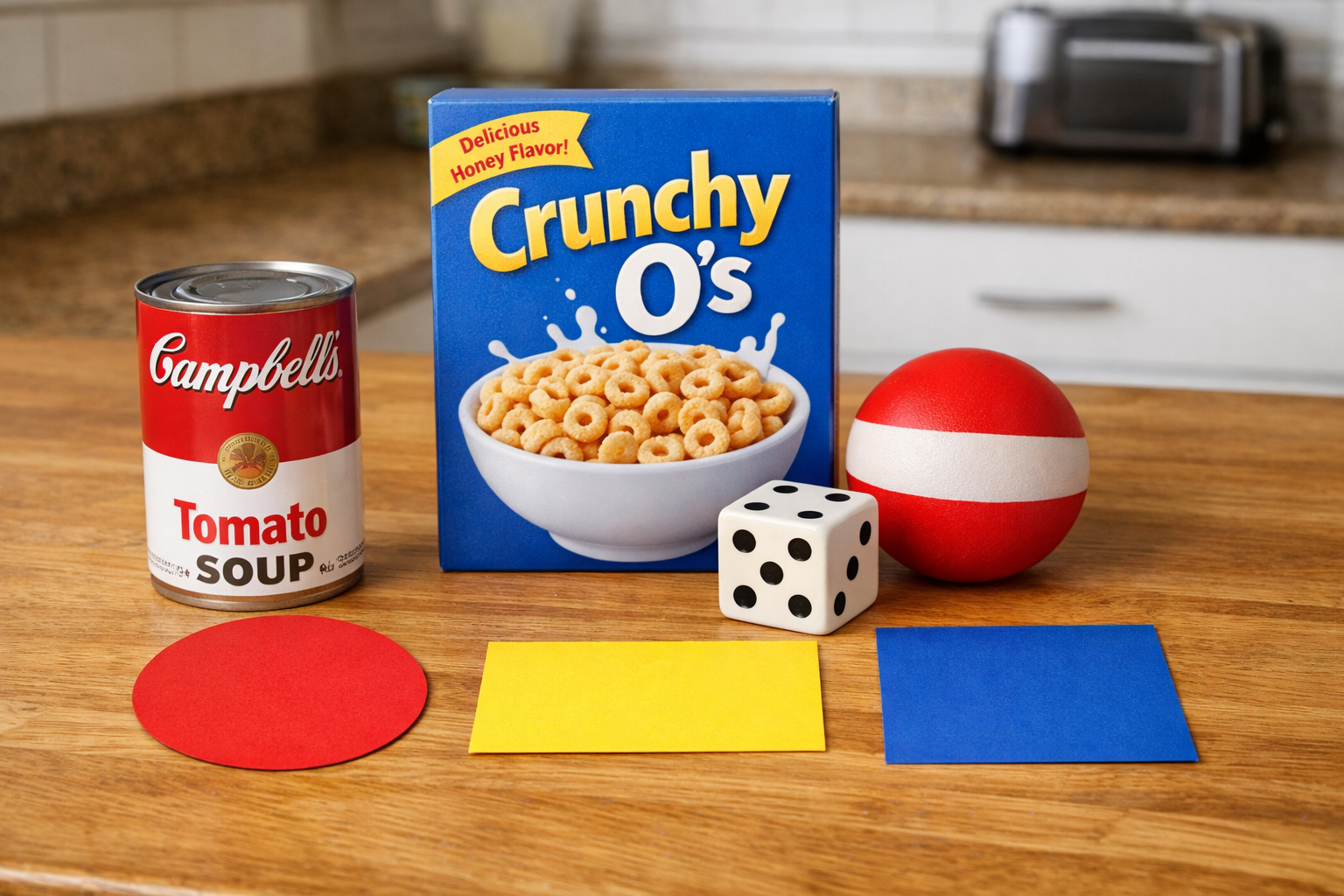
Your child traces the bottoms of a can, a box and a die to make flat paper shapes, sorts those and the real objects onto flat and solid towels, then counts sides and corners to compare them.

Objective

Your child will identify shapes as flat (2D) or solid (3D) and compare shapes of different sizes and turns by counting sides and corners.

Standards

K.G.3Math · Grade K · Geometry
Identify shapes as two-dimensional (lying in a plane, "flat") or three-dimensional ("solid").
K.G.4Math · Grade K · Geometry
Analyze and compare two- and three-dimensional shapes, in different sizes and orientations, using informal language to describe their similarities, differences, parts (e.g., number of sides and vertices/"corners") and other attributes (e.g., having sides of equal length).

Materials

ItemQuantity
Solid objects: a soup can, a tissue or cereal box, a ball and a die1 each
Plain paper3 sheets
Pencil and crayons1 set
Child-safe scissors1 pair
Dish towels for sorting mats2

Vocabulary

Flat
A shape you can draw on paper. It lies flat, like a circle or square.
Solid
A shape you can hold that takes up space, like a ball or box.
Corner
The point where two sides meet. Grown-ups call it a vertex.
Side
A straight line that makes the edge of a flat shape.

Preparation

Introduction

Hand your child the ball and a paper circle. Ask: these are both round, so are they the same shape? What is different?
Which one could you roll across the floor?
Which one can you slide under a door?

Steps

1Step 1
Trace flat shapes
(6 min) Your child stands the soup can on a sheet of paper and traces around the bottom to make a circle, then traces the bottom of the box for a rectangle and one side of the die for a square. They cut out the 3 shapes with the scissors. Talk about how the paper shapes lie flat and you can only see one side.
2Step 2
Sort on the towels
(6 min) Your child places each paper shape and each real object on the dish towel marked FLAT or the one marked SOLID. Ask them to explain each choice, for example the can is solid because you can hold it and it takes up space. Add 2 more things from the kitchen, like a spoon and a napkin, to sort.
3Step 3
Count sides and corners
(8 min) Draw a big triangle and a small triangle on the last sheet of paper, then turn the paper upside down. Your child counts the sides and corners of each with a crayon and sees that big, small or turned, a triangle still has 3 sides and 3 corners. Then compare the paper square to the die: both have equal sides, but the die has 6 square faces and 8 corners.
4Step 4
Practice questions
(4 min) Read the Practice problems aloud and your child answers by pointing to or holding the shapes. Check with the Answer key.

Conclusion

Take a walk around the house and have your child name 3 flat shapes, like a picture frame, and 3 solid shapes, like an orange.

Make your own lesson plan in minutes

Describe a topic and Resource Portal AI writes the objectives, materials and steps for your group.

Try Resource Portal AI