Lesson planThe Declaration of Independence in Kid Words
Language Arts40 minutesGrades: 3rd, 4th, 5th
Overview
Decode real lines from the Declaration and rewrite them in kid words.
Description
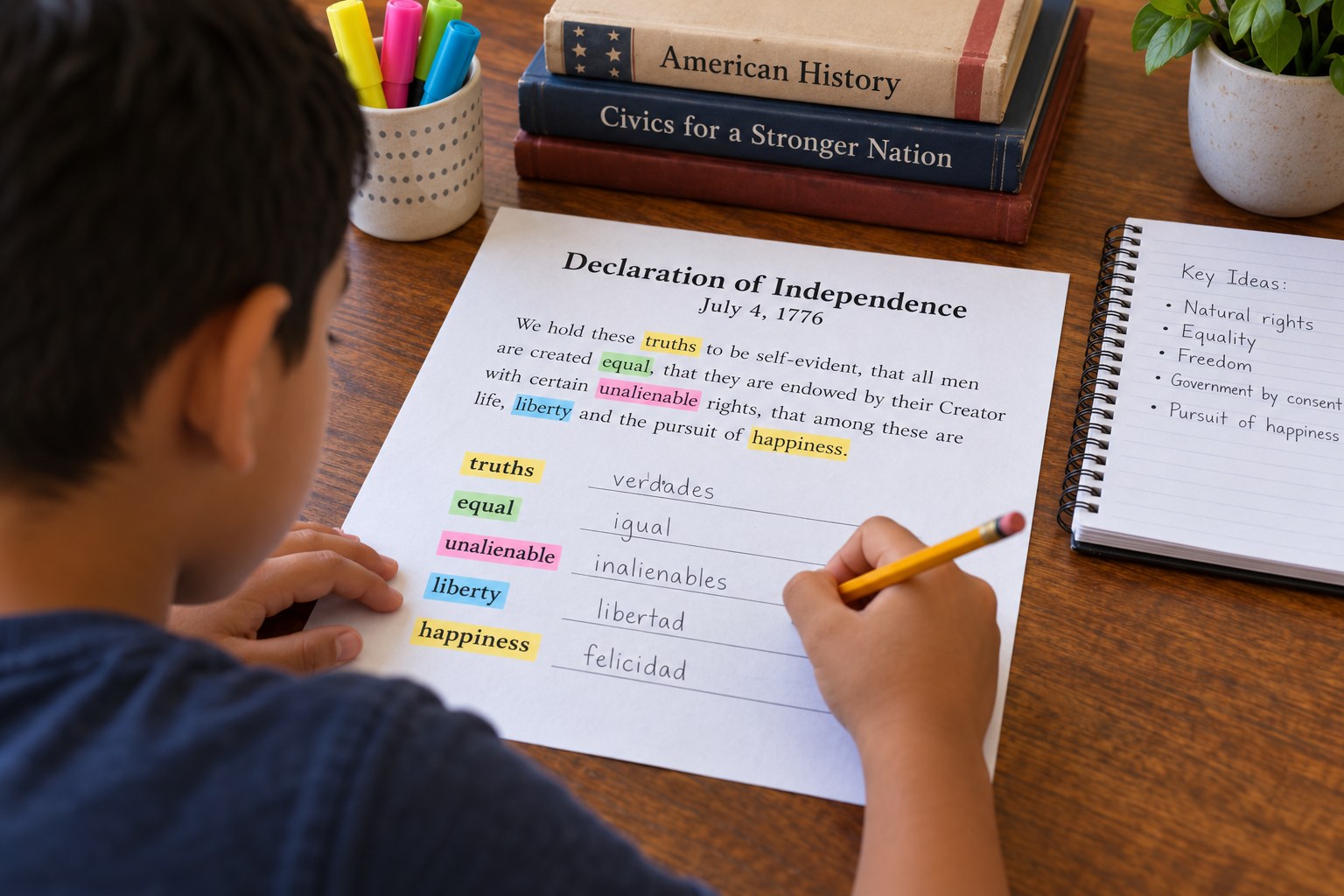
Your child reads four short lines from the real Declaration of Independence, uses context clues and a word chart to decode the 1776 language, rewrites each line in their own words, and finds which lines are big ideas and which are reasons.
Objective
Your child will determine the meaning of words such as unalienable, consent and dissolve, paraphrase four lines of the Declaration, and explain how the complaints serve as reasons supporting the decision to declare independence.
Standards
RI.4.4ELA · Grade 4 · Reading: Informational Text Determine the meaning of general academic and domain-specific words or phrases in a text relevant to a grade 4 topic or subject area.
RI.5.4ELA · Grade 5 · Reading: Informational Text Determine the meaning of general academic and domain-specific words and phrases in a text relevant to a grade 5 topic or subject area.
RI.5.8ELA · Grade 5 · Reading: Informational Text Explain how an author uses reasons and evidence to support particular points in a text, identifying which reasons and evidence support which point(s).
Materials
| Item | Quantity |
|---|
| Copy of the four Declaration lines (from the 'Primary source lines' section) | 1 per child |
| Index cards | 8 |
| Pencil and highlighter | 1 each per child |
| Dictionary or a phone/tablet dictionary | 1 to share |
| Large paper folded into two columns | 1 per child |
Vocabulary
Unalienable
Cannot be taken away or given away.
Consent
Permission or agreement.
Dissolve
To break up or end something, like a connection.
Grievance
A complaint about something that is unfair.
Paraphrase
To say the same idea in your own words.
Preparation
- Copy the four primary source lines onto paper with space under each line for a kid-words version.
- Write each vocabulary word on the front of an index card, leaving the back blank for your child's definition.
Introduction
Read the first line of the Declaration aloud in your most dramatic voice. Ask: did you understand that? People in 1776 wrote very differently. Today you're the translator.
What does it mean to be independent?
What might make people want to start their own country?
Steps
1Step 1
Set the scene
(5 min) Read the 'About the Fourth of July' section together. Explain that the Declaration of Independence was a letter to the world explaining why 13 colonies were breaking away from Great Britain, and that July 4, 1776 is the day Congress approved it.
2Step 2
Hunt for hard words
(8 min) Your child reads each line and highlights words they don't know. For each vocabulary card, they look for clues in the sentence, make a guess, then check the dictionary and write a kid-friendly definition on the back.
3Step 3
Translate the lines
(12 min) Your child rewrites each of the four lines in their own words under the original. Push for plain everyday language, such as 'Everyone is born with rights nobody can take away.' Compare versions and pick the clearest one.
4Step 4
Big idea or reason?
(8 min) On the two-column paper, your child sorts the lines into 'Big idea' and 'Reasons (grievances)'. Ask: how do the complaints about trade and taxes support the decision to become independent? Do you think they are strong reasons?
5Step 5
Read it to someone
(5 min) Your child reads the original line and then their kid-words version aloud to a family member. The listener says which word was the hardest to translate.
Conclusion
Ask: which line do you think is most important today, and why? Many people in history, including abolitionists and civil rights leaders, quoted 'all men are created equal' when asking the country to include everyone.
Make your own lesson plan in minutes
Describe a topic and Resource Portal AI writes the objectives, materials and steps for your group.
Try Resource Portal AI