Lesson planHieroglyph Name Cartouche: Ancient Egypt Sound Signs
Language Arts30 minutesGrades: K, 1st, 2nd
Overview
Sound out your name and write it in hieroglyphs.
Description
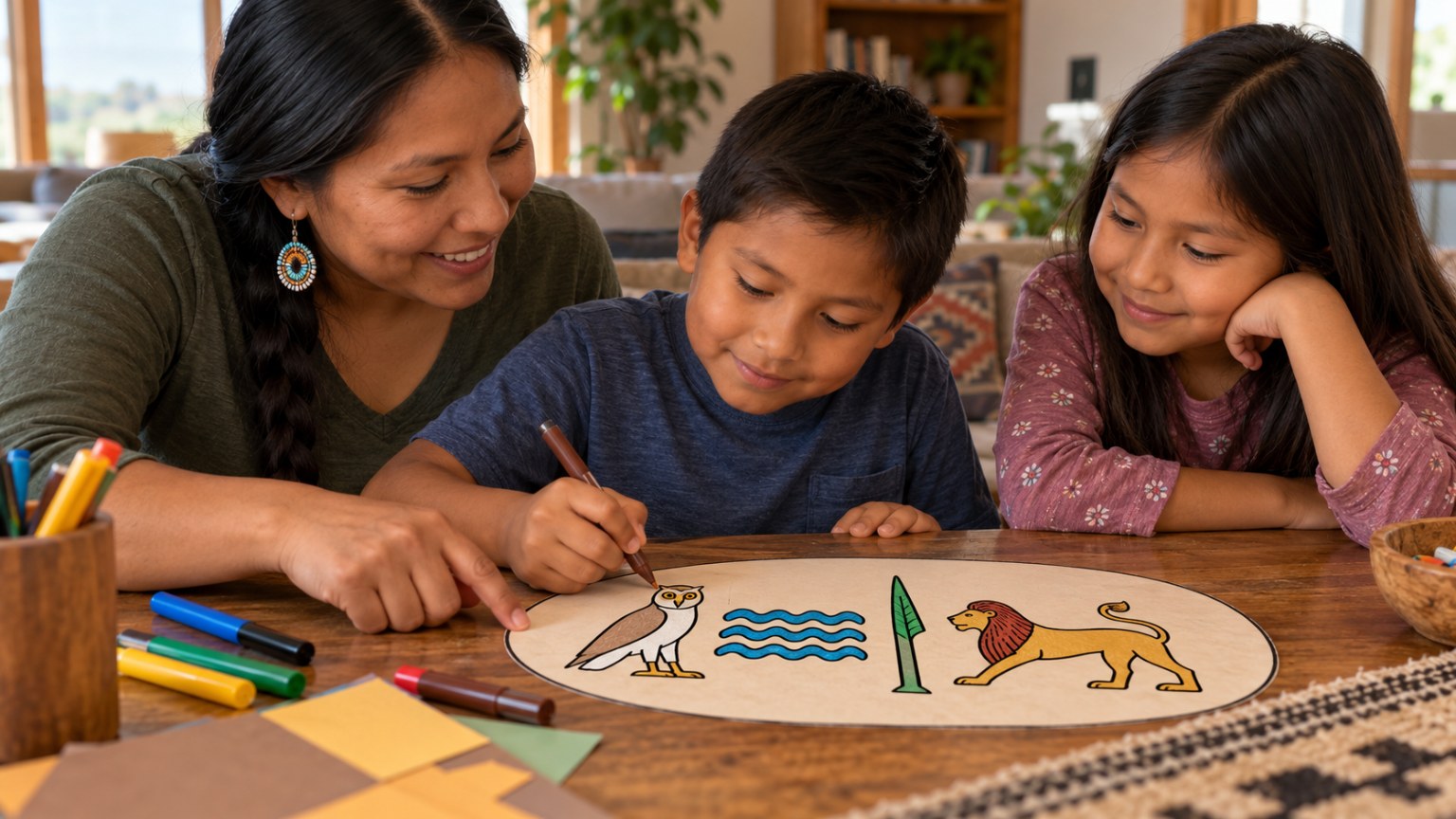
Your child learns that some Egyptian hieroglyphs stood for sounds, breaks their own name into its sounds, and writes it with a simple hieroglyph sound chart inside an oval cartouche like a pharaoh's name.
Objective
Your child will segment their name and a few short words into individual sounds and match each sound to a hieroglyph sign.
Standards
RF.1.2dELA · Grade 1 · Reading: Foundational Skills Segment spoken single-syllable words into their complete sequence of individual sounds (phonemes).
RF.K.2dELA · Grade K · Reading: Foundational Skills Isolate and pronounce the initial, medial vowel, and final sounds (phonemes) in three-phoneme (consonent-vowel-consonent, or CVC) words. (This does not include CVCs ending with /l/, /r/, or /x/.)
Materials
| Item | Quantity |
|---|
| Hieroglyph sound chart (see Additional Sections), copied by hand or printed | 1 to share |
| Paper or a strip of brown paper bag | 2 per child |
| Pencil and crayons or markers | 1 set per child |
| Yarn or string (optional, to hang the cartouche) | 1 piece per child |
Vocabulary
Hieroglyph
A picture sign used in ancient Egyptian writing.
Cartouche
An oval ring drawn around a pharaoh's name in hieroglyphs.
Sound
One small piece of a spoken word, like the /m/ at the start of 'mom'.
Scribe
A person in ancient Egypt whose job was writing.
Preparation
- Copy the hieroglyph sound chart onto a sheet of paper with a simple drawing next to each sound.
- Draw a long oval on each child's paper, big enough for 4-6 pictures in a row.
Introduction
Draw a simple owl and say 'mmm'. Explain that in ancient Egypt, the owl picture could stand for the /m/ sound. Ask: what if we could write your name with pictures?
What sound does your name start with?
How many sounds can you hear in the word 'cat'?
Steps
1Step 1
Meet the scribes
(5 min) Read the About section aloud and look at the chart together. Explain that some hieroglyphs stood for whole words and some stood for sounds, and that a pharaoh's name was written inside an oval called a cartouche.
2Step 2
Tap the sounds
(6 min) Say short words slowly and have your child tap a finger for each sound: sun (/s/ /u/ /n/), map, dog, then their own name. Count the taps each time.
3Step 3
Match sound to sign
(6 min) For each sound in your child's name, find the matching picture on the chart and draw it on scrap paper first. Explain that Egyptian writing usually skipped some vowel sounds, so it is fine to choose the closest sign.
4Step 4
Write the cartouche
(9 min) Your child draws the name signs in order inside the oval and colors them. Add a short line at one end of the oval like a real cartouche.
5Step 5
Swap and read
(4 min) Your child writes a short word like 'cat' or 'sun' in signs and you (or a friend) read it using the chart. Then switch jobs.
Conclusion
Ask your child how many sounds are in their name. Point out that they did the same work as an Egyptian scribe: listened for sounds and chose a sign for each one.
Make your own lesson plan in minutes
Describe a topic and Resource Portal AI writes the objectives, materials and steps for your group.
Try Resource Portal AI