Free lesson planYogurt Parfait Assembly Line: Dividing Fractions into Servings
Cooking30 minutesGrades: 6th
Overview
Divide fractions to plan and build yogurt parfaits.
Description
Your sixth grader uses fraction division to figure out how many parfaits the yogurt, granola and berries can make, discovers which ingredient runs out first, converts cups to tablespoons, teaspoons and fluid ounces, then layers the parfaits for the family.
Objective
Your child will compute and interpret quotients of fractions in a recipe context and use ratio reasoning to convert between cups, tablespoons, teaspoons and fluid ounces.
Standards
6.NS.1Math · Grade 6 · The Number System Interpret and compute quotients of fractions, and solve word problems involving division of fractions by fractions, e.g., by using visual fraction models and equations to represent the problem.
6.RP.3dMath · Grade 6 · Ratios & Proportional Relationships Use ratio reasoning to convert measurement units; manipulate and transform units appropriately when multiplying or dividing quantities.
Materials
| Item | Quantity |
|---|
| Plain or vanilla yogurt | 2 cups |
| Granola | 1 1/2 cups |
| Fresh or thawed frozen berries | 1 1/2 cups |
| Honey | 4 teaspoons |
| Measuring cups (1/4, 1/3 and 1/2 cup) and measuring spoons | 1 set |
| Clear cups or jars | 4 |
| Pencil and paper | 1 set |
Vocabulary
Quotient
The answer to a division problem. 1 1/2 ÷ 1/4 has a quotient of 6.
Reciprocal
A fraction flipped upside down. The reciprocal of 1/3 is 3/1, or 3.
Limiting ingredient
The ingredient that runs out first and decides how many servings you can make.
Conversion factor
A ratio that changes one unit to another, like 1 cup = 16 tablespoons.
Preparation
- Wash hands and the berries. If using frozen berries, thaw them in the fridge ahead of time.
- Set the 2 cups of yogurt, 1 1/2 cups of granola and 1 1/2 cups of berries in separate bowls without telling your child how many parfaits they make.
Introduction
Say: each parfait gets 1/2 cup of yogurt, 1/4 cup of granola and 1/3 cup of berries. Before anyone scoops, you need to tell me exactly how many parfaits we can make and what will be left over.
What question does 1 1/2 ÷ 1/4 answer in this kitchen?
Why might one ingredient decide how many parfaits we get?
Steps
1Step 1
Divide each ingredient
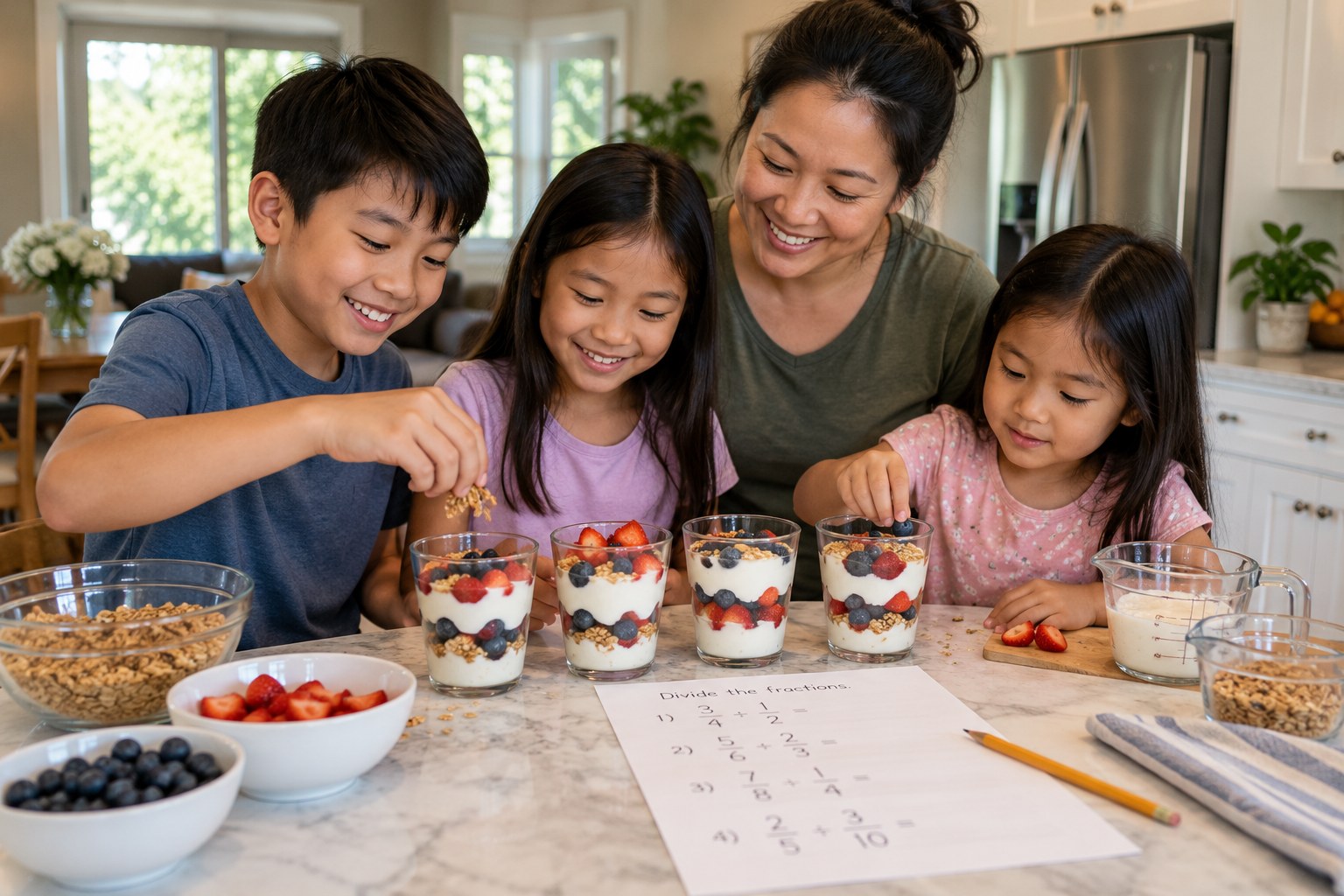
(8 min) Your child writes and solves a division for each bowl on the paper: 2 cups of yogurt ÷ 1/2 = 4, 1 1/2 cups of granola ÷ 1/4 = 6, and 1 1/2 cups of berries ÷ 1/3 = 4 1/2. They check one answer with the measuring cups, scooping 1/3 cup of berries again and again to see 4 full scoops and half of one more.
2Step 2
Find the limiting ingredient
(4 min) Your child compares the 3 quotients and decides that yogurt and berries both allow only 4 full parfaits. They calculate the leftovers: 1 1/2 − 4 × 1/4 = 1/2 cup of granola and 1 1/2 − 4 × 1/3 = 1/6 cup of berries.
3Step 3
Convert the units
(6 min) Using 1 cup = 16 tablespoons, 1 tablespoon = 3 teaspoons and 1 cup = 8 fluid ounces, your child converts: the 4 teaspoons of honey = 1 1/3 tablespoons, 1/4 cup of granola = 4 tablespoons, and the 2 cups of yogurt = 16 fluid ounces of space in the cups. They write each conversion as a ratio on the paper.
4Step 4
Assemble the parfaits
(7 min) Your child layers each of the 4 clear cups with 1/4 cup yogurt, a scoop of berries, the 1/4 cup granola, then the rest of the 1/2 cup yogurt and berries, finishing with 1 teaspoon of honey. Serve right away so the granola stays crunchy.
5Step 5
Practice problems
(4 min) While everyone eats, your child solves the Practice Problems with the pencil and paper. Then they check each one with the Answer Key.
Conclusion
Ask your child: what does 1 1/2 ÷ 1/3 = 4 1/2 mean in this kitchen? Have them plan how much of each ingredient to buy to make 10 parfaits next time.
Make your own lesson plan in minutes
Describe a topic and Resource Portal AI writes the objectives, materials and steps for your group.
Try Resource Portal AI