Full lesson previewJefferson's Farmer Republic: Tracing the Argument in Query XIX
Agriculture50 minutesGrades: 10th
Overview
Find the central idea in Jefferson's farmer argument and trace how it unfolds.
Description
Your teen reads Query XIX of Thomas Jefferson's Notes on the State of Virginia (1785), his short argument that America should remain a nation of farmers and 'let our work-shops remain in Europe.' They identify the central idea, write an objective summary, map how Jefferson orders and connects his points, and discuss the contradiction of praising farm labor while enslaving the people who worked his own fields.
Objective
Your teen will determine a central idea of a foundational text, analyze how it is developed and refined by specific details, write an objective summary and analyze how the author orders and connects his points.
Standards
RI.9-10.2ELA · Grade 9-10 · Reading: Informational Text Determine a central idea of a text and analyze its development over the course of the text, including how it emerges and is shaped and refined by specific details; provide an objective summary of the text.
RI.9-10.3ELA · Grade 9-10 · Reading: Informational Text Analyze how the author unfolds an analysis or series of ideas or events, including the order in which the points are made, how they are introduced and developed, and the connections that are drawn between them.
Materials
| Item | Quantity |
|---|
| Device or printed copy of Query XIX of Notes on the State of Virginia (public domain) | 1 |
| Index cards | 6 |
| Highlighter | 1 |
| Sheets of lined paper | 2 |
| Pen | 1 per teen |
Vocabulary
Agrarian
Relating to farming and land; an agrarian society is built mainly on agriculture.
Husbandman
An older word for a farmer.
Central idea
The main point an author develops throughout a text.
Objective summary
A short retelling of a text's main points without the reader's opinions.
Dependence
Relying on others, such as customers or employers, for a living; Jefferson argued it made citizens less free.
Preparation
- Find Query XIX ('Manufactures') of Jefferson's Notes on the State of Virginia online, for example through the University of Virginia, Yale's Avalon Project or Project Gutenberg. It is about one page long.
- Number the paragraphs or major sentences in the printed copy so your teen can refer to them.
Introduction
Read aloud: 'Those who labour in the earth are the chosen people of God, if ever he had a chosen people.' Ask: what kind of country do you think the person who wrote this wanted?
Why might a leader in the 1780s worry about factories and big cities?
What does it mean when an author's life does not match his words?
Steps
1Step 1
First read and gist
(8 min) Your teen reads Query XIX once through and writes a one-sentence gist at the top of the first sheet of lined paper. They highlight the single sentence they think comes closest to stating Jefferson's central idea.

2Step 2
Card the moves
(12 min) Your teen writes each major step of Jefferson's argument on its own index card, using the 6 index cards: the European view he starts with, America's abundant land, his claim about the virtue of farmers, his warning about dependence, his 'work-shops' conclusion, and his closing comparison about great cities. They put the cards in the order Jefferson uses and write a connecting word between each pair, such as 'but,' 'because' or 'therefore.'

3Step 3
Analyze the order
(10 min) On the second sheet of lined paper your teen explains why Jefferson starts with what European economists believe and ends with the image of 'sores' on a body. They answer Questions 3 and 4 about how specific details refine the central idea.

4Step 4
Write the summary
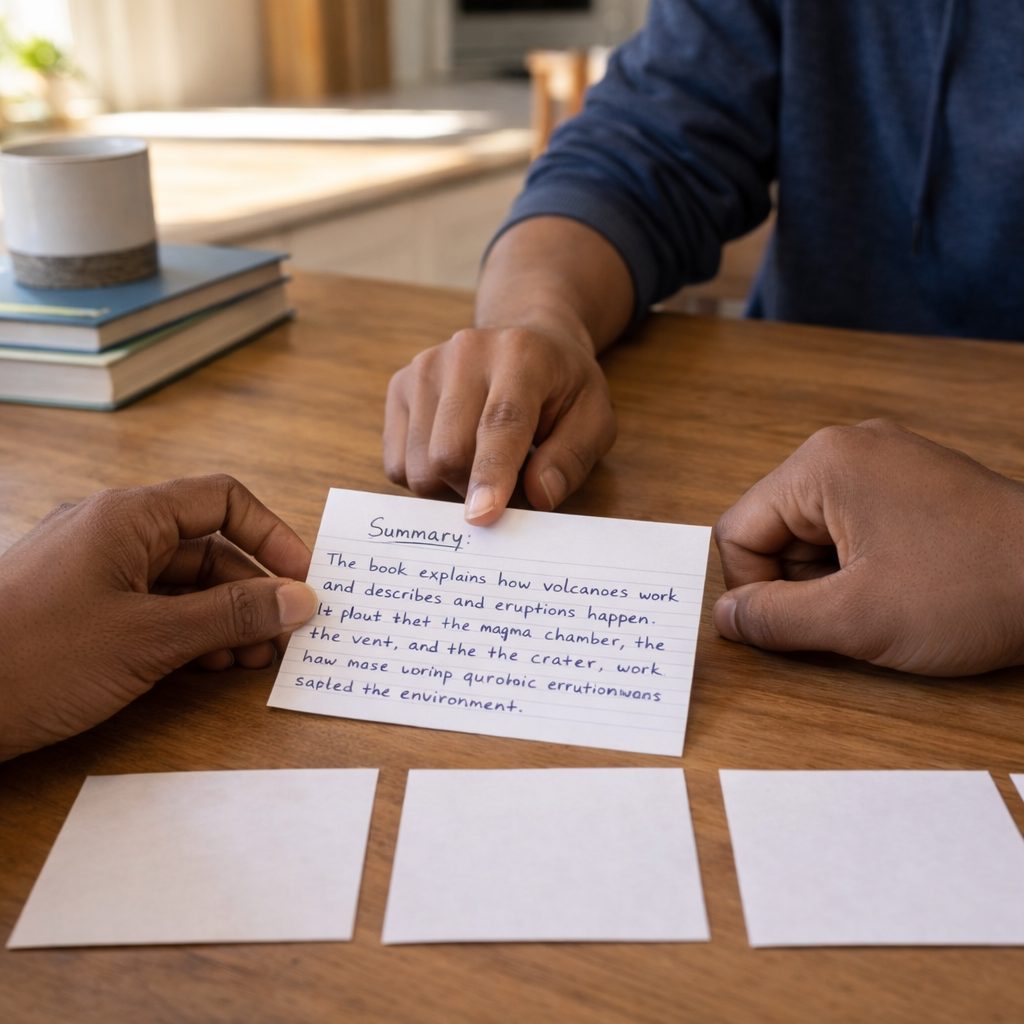
(10 min) Your teen writes a 4 to 5 sentence objective summary of Query XIX in their own words, with no opinions. You check it together for any word that sneaks in judgment, such as 'brilliant' or 'wrong,' and your teen revises.
5Step 5
Discuss the contradiction
(10 min) Separately from the summary, your teen answers Question 6 aloud: Jefferson praised the virtue of people who work the land while enslaving more than 600 people over his lifetime, many of whom farmed at Monticello. You discuss how a reader can analyze an argument fairly and also judge it against the author's actions.

Conclusion
Ask your teen to state Jefferson's central idea in one sentence and the one detail that shaped it most. Tracing how an argument is built is the first step to judging whether it holds up.
Make your own lesson plan in minutes
Describe a topic and Resource Portal AI writes the objectives, materials and steps for your group.
Try Resource Portal AI